Roughly 78% of nonprofit chief executives report having a formal strategic plan or framework in place, according to BoardSource's Leading with Intent survey. That leaves close to one in five organizations navigating funding cuts, staffing gaps, and rising demand without a documented roadmap.
For small nonprofits, that gap is especially costly. Limited staff capacity makes it tempting to skip formal planning entirely, or to write a plan once and never open it again. But 2026 doesn't reward that approach. Funding is volatile, donor behavior is shifting, and service demand keeps climbing.
This guide covers what a nonprofit strategic plan should include, the frameworks behind it (the 5 steps, 5 C's, and 5 P's), and how to move from a paper plan to real execution. It draws on RZCG's work embedding experienced executives inside nonprofits, not just to write strategic plans, but to run them.
Key Takeaways
- Nearly 25% of nonprofit CEOs lack a formal strategic plan, leaving decisions unanchored during funding shifts
- A strong plan names 3-5 measurable priorities, assigns ownership, and sets a review cadence
- Frameworks like the 5 steps, 5 C's, and 5 P's help, but fit matters more than the model
- Execution usually stalls from limited staff bandwidth or weak financial systems, not flawed strategy
What Is Nonprofit Strategic Planning, and Why Does It Matter in 2026?
Nonprofit strategic planning is a structured, documented process, typically spanning three to five years, that answers three questions: where are we now, where do we want to go, and how will we get there.
A good plan works as a living decision-making document. Staff and board members return to it when setting budgets, hiring, or weighing a new program idea. It shouldn't sit as a static PDF pulled out once a year for a board meeting and forgotten the rest of the time.
Board members play a central role in keeping that document alive, and the data back it up.
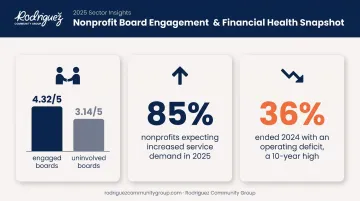
A BoardSource governance survey found a strong link between board engagement and organizational performance. Boards that acted as partners in leading strategy earned an average performance rating of 4.32 out of 5, compared to just 3.14 out of 5 for boards that stayed uninvolved.
Three forces make disciplined planning harder to skip in 2026:
- Funding uncertainty continues, as government and foundation grants shift unpredictably from year to year
- Donor behavior keeps evolving, with more funders favoring flexible, outcomes-focused giving over restricted grants
- Operational complexity is climbing as organizations run more programs without adding headcount
The Nonprofit Finance Fund's 2025 State of the Nonprofit Sector survey found that 85% of nonprofits expected service demand to increase in 2025. Meanwhile, 36% ended 2024 with an operating deficit, the highest share in ten years of NFF survey data. Rising demand paired with thinner margins is exactly why disciplined planning can't wait for a quieter year.
How Often Should a Nonprofit Update Its Strategic Plan?
The traditional model calls for a full rewrite every three to five years. But a plan shouldn't collect dust in between.
- Treat the document as a living resource and revisit priorities at least once a year
- Use regular check-ins, monthly or quarterly, to track progress and catch warning signs early
- Trigger an earlier rewrite if a major funding source disappears, leadership changes, or community needs change
3 Misconceptions That Stop Nonprofits From Planning
- "Planning wastes money we don't have." Skipping it usually costs more, through duplicated effort, missed grant opportunities, and reactive decisions made under pressure.
- "Nonprofits shouldn't take risks." Calculated risks, like piloting a new program model, are part of responsible strategy. Avoiding all risk often means avoiding growth too.
- "The board should lead the process." Staff, especially those closest to programs and operations, should drive the day-to-day planning work. The board's role is oversight and approval, not authorship.
What Should a Nonprofit Strategic Plan Include? (Core Components)
A strategic plan is only useful if it translates into decisions. These six components turn a document into a working tool instead of a shelf item.
Mission, vision, and values. Every priority in the plan should trace back to these statements. If an initiative doesn't advance the mission, it doesn't belong in the plan, no matter how attractive the funding opportunity looks.
Organizational assessment findings. Summarize what you learned from a SWOT analysis, stakeholder interviews, and landscape research. This section justifies your priorities rather than presenting them as assumptions.
3-5 strategic priorities with SMART goals. Keep the list narrow. Each priority should convert into goals that are specific, measurable, achievable, realistic, and time-bound.
Clear ownership. Name who's accountable for each objective, plus the specific activities they'll complete. Without a named owner, goals default to "everyone's job," meaning no one's.
A measurement framework. Choose KPIs, dashboards, or OKRs, and set how often you'll review them. Monthly or quarterly works for most small teams.
An implementation section. Budget alignment, a realistic timeline, and a communication plan belong here. This is the gap between a plan and a wish list:
| Element | Wish List | Working Plan |
|---|---|---|
| Priorities | Vague aspirations | 3-5 SMART goals |
| Ownership | Unassigned | Named owner per goal |
| Budget | Not addressed | Aligned to priorities |
| Review | None scheduled | Monthly or quarterly |
RZCG's team often steps into exactly this gap. The English Learners Success Forum needed strategic direction along with the financial and operational systems to carry it out. Embedded interim COO and CFO support made the difference between a plan on paper and one actually in motion.
Nonprofit Strategic Planning Frameworks: The 5 Steps, 5 C's, and 5 P's Explained
Leaders often ask about specific planning frameworks. Methods vary by consultant and organization, but most fall into a handful of recognizable structures you can borrow from freely.
The 5 Steps of Nonprofit Strategic Planning
Most planning processes move through five phases:
- Set goals and vision: clarify mission, intended impact, and direction
- Gather stakeholder and data input: assess the landscape, resources, and community needs
- Conduct a SWOT or organizational analysis: examine internal strengths and weaknesses against external opportunities and threats
- Build SMART objectives and assign ownership: select measurable priorities and estimate what they'll require
- Monitor and adjust: build in performance tracking and adaptation
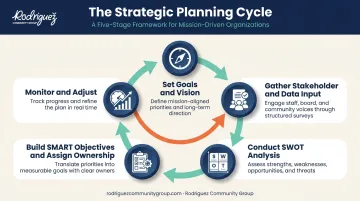
This sequence isn't strictly linear. Organizations frequently loop back to stakeholder input or research mid-process, especially when early data surfaces a gap in the original assumptions.
The 5 C's of Strategic Planning
The 5 C's framework examines the internal and external forces shaping strategy:
- Company (Context): Your organization's internal capacity, culture, and resources
- Customers: For nonprofits, this means beneficiaries and donors together
- Competitors: Peer organizations and the broader competition for grants and donor attention
- Collaborators: Partner organizations, coalitions, and funders who extend your reach
- Climate: Economic conditions, policy shifts, and sector-wide trends
A food bank applying the 5 C's during an environmental scan might map declining government funding (Climate) and rising need among working families (Customers). It could also flag three regional food banks competing for the same foundation grants (Competitors) and a school district willing to share distribution space (Collaborators).
The 5 P's of Strategic Planning
The 5 P's framework offers a coherence check, a way to confirm a strategy actually holds together before you finalize it:
- Purpose: Does the strategy connect to the mission?
- People: Do you have the staff and volunteer capacity to execute it?
- Process: Are the workflows and systems in place to support the work?
- Performance: How will you know if it's working?
- Partnerships: Who else needs to be involved for this to succeed?
You don't need to adopt every framework here. Picking the one that matches your organization's maturity and complexity matters more than forcing all three into a single planning retreat.
Choosing the Right Planning Model for Your Nonprofit's Situation
Not every nonprofit needs the same planning approach. Matching the model to your actual situation, rather than copying whatever a peer organization used, produces better results.
- Organizations that are stable and well-established typically do well with a standard goals-based model: set priorities, build SMART objectives, execute against a timeline
- Organizations facing internal turnover or crisis need a fluid, issues-based approach that responds to challenges as they surface, not a formal planning cycle
- Organizations facing uncertain external conditions, like funding cuts or policy shifts, benefit from adaptive, nonlinear planning that maintains long-term goals while allowing near-term flexibility
- Organizations with strong departments but weak cross-team communication benefit from alignment-focused planning built around an operating model that clarifies how people and resources connect
There's no universally correct model here.
A three-person environmental nonprofit navigating a leadership transition needs a different approach than a 40-person education nonprofit with stable funding and departmental silos.
Start with an honest read of your current reality, then choose accordingly.
Common Nonprofit Strategic Planning Mistakes to Avoid
Candid's research on nonprofit strategic planning identifies four recurring failure patterns. Spotting them early can save months of wasted effort.
- Writing a plan without genuine stakeholder buy-in. Candid calls this "the manifesto," a document built without enough input from the people who must carry it out, leaving no real ownership.
- Overloading the plan with too many priorities. Candid's "everything but the kitchen sink" pattern happens when nonprofits can't narrow their focus. Stick to 3-5 pillars.
- Ignoring budget and staffing capacity. This is Candid's "impossible dream," aspirations disconnected from the skills, capacity, or funding required to reach them.
- Treating the plan as static. Candid describes this as "the work plan," a document too rigid to adapt when conditions change.
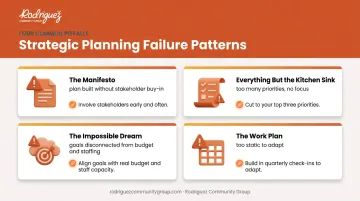
Each mistake is fixable during drafting, as long as someone is actively checking for it before the plan gets finalized.
Turning Strategy Into Action: Why Execution Determines Success
Most nonprofits don't fail at strategic planning because they lack good ideas. They fail because they lack the staff bandwidth, financial systems, or operational structure to execute the plan once the retreat ends.
Underinvestment in infrastructure, financial systems, staff training, and operational capacity is a common barrier to nonprofit performance. A plan can name the right priorities and still stall if no one has the bandwidth to run point on them.
What embedded execution support looks like in practice:
- An experienced team works alongside existing staff on governance, finance, and operations, rather than handing over a binder and leaving
- Financial controls and decision-making structures get built at the same time priorities are set, not months later
- Change management is built into the process, so staff stay focused on mission-critical work instead of getting pulled into transition mechanics
This is the model RZCG applies with its clients. The team, averaging 15 years of nonprofit leadership experience, integrates directly into small nonprofits with up to 50 staff and up to $25 million in annual revenue. They help translate strategic priorities into financial controls, operations plans, and governance structures that actually get implemented.
This approach plays out differently depending on the engagement:
- Climate Lead: Built financial structures, human capital systems, compliance frameworks, and a governance board suited to the organization's future, not just its immediate needs, through a fiscal sponsor spin-off
- English Learners Success Forum: Provided interim COO support, then interim CFO services, during a similar transition, keeping spin-off activities from pulling staff away from mission-critical work
- The Oakland REACH: Stepped in as interim Chief of Staff, then moved into COO functions overseeing CFO activities, aligning financial strategy with growth goals
That distinction, between advising on a plan and staying embedded through execution, is often what separates a strategic plan that gets implemented from one that gets filed away.
Frequently Asked Questions
What should a nonprofit strategic plan include?
A complete plan includes mission and vision statements, findings from an organizational assessment, 3-5 measurable priorities with SMART goals, named ownership for each goal, and a set review cadence for tracking progress.
What are the 5 steps of strategic planning?
The standard sequence is: set goals and vision, gather stakeholder and data input, conduct a SWOT analysis, build SMART objectives with assigned ownership, then monitor and adjust. Organizations often loop back between steps as needed.
What are the 5 C's of strategic planning?
The 5 C's are Company (context), Customers, Competitors, Collaborators, and Climate. For nonprofits, customers become beneficiaries and donors, while competitors become peer organizations competing for the same funding.
What are the 5 P's of strategic planning?
The 5 P's are Purpose, People, Process, Performance, and Partnerships. They function as a coherence check, helping leaders confirm a strategy is complete before finalizing it.
How long does the nonprofit strategic planning process typically take?
Most nonprofits complete the process in 3 to 6 months, moving through stakeholder input, analysis, drafting, and board approval. Organizations with limited staff capacity or extensive data gathering needs may take longer.
Who should be involved in a nonprofit's strategic planning process?
Staff leadership should drive the day-to-day work, with board members providing oversight and approval. Frontline staff and program stakeholders often provide the most grounded, practical feedback on what's realistic.