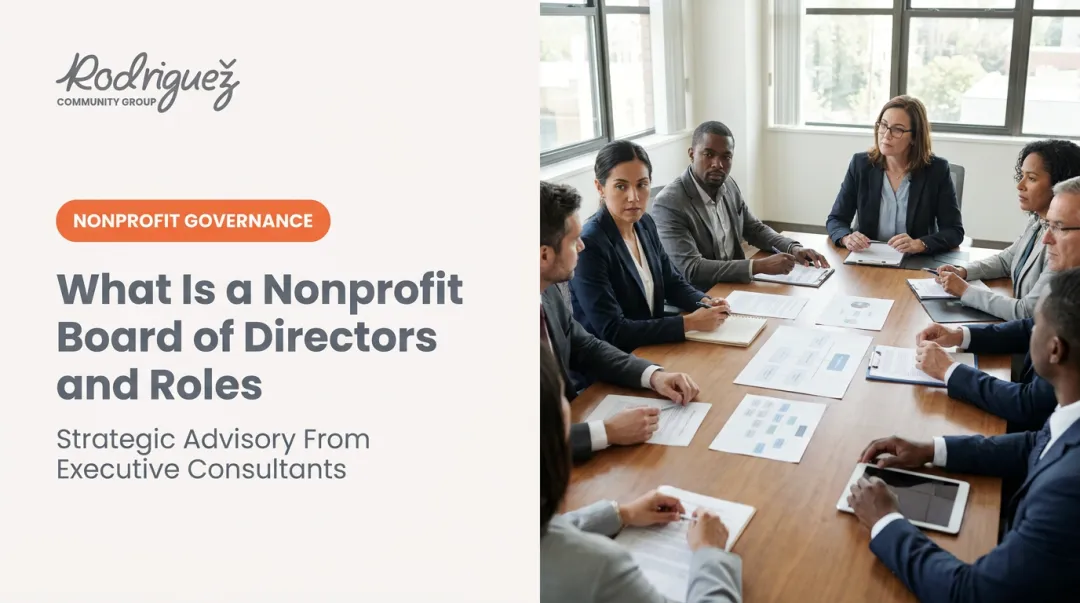

This scenario plays out constantly, and it usually traces back to one root problem: confusing an advisory board with a governing board of directors. The mix-up leads to mismatched expectations, underused expertise, and volunteers who feel more decorative than useful.
This guide breaks down what a nonprofit advisory board actually is, how it differs from a board of directors, the common types organizations build, what these groups really do, whether they're worth the investment, and how to structure one that doesn't fizzle out.
Key Takeaways
- Advisory boards bring expertise and networks, not votes or fiduciary duty.
- Governing boards hold legal authority; advisory boards answer to staff.
- Common formats: fundraising cabinets, young professional councils, issue groups.
- A charter and regular meeting cadence keep advisory boards active, not dormant.
- These boards only work when staff have capacity to use their input.
What Is a Nonprofit Advisory Board?
An advisory board is a group of volunteers a nonprofit assembles to provide specialized expertise, insight, connections, or community perspective to its leadership and governing board.
BoardSource describes advisory councils as bodies that "advise and support the governance work of the board or the management tasks carried out by staff." They support decision-making; they don't replace it.
That distinction matters. Advisory board members:
- Carry no fiduciary responsibility for the organization
- Cannot vote on organizational decisions, budgets, or policy
- Have no legal liability tied to governance the way a director does
They exist to lend expertise, not authority. Some advisory boards are permanent fixtures. Others are stood up for a specific campaign, capital project, or program launch and then dissolved once the work is done.
Why Nonprofits Create Advisory Boards
Most advisory boards form in response to a specific gap. The usual triggers:
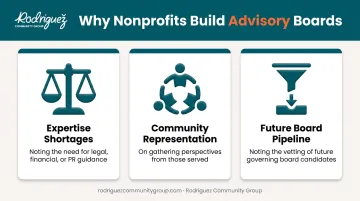
- Expertise shortages: a small nonprofit needs legal, financial, healthcare, or PR guidance it can't afford to hire full-time
- Community representation: leadership wants perspectives from people the organization actually serves
- Future board pipeline: staff want a low-stakes way to evaluate potential governing board candidates before asking for a formal commitment
That same BoardSource research highlights specialized expertise, ambassadorship, fundraising support, and pipeline-building as the most common reasons nonprofits create these groups.
Nonprofit Advisory Board vs. Board of Directors: What's the Difference?
Governing boards hold fiduciary duty, legal authority, and voting power over organizational decisions. Advisory boards exist purely to offer counsel. That's the core distinction, and it shapes everything else about how the two groups function.
| Attribute | Board of Directors | Advisory Board |
|---|---|---|
| Legal authority | Yes, binding decisions | None |
| Fiduciary duty | Yes (care, loyalty, obedience) | No |
| Voting rights | Yes | No |
| Typical size | Average of 15, median of 13 | Varies by purpose (often 8-20) |
| Term length | Usually fixed, often two 3-year terms | Flexible, no standard |
| Reporting line | Reports to itself/membership | Reports to executive leadership or staff |
Example: Say a governing board is deciding whether to expand a program into a new region. A programmatic advisory board might weigh in with data on community need, cultural considerations, or clinical best practices. The governing board listens, discusses, and then makes the final call — the advisory input shapes the conversation but doesn't decide it.
A common misconception is that serving on an advisory board is a guaranteed path to a governing board seat. It isn't automatic, but it is a natural feeder relationship: advisory service lets both the organization and the volunteer assess fit before anyone commits to fiduciary responsibility.
One more practical difference worth knowing: the IRS Form 990 instructions specifically note that an advisory board member who doesn't exercise governance authority isn't considered a director or trustee for reporting purposes. State nonprofit statutes similarly focus their oversight on governing boards, not advisory ones.
That regulatory gap works in your favor. Compared to the formal rules governing a board of directors, it gives nonprofits far more flexibility to:
- Structure advisory groups however best fits the mission
- Staff them with subject-matter experts rather than voting members
- Use them for short-term projects or ongoing counsel, as needed
Types of Nonprofit Advisory Boards
Not every advisory board looks the same, and a single nonprofit can run several at once, each with its own charter and membership criteria. The most common formats:
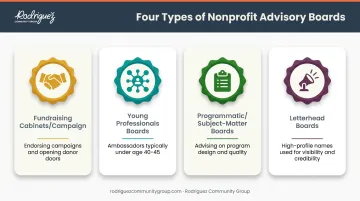
- Fundraising advisory boards or campaign cabinets: members who endorse a specific campaign and open doors to prospective donors
- Young professionals boards: younger supporters who serve as ambassadors through fundraising events and social media reach, often capped by age (under 40 or 45)
- Programmatic or subject-matter boards: experts in a specific field (clinical, legal, technical) who weigh in on program design and quality
- Letterhead boards: high-profile names used mainly for visibility and credibility, with lighter engagement expectations
There's also a growing category worth calling out on its own: boards made up of people with lived experience of the issue a nonprofit addresses. The National Health Care for the Homeless Council's National Consumer Advisory Board, for example, is composed entirely of people who've experienced homelessness and used the organization's services.
This board advises on program design and helps local affiliates build their own consumer input structures. More funders are now actively encouraging this model.
What Does a Nonprofit Advisory Board Actually Do?
Day-to-day, an advisory board's value shows up in a handful of concrete ways:
- Specialized subject-matter advice: filling gaps in legal, financial, clinical, or technical knowledge that staff or governing board members don't have
- Ambassadorship: lending their name, professional network, and reputation to raise the organization's profile
- Fundraising support: making introductions, attending events, and sometimes directly soliciting their own networks
- Community and lived-experience input: bringing perspective into program decisions that staff alone might miss
- Future board pipeline: serving as a vetted group of people who already understand the mission before they're asked to join formal governance
That fourth point deserves a little more attention. Ford Foundation's research on participatory grantmaking describes a real shift toward giving people directly affected by an issue more say in decisions that affect them.
Funders increasingly expect grantees to build this kind of structure, not just tolerate it.
An advisory board made up of program participants isn't a nice-to-have anymore in many funding relationships. It's becoming an expectation.
Are Nonprofit Advisory Boards Worth It?
Honestly, it depends on the organization. The upside is real:
- Access to expertise a small nonprofit couldn't otherwise afford
- A low-commitment entry point for volunteers who aren't ready for governing board responsibility
- Stronger trust and credibility with the communities being served
But there's a cost most nonprofits underestimate. Someone has to:
- Recruit members with the right expertise
- Onboard them into the organization's work
- Prepare materials before every meeting
- Run the meetings themselves
- Incorporate their advice into actual decisions
Skip that step, and the advisory board becomes a morale liability instead of an asset. Volunteers who signed up to contribute start feeling ignored, and word travels.
This is exactly where a lot of small nonprofits get stuck. They know an advisory board, or a governance overhaul in general, would help, but they don't have the internal bandwidth to build it properly.
That's the gap Rodriguez Community Group (RZCG) works in. Rather than showing up as an outside consultant with a generic template, RZCG embeds with the client team to design governance structures that fit the organization's actual stage and needs.
The Climate Lead engagement is a good example. During a fiscal sponsor spin-off, RZCG's team facilitated what they describe as "a creative approach to building the right governance board to support the organizational needs of today and tomorrow." That governance work took shape alongside financial, operational, and compliance planning, not as an afterthought.
Denver Lab School received similar board structuring support bundled with mission and strategy alignment. The pattern across RZCG's client work is consistent: governance design tends to work best when it's integrated into broader organizational planning, not bolted on separately.

Best Practices for Building an Effective Advisory Board
A few habits separate advisory boards that actually function from ones that quietly go dormant.
Write the charter first: define the purpose, expected time commitment, and how input will actually reach decision-makers. Skipping this step is the single most common cause of an advisory board losing steam within a year.
Once the charter is set, the next question is who sits at the table. Right-size the group: a commonly cited range is 12 to 20 members — large enough for diverse perspective, small enough that meetings stay productive. Appoint a chair who can act as the communication bridge to the governing board, so advice doesn't get lost between meetings.
With the right people and structure in place, sustained engagement becomes the ongoing work. Keep members engaged on purpose, not by accident:
- Provide structured onboarding so new members understand their role from day one
- Set a predictable meeting cadence (monthly, quarterly, whatever fits the purpose)
- Create feedback loops showing members how their advice was used
- Recognize contributions annually to prevent quiet burnout
Frequently Asked Questions
Do members of a nonprofit advisory board get paid?
Advisory board service is typically an unpaid volunteer role, similar to governing board service across the sector. Some nonprofits reimburse reasonable expenses like travel, but direct compensation is uncommon.
What does a nonprofit advisory board do?
It offers specialized advice, expands the organization's network, and supports fundraising or programmatic goals, all without governance authority. The board advises; it doesn't vote on policy or fiduciary matters.
Are nonprofit advisory boards worth it?
That depends entirely on whether the organization has a clear purpose for the group and the staff capacity to manage it well. Without both, the effort often outweighs the value.
What is the 33% rule for nonprofit boards?
This typically refers to guidelines around limiting staff or insider representation on governing boards, not advisory ones. Advisory boards have no formal composition requirements under IRS or state law.
How many members should a nonprofit advisory board have?
A commonly recommended range is 12 to 20 members, though this should flex based on the group's specific purpose and how much one-on-one attention staff can realistically provide.
Can an advisory board member later join the board of directors?
Yes, this is a common and encouraged path. Advisory service gives both the organization and the volunteer a chance to evaluate fit before committing to the fiduciary responsibilities of a governing board seat.