Introduction
Most nonprofit boards inherit their committee structure. Nobody designed it on purpose. It's usually a patchwork of committees added over the years, some active, some forgotten, none of them reviewed since the bylaws were last updated.
That's a problem. Board burnout is real, volunteer time is scarce, and compliance requirements keep shifting. A committee structure that made sense five years ago may now be creating more friction than value.
This article breaks down the three common committee structure models nonprofits use, how they differ, and how to figure out which one actually fits your board's size, complexity, and growth stage.
Key Takeaways
- Committee structure determines how board work gets delegated, researched, and reported
- Three models dominate: multi-committee, consolidated three-committee, and committee-of-the-whole
- Base committee choices on board size, complexity, and growth stage, not peer practices
- Regular reassessment prevents "zombie committees" that no longer serve a purpose
What Is a Nonprofit Board Committee Structure?
A nonprofit board committee structure is the organized set of standing and ad hoc committees a board uses to divide labor and concentrate expertise, channeling recommendations back to the full board for final decisions.
Most structures include two types of groups:
- Standing committees — permanent bodies handling ongoing functions like finance, governance, or audit
- Ad hoc committees or task forces — temporary groups formed for a single project, then dissolved once the work is done
Treat committee structure as a flexible working tool that adapts over time, rather than a rigid bylaws requirement. It should flex as your organization grows, adds staff, or takes on new compliance obligations. A structure built for a five-person founding board rarely works once that same board has fifteen members and a $10 million budget.
Why Is Committee Structure Important for Nonprofit Governance?
A deliberate structure speeds up decisions, spreads expertise across the board, and keeps fiduciary oversight sharp. Without one, boards tend to drift into overlapping responsibilities, unclear lines of authority, and members stretched across too many groups.
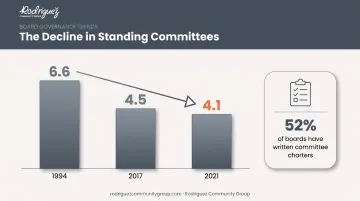
Here's what the data shows about how committee counts have shifted over time:
| Year | Average Standing Committees |
|---|---|
| 1994 | 6.6 |
| 2017 | 4.5 |
| 2021 | 4.1 |
The sector has been moving toward fewer, more focused committees for nearly three decades, according to BoardSource's committee structure research. That same research found that only 52% of boards have written committee charters, which explains a lot of the role confusion boards experience.
Common signs your structure needs work:
- Committees with overlapping mandates that duplicate the same conversations
- No clear line on which committee has final say over a decision
- The same three or four board members sitting on every committee
- Meetings that report status but never actually decide anything
At RZCG, we see these same patterns when auditing nonprofit board structures, and they're usually the first sign a reset is overdue.
Types of Nonprofit Board Committee Structures
Committee structure isn't one-size-fits-all. Nonprofits fall along a spectrum, from many specialized committees to almost none, depending on board size, organizational complexity, and staff capacity. Most boards will move between these models as they grow.
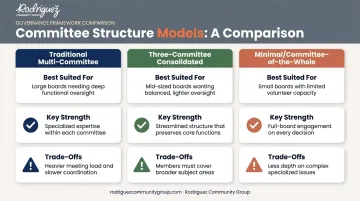
Type 1: Traditional Multi-Committee Model
This model keeps several dedicated standing committees, each with a narrow mandate. Common examples include Executive, Finance, Governance/Nominating, and Audit. Each committee meets separately, digs into its specific domain, and brings recommendations back to the full board.
Best suited for: Larger boards (12+ members) with enough volunteers to staff multiple committees, and established or highly regulated nonprofits needing dedicated oversight for audit or investment matters.
Key strength: Deep subject-matter focus with function-specific accountability.
Trade-offs: Higher administrative overhead and more meetings to coordinate, with added risk of overlapping responsibilities and burnout if committees aren't tightly scoped.
Type 2: Three-Committee (Consolidated) Model
This model consolidates most standing work into three umbrella committees: Governance, Internal Affairs, and External Affairs. Internal Affairs might cover finance, HR, and facilities together, while External Affairs handles fundraising and communications. Each committee reports to the board as a single, unified voice rather than several fragmented ones.
Consultant David La Piana popularized this approach in a widely read Blue Avocado piece arguing boards should only have three committees. This is a proposed framework, not evidence of widespread adoption, though the logic holds up for many mid-sized boards.
Best suited for: Mid-sized nonprofits wanting to streamline governance without losing oversight, and boards that want more meeting time for strategy and less for status reports.
Key strength: Simplified agendas and clearer accountability lines.
Trade-offs: Less granular focus on technical issues like audit, which may still need a dedicated subcommittee, plus a need for strong committee chairs comfortable managing a broad portfolio.
Type 3: Minimal / Committee-of-the-Whole Model
Small or highly cohesive boards sometimes skip standing committees entirely. The full board handles work collectively, acting as a "committee of the whole," or assigns issues to short-term task forces that dissolve once the work wraps up.
Best suited for: Small nonprofits with lean boards and limited volunteer or staff capacity, and organizations that value speed and flexibility over specialized subgroups.
Key strength: Minimal administrative burden and fast decision cycles.
Trade-offs: Insufficient dedicated oversight for complex financial or compliance matters, and a risk of becoming unsustainable as workload grows past what a full board can absorb in one meeting.
How to Choose the Right Nonprofit Board Committee Structure
The right model depends on your board's size, your organization's complexity, and where you sit in your growth trajectory. Copying a peer nonprofit's structure because it looks tidy on paper is a common (and avoidable) mistake.
Board size and volunteer capacity. A board with eight members can't realistically staff five committees without burning people out. Match committee count to actual available hours.
Organizational complexity and legal requirements. Some obligations aren't optional. California, for example, requires charities with $2 million or more in gross annual revenue to obtain an audit and maintain a separate audit committee, with specific rules on who can and can't serve on it, under California Government Code Section 12586.
New York has its own thresholds. Check your state before you restructure anything.
Growth trajectory. As nonprofits scale toward larger budgets and staff counts, governance needs typically shift from informal, all-hands decision-making to more structured committee models.
At RZCG, we work embedded with nonprofit leadership teams to help design governance and executive structures suited to each stage of growth, particularly during transitions like fiscal sponsor spin-offs, when leaders must build a new governance board from scratch.
Staff capacity. Committees generate work for staff too, whether that's preparing financial reports or drafting board materials. A structure that overwhelms a small staff team defeats its own purpose.
Common Mistakes to Avoid When Finalizing Your Structure
- Overcomplicating things. More committees than your board currently needs just adds meetings nobody wants to attend
- Ignoring bylaws or state law. Legal requirements can override your structural preferences, especially around audit committees
- Copying another nonprofit's model. What works for a $20 million organization won't fit a $2 million one
- Keeping zombie committees alive. If a committee hasn't met in a year or has finished its original purpose, sunset it
Conclusion
Committee structure functions as the operating system for how your board actually gets things done, not just a bylaws formality. The three models covered here, traditional multi-committee, consolidated three-committee, and minimal committee-of-the-whole, each serve boards at different sizes and stages.
There's no permanently correct answer. What fits your board at 8 members and a $1 million budget won't fit the same board at 20 members and $15 million. Revisit the structure every couple of years, and be willing to retire what no longer earns its place on the calendar. RZCG's governance advisors can help assess which model fits your organization's current stage.
Frequently Asked Questions
What are examples of board committees?
Common examples include Executive, Finance, Governance/Nominating, Fundraising, Audit, and Communications committees. Which ones you actually need depends on your organization's size and regulatory obligations.
What is the structure of a board committee?
Most committees have a chair (or co-chairs) who runs meetings and reports to the full board, along with members who research issues and recommend actions. Someone typically also tracks minutes for institutional memory.
How many board committees should a nonprofit have?
There's no fixed number, but most boards function best with three to four well-defined committees rather than many under-utilized ones. BoardSource's research puts the current average at 4.1 standing committees.
Can non-board members serve on committees?
Yes. Non-board members can often serve in an advisory or non-voting capacity, bringing outside expertise the board may lack. This can also double as a way to identify future board candidates.
What is the difference between a standing committee and an ad hoc committee?
Standing committees are permanent and handle ongoing responsibilities like finance or governance. Ad hoc committees, or task forces, are temporary and dissolve once their specific goal, like an executive search, is complete.
Who should lead a nonprofit board committee?
Committee chairs are typically experienced board members with relevant subject expertise who can run meetings, delegate tasks, and report clearly back to the full board. Avoid having the same person chair both finance and audit committees.