Introduction
A nonprofit board wants outside expertise, maybe a fundraising veteran, a program specialist, or a lawyer willing to donate time. But forming an advisory committee feels like adding a layer of complexity nobody has bandwidth to manage.
That hesitation is understandable. Without a documented charter, advisory committees often drift into confusing "honorary" groups.
Members show up (or don't). Nobody's sure what they're allowed to decide, and the board ends up untangling conflicts that a single page of clear language could have prevented.
This post gives you a ready-to-use sample advisory committee charter, breaks down each section, and shows how to adapt it for a small or growing nonprofit.
Key Takeaways
- A written charter separates a managed advisory committee from an informal, ineffective one
- Advisory committees have no fiduciary duty or voting power; they supplement, not replace, your board
- Formality should match your organization's size, not a generic template
- Customize by committee type: governance, fundraising, programmatic, or young professionals
What Is an Advisory Committee Charter and Why Your Board Needs One
An advisory committee charter is a governing document outlining a committee's purpose, composition, responsibilities, and its relationship to the board. It's distinct from bylaws, which govern the board of directors itself.
Charters range widely in scope:
- One-page informal document: for a small, single-purpose advisory group
- Mid-level policy document: for committees with defined terms, reporting expectations, and renewal cycles
- Multi-section detailed policy: for committees supporting complex fundraising or programmatic work
The right level of formality depends on the committee's purpose and your organization's capacity, not on what looks impressive.
Why does this matter? Consider what happens without clear written authority. Nonprofit Quarterly reported on a fiscal sponsorship dispute where the parties had no written sponsorship agreement and no defined terms for the relationship.
Disputes followed over financial reporting, budgets, and invoicing, eventually landing in litigation. The lesson applies directly to advisory groups: undefined authority creates room for conflict.
The publication has also warned that when boards fail to delineate an advisory group's role, members may misunderstand their authority or, worse, present themselves as actual board members to funders and partners.
Advisory Committee vs. Board of Directors: Why the Distinction Matters
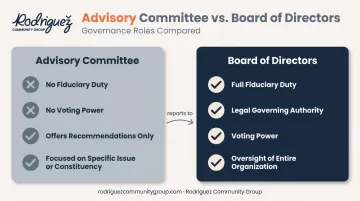
Advisory committees carry no legal authority, fiduciary duty, or governing-level voting rights. They offer recommendations. The board of directors retains all governing responsibility.
BoardSource's own glossary defines an advisory council as a group created to "advise and support an organization or its leadership," typically focused on a particular issue or constituency, not on governance itself. That's a meaningfully different job than sitting on the board.
A well-written charter states this reporting relationship explicitly. When both committee members and directors start from the same page about who decides what, you avoid the awkward moment six months in when an advisor assumes their recommendation is final.
Sample Advisory Committee Charter for Boards [Customizable Template]
Below is a plug-and-play sample charter. Copy it, adapt the bracketed language, and populate it with your organization's specifics.
Section I: Purpose and Mission Statement
Sample language:
"[Organization Name] Advisory Committee is established to provide guidance and expertise on [specific purpose], supporting the Board of Directors in achieving [mission-related goal]."
A specific, written purpose prevents scope creep. Without it, a fundraising advisory committee can slowly start weighing in on program decisions it was never meant to touch.
Section II: Committee Composition and Membership
Sample provisions to include:
- Target size (many organizations use a range like 5–15 members, adjusted to their actual needs)
- Selection criteria tied to the committee's purpose
- How members are nominated and appointed (often by the board or executive director)
Composition should mirror purpose: a programmatic committee needs subject matter experts, while a fundraising committee needs donors and connectors. Don't mix the two unless there's a deliberate reason.
Section III: Roles and Responsibilities
Committee members typically agree to:
- Attend scheduled meetings and review materials in advance
- Provide expert input within their designated scope
- Disclose conflicts of interest as they arise
- Refrain from speaking on the organization's behalf without authorization
The staff or board liaison generally:
- Manages meeting logistics and communication
- Follows up on action items between meetings
- Reports committee recommendations to the board
Section IV: Meeting Cadence and Reporting Structure
Sample language:
"The Advisory Committee meets [quarterly/semi-annually]. Recommendations are documented and submitted to the Board of Directors for review at the next scheduled board meeting."
Spell out exactly how a recommendation travels from committee discussion to board decision. This is where confusion most often creeps in.
Section V: Confidentiality and Conflict of Interest
Sample clause:
"Committee members shall maintain confidentiality regarding sensitive organizational information and shall disclose any actual or potential conflicts of interest, consistent with [Organization Name]'s Conflict of Interest Policy."
Tie this directly to your existing board-level COI policy rather than drafting a separate standard.
Section VI: Term Limits, Renewal, and Removal
Sample language:
"Members serve [1–3 year] terms, renewable for [one/two] additional terms upon board approval. Members may be removed for excessive absence or failure to fulfill committee responsibilities."
Some committees, such as emeritus advisory groups honoring former directors, intentionally skip term limits. That's a valid choice as long as it's a deliberate one, not an oversight.
Customizing Your Charter for Your Nonprofit's Needs
Not every advisory committee needs the same charter. The right structure depends on committee type and organizational size.
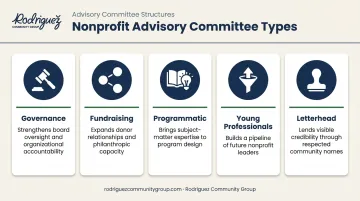
Match the charter to committee purpose:
- Governance advisory committees — support board development, self-assessment
- Fundraising committees — tap into donor networks and relationships
- Programmatic committees — bring subject-matter depth to service design
- Young professionals committees — build a pipeline of future leaders and donors
- "Letterhead" committees — lend credibility and visibility, minimal operational role
Organization size matters too. A five-person nonprofit needs a lighter, flexible charter. A multi-program organization with regulatory complexity needs more detail around reporting and compliance.
This is where many small nonprofits get stuck. They don't have in-house governance expertise, so they either skip the charter entirely or borrow a template built for a much larger organization. Neither works well.
Rodriguez Community Group (RZCG) works with nonprofits up to 50 staff and $25M in revenue on this kind of structural work. In its engagement with Climate Lead, a climate philanthropy advisory organization spinning off from its fiscal sponsor, RZCG helped build a governance board designed for the organization's needs today and its growth trajectory tomorrow.
That same principle applies to advisory committee charters. A charter should fit your organization's actual capacity, not follow a template built for someone else's.
Best Practices for Keeping Your Advisory Committee Effective
A charter gets your committee started, but these practices keep it functional.
- Set term limits and renewal terms in writing from day one so you avoid the uncomfortable conversation later about why someone isn't being asked back.
- Evaluate the committee annually, measuring its contributions against the original purpose and rotating out members who aren't engaged or whose expertise no longer fits.
- Designate a liaison and build between-meeting touchpoints, since advisors who go quiet between quarterly meetings tend to disengage. A short monthly check-in email keeps them connected to the work.
Frequently Asked Questions
Does an advisory board need a charter?
Nonprofit governance experts consider a charter a best practice, even though it isn't legally required. Pro Bono Partnership's governance FAQ notes that defining an advisory group's role and limits "may be a good idea," since it helps prevent confusion among undocumented advisory groups.
Can a 501(c)(3) have an advisory board?
Yes. A 501(c)(3) can form an advisory board or committee at any time. It supplements the board of directors but never replaces its legal governing authority.
What is a nonprofit advisory board?
It's a group of volunteers or experts who provide guidance, expertise, or fundraising support to leadership. They hold no voting rights or fiduciary responsibility.
What do advisory board members get paid?
Most nonprofit advisory board members serve as volunteers, sometimes receiving small honoraria. This differs from corporate or startup advisory boards, which may offer retainers or equity.
How many members should an advisory committee have?
There's no official sector benchmark, but most committees function well with roughly 5–15 members. This range balances diverse expertise with manageable coordination.
Does an advisory committee report to the board of directors?
Typically, yes. Advisory committees report recommendations to the board or executive staff, who retain final decision-making authority. Some committees report to management instead, depending on how the charter defines that relationship.