
Introduction
Small nonprofits face a familiar dilemma: you need specialized expertise in fundraising, law, or your sector, but expanding your governing board isn't practical. Many organizations solve this by creating an advisory board instead.
BoardSource notes that many nonprofits use advisory councils to support governance work and staff-level tasks without adding formal directors. The catch? Too many organizations treat these relationships informally, with nothing but a handshake and good intentions.
That informality creates real problems: confusion over roles, murky confidentiality expectations, and unclear liability exposure if something goes wrong.
This guide breaks down what an advisory board member agreement actually is and how advisory service differs from governing board duties. It also covers what 501(c)(3) rules require and the specific clauses your agreement needs to protect everyone involved.
Key Takeaways
- Advisors provide expertise and connections, not fiduciary duty or voting power
- 501(c)(3)s can form advisory boards freely, keeping governance with the official board
- Use a written agreement, not bylaws, to define scope, term, confidentiality, and liability
- Get board resolution approval and legal counsel review before onboarding advisors
What Is an Advisory Board Member Agreement?
An advisory board member agreement is a written document between a nonprofit and an individual who provides counsel in a non-fiduciary, non-governing capacity. It's distinct from a governing board member agreement, and it has no legal relationship to your bylaws.
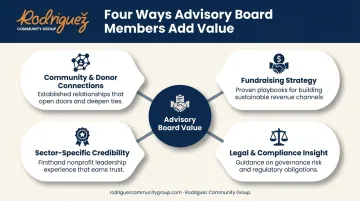
Advisors typically bring something the governing board lacks:
- Fundraising strategy or major gift experience
- Legal or compliance insight
- Sector-specific credibility (education policy, climate science, healthcare)
- Community connections or donor relationships
Unlike directors, advisors have no governance authority and no voting rights. They can't approve budgets, hire executives, or bind the organization to contracts.
There's also a difference in how advisors join. Governing board members are usually elected according to bylaw procedures, while advisory board members are appointed by leadership or the board.
This appointment-based relationship means advisors generally serve at the organization's pleasure. The relationship can end without the formal removal process that applies to directors.
As Pro Bono Partnership recommends, nonprofits should adopt a charter clearly defining the advisory group's role and limits. The agreement puts that charter into practice for each individual advisor. It's a practical tool for managing the relationship, distinct from a governance document.
Advisory Board vs. Board of Directors: What's the Difference?
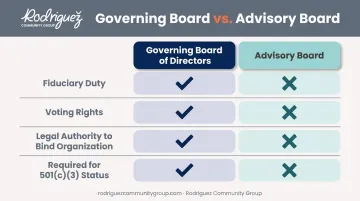
The core distinction comes down to one thing: fiduciary duty and legal authority. Governing board members carry both. Advisory board members carry neither, provided they stay in their lane.
Fiduciary Duty and Legal Authority
Directors owe three specific duties under nonprofit law:
- Duty of care — ensuring prudent use of the organization's assets and resources
- Duty of loyalty — putting the nonprofit's interests ahead of personal gain and disclosing conflicts
- Duty of obedience — following the law, the bylaws, and the mission
These duties come with accountability to state regulators and the IRS. Directors can be held personally liable for breaches. Advisory board members, by contrast, generally don't owe these duties.
NEO Law Group's analysis makes an important caveat, though: labels don't control. If an "advisor" actually functions like a director, exercising real governance authority, courts and regulators may treat them as one regardless of title.
Voting Rights and Decision-Making Power
That legal separation carries into daily decision-making. Advisory board members offer recommendations and expertise, nothing more. They cannot:
- Vote on organizational policy
- Approve budgets or major expenditures
- Legally bind the nonprofit to contracts or commitments
- Represent themselves as speaking for the organization
A board member might recommend a fundraising strategy, but the governing board decides whether to adopt it. This separation is deliberate, letting advisory boards operate without the legal exposure that governing authority carries.
Role and Purpose Within the Organization
So what does an advisory board actually do? In practice, its role centers on:
- Subject-matter expertise in areas the governing board lacks
- Credibility building through recognized names in your field
- Donor and community connections that open doors
- Strategic sounding board functions, without the governance burden
Governing boards are legally required for 501(c)(3) status. Advisory boards are entirely optional, created voluntarily to fill capacity or expertise gaps the existing board can't cover. That's why many organizations formalize these boundaries in a written advisory board member agreement.
Can a 501(c)(3) Nonprofit Have an Advisory Board?
Yes. Nothing in federal tax law or standard state nonprofit corporation law prevents a 501(c)(3) from creating an advisory board or council. Pro Bono Partnership confirms that nonprofits may establish advisory boards, provided the group doesn't take on the legal rights or responsibilities that belong to the board of directors.
There's an important reporting wrinkle, though. On IRS Form 990, only your actual governing body members count as directors or trustees. The 2025 IRS instructions state plainly that members of advisory boards who don't exercise governance authority aren't considered directors or trustees for reporting purposes.
What this means practically:
- Advisory members should not appear as directors or officers on your Form 990 or state filings
- If an advisor separately qualifies as a key employee or officer, that separate role controls the reporting, not their advisory title
- Blurring this line on paper can create confusion about who actually governs your organization
Do You Need to Update Your Bylaws?
Not necessarily. Bylaws don't have to reference an advisory board at all. Best practice, though, is to include either a brief enabling provision authorizing the board to create advisory bodies, or a standalone advisory board charter or policy approved separately.
Either way, the governing board should formally approve the advisory board's creation through a board resolution. The advisory board member agreement itself, not the bylaws, is where you define specific roles, terms, and expectations for each advisor.
Because nonprofit corporate law varies by state, consult legal counsel before finalizing this structure. What works in one state's formation documents may not translate cleanly elsewhere.
Essential Clauses to Include in Your Advisory Board Member Agreement
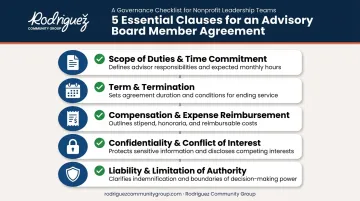
Once you've decided to formalize the relationship, the agreement itself needs to do real work. Here's the practical checklist.
Scope of Duties and Time Commitment
Vague expectations lead to disengaged advisors or frustrated staff. Spell out:
- Specific expected activities (quarterly meeting attendance, strategic plan review, sector expertise on request, introductions to funders)
- Anticipated time commitment per month
- Whether the role is general advisory or tied to a specific project
Term, Renewal, and Termination
Include:
- Initial term length (one year is common, though there's no legal requirement)
- Renewal process, whether automatic or requiring re-appointment
- Conditions for ending the relationship, with or without cause
- Notice periods for either party
Compensation and Expense Reimbursement
Most nonprofit advisors serve pro bono, similar to how most governing board members volunteer their time. Even so, the agreement should address:
- Whether reasonable expenses (travel, materials) will be reimbursed
- Any pre-approval thresholds for reimbursed costs
- Confirmation that the role carries no salary or stipend, if applicable
Confidentiality and Conflict of Interest
Advisors often see sensitive material: donor lists, financials, strategic plans. The agreement should require:
- Confidentiality of nonpublic organizational information
- Disclosure of potential conflicts, such as ties to grantees, competitors, or related organizations
- A recusal process when a conflict arises
Liability, Indemnification, and Limitation of Authority
This clause protects both sides. It should clearly address:
- Confirmation that advisors have no authority to bind the organization or speak on its behalf
- Whether the nonprofit will indemnify advisors for good-faith actions taken within their advisory scope
Without this language, an advisor's offhand comment to a reporter or funder could create real confusion about the organization's official position.
Best Practices for Drafting and Managing Your Agreement
Getting the document right is only half the job. Managing the relationship well matters just as much.
Before You Onboard Anyone
- Have the governing board formally approve the advisory board policy or agreement through a board resolution, ensuring alignment with existing bylaws and governance structures
- Pair the agreement with a short onboarding memo or charter outlining the advisory board's purpose, meeting cadence, and reporting relationship to staff and board leadership
- Confirm with legal counsel that the arrangement fits your state's nonprofit corporate law
Even with a clear checklist, execution is often the harder part. Small nonprofits without in-house legal or HR capacity often struggle to get this right on their own. Building a governance structure that actually holds up takes experience most lean nonprofit teams don't have in-house.
This is where a team like Rodriguez Community Group (RZCG) typically gets involved. RZCG works with small nonprofits and mission-driven organizations on governance structures and executive frameworks, formalizing the roles, responsibilities, and mechanisms that let boards and staff collaborate effectively.
In practice, that has meant facilitating governance board design during a fiscal sponsor spin-off for one climate-focused client, and supporting governance alongside mission alignment work for an education client. RZCG's team embeds directly with your leadership, working through the specifics so the resulting agreement fits your organization instead of a generic template.
Frequently Asked Questions
Can a 501c3 have an advisory board?
Yes. A 501(c)(3) can establish an advisory board as long as ultimate governance authority stays with the official board of directors. The relationship should be documented through a resolution and a separate advisory board agreement, not the bylaws.
What's the difference between a board and an advisory board?
A governing board holds fiduciary duty, voting rights, and legal authority to bind the organization. An advisory board offers expertise and recommendations only, with no governance power or fiduciary obligation.
What is the role of the advisory board in a nonprofit organization?
Advisory boards provide subject-matter expertise, credibility, and donor or community connections. They act as a strategic sounding board without taking on governance responsibility or voting authority.
Do advisory boards need bylaws?
No. Bylaws don't have to mention the advisory board at all. Best practice is a separate charter, policy, or board resolution authorizing the group's creation and defining its limits.
What should be included in a nonprofit advisory board member agreement?
Key clauses cover scope of duties, term and termination, compensation or expense reimbursement, confidentiality, conflict of interest, and limitation of authority. Each protects the organization while clarifying advisor expectations.
Are nonprofit advisory board members compensated?
Most serve on a volunteer basis, mirroring typical governing board practice. Reimbursement of reasonable, pre-approved expenses is far more common than paid compensation for advisory roles.