Introduction
Nonprofit leaders are heading into 2026 with less certainty than they've had in years.
A 2025 Urban Institute survey found 48% of nonprofit leaders reported a worse outlook than the year before, with just 19% seeing improvement. A third experienced government funding disruptions.
That kind of uncertainty punishes organizations without a plan. Small nonprofits, especially those running lean with limited staff, often operate reactively, responding to whatever grant deadline or crisis lands first.
Without a clear roadmap, mission drift creeps in and resources get spread too thin.
This guide covers the essential elements of a strategic plan, the frameworks worth understanding, the planning process itself, common pitfalls, and how to build a plan your team will actually use in 2026.
Key Takeaways
- 48% of nonprofit leaders expect a worsening 2025 outlook, making financial resilience essential
- Strong plans stick to 3-5 strategic priorities instead of tackling everything at once
- Plans without owners, timelines, and review cadences quickly become shelfware
- Financial reality, not aspiration, should decide which priorities make the cut
What Is a Strategic Plan and What Should It Include for 2026
A strategic plan is a decision-making framework. It's not a mission statement, and it's not a fundraising pitch. It's the tool your organization uses to decide what to prioritize, what to say no to, and how to allocate limited staff time and dollars over the next three to five years.
Why does 2026 specifically call for a fresh look, rather than dusting off last year's plan? Three forces are converging:
- Economic uncertainty is squeezing both government and philanthropic revenue streams
- AI-driven operational shifts are changing how nonprofits deliver services and manage staff capacity
- Donor and funder expectations around transparency are rising fast
AI adoption is no longer theoretical: a Bridgespan survey of more than 250 nonprofit leaders found meaningful use already underway, though roughly a third flagged employee resistance and ethical concerns as real barriers.
What Should a Nonprofit Strategic Plan Include
At minimum, your plan should cover:
- A revisited mission and vision that still matches today's reality
- A situational analysis pairing internal capacity with external conditions
- A short list of strategic priorities, not a wish list
- Measurable goals tied to each priority
- Financial alignment, with every priority tested against budget capacity
- An implementation and accountability system
Public-Facing Plan vs. Internal Operating Document
These are two different artifacts. The public-facing version is polished and high-level, built for board binders and funder conversations. The internal version is where the real work lives: detailed OKRs, dashboards, named owners, and deadlines. Skipping the internal document is exactly how good strategy dies in a drawer.
Whichever version you're building, one rule matters more than any framework: every priority must survive contact with your budget. A pillar that sounds inspiring at a retreat but has no realistic funding or staffing pathway is just a wish, not a plan.
The 7 Basic Elements of a Strategic Plan
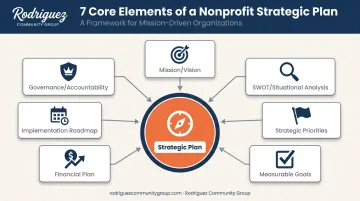
Regardless of format, most credible nonprofit strategic plans include seven components. National Council of Nonprofits and BoardSource both point to these as the backbone of an effective plan.
| Element | What It Does |
|---|---|
| Mission, vision, and values | Confirms why you exist and where you're headed |
| Situational or SWOT analysis | Grounds decisions in evidence, not assumption |
| Strategic priorities or pillars | Narrows focus to 3-5 real thematic bets |
| Measurable goals and objectives | Translates each pillar into trackable outcomes |
| Financial plan and budget alignment | Tests priorities against real resourcing |
| Implementation roadmap and timeline | Assigns phases, milestones, and deadlines |
| Accountability and governance structure | Keeps the plan alive after the retreat ends |
A few of these deserve extra attention:
- Mission and vision aren't static, so revisit them honestly. Does your mission statement still describe what you actually do, or has your work quietly evolved?
- SWOT or situational analysis should happen before you set priorities, not after, since skipping this step means guessing.
- Strategic priorities work best when they represent genuine trade-offs; if your list of "priorities" includes everything the organization already does, it's not a strategy.
Each of these elements connects to the next, and a goal without financial backing is just a wish. A roadmap without accountability is a document nobody opens again.
Strategic Planning Frameworks: The 5 C's and 5 P's
Frameworks don't replace judgment, but they're useful for structuring conversations before you draft anything. Two common lenses show up repeatedly in nonprofit planning circles.
The 5 C's of Strategic Planning
Originally a marketing situation-analysis tool, the 5 C's adapt well to a nonprofit environmental scan:
- Company: your mission, internal capacity, and constraints
- Customers: the beneficiaries and stakeholders your programs actually serve
- Competitors: peer organizations competing for the same funding, talent, or attention
- Collaborators: partners, coalitions, and funders who enable your work
- Climate: the external funding, political, and regulatory environment
Use this as a scanning tool to surface blind spots, not as a finished strategy in itself.
The 5 P's of Strategic Planning
A separate, complementary checklist some planning teams use to organize internal discussion:
- Purpose: why the organization exists
- Priorities: what matters most right now
- People: talent and leadership capacity
- Process: how work actually gets done
- Performance: how success gets measured
This version differs from management scholar Henry Mintzberg's Five Ps for strategy (Plan, Ploy, Pattern, Position, and Perspective). Treat the Purpose-Priorities-People-Process-Performance version as a practical planning lens your team can use to ask better questions, not as an academically established framework.
Both sets of C's and P's exist to organize research and discussion before drafting priorities. Neither substitutes for the actual work of writing a plan.
The Strategic Planning Process for 2026: A Step-by-Step Overview
A strategic plan built in isolation by one or two executives rarely survives contact with the rest of the organization. The process matters as much as the document.
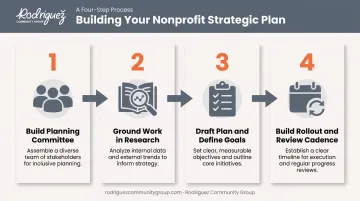
Build a planning committee early. Include staff at multiple levels, board members, and (where possible) beneficiary or community voice. Leadership working alone tends to produce plans nobody else buys into. Many organizations bring in an embedded partner, similar to RZCG's program managers, to keep the group representative and moving forward.
Ground the work in research before the retreat. Run staff and stakeholder surveys, hold interviews, and pull financial and program data. A one-day priority-setting retreat works far better when decisions rest on evidence instead of whoever spoke loudest in the room.
Draft the plan and define measurable goals. Convert each priority into OKRs or SMART goals with named owners.
Build a rollout and review cadence. A quarterly review meeting — bringing together the people responsible for each initiative — keeps the plan connected to reality instead of becoming a one-time exercise.
Nonprofit planning processes commonly take a few months from initial research through final draft, not a single retreat weekend. Rushing this timeline is one of the more common reasons plans lack buy-in later.
Common Pitfalls That Keep Strategic Plans From Being Used
Even well-intentioned plans fail for predictable, avoidable reasons.
- Shelfware plans. Strategies that sound great at the retreat but lack assigned ownership, deadlines, or a review cadence get revisited once, then forgotten.
- Disconnected financial planning. Priorities set without testing them against budget capacity, staff bandwidth, or realistic funding pipelines collapse the moment implementation starts.
- Too many priorities. Trying to advance eight or nine initiatives at once dilutes focus. Most nonprofits execute better when they cap real strategic choices at 3-5 focus areas.
The fix for all three is the same: build financial testing and accountability into the plan from day one, not as an afterthought once the document is finalized.
Why Nonprofits Are Partnering With Embedded Strategic Advisors for 2026
Plenty of consultants can facilitate a retreat and hand over a polished PDF. Fewer stick around to make sure the plan survives contact with an actual budget and an actual staff calendar.
Rodriguez Community Group (RZCG) takes a different approach: the team works as an integrated part of the client's organization, not an outside consultant parachuting in for a workshop.
RZCG's team members average 15 years of nonprofit leadership experience. They step directly into functions like interim COO, CFO, or Chief of Staff when an organization needs it, rather than advising from a distance.
This matters most for the organizations RZCG focuses on: small nonprofits and mission-driven groups with up to 50 staff and $25M in annual revenue. These organizations often don't have a dedicated strategy team to hand a plan off to. RZCG's work spans:
- Strategic finance and budget alignment, ensuring priorities are tested against real financial capacity
- Governance and board structure, so accountability doesn't stop at the executive director's desk
- Operations planning, keeping day-to-day work connected to long-term priorities
Beyond these core functions, RZCG has supported organizations across education, climate, and community empowerment sectors — helping teams strengthen the operational and financial foundation a strategic plan actually needs to succeed. If you're planning your 2026 strategy and want it built for execution rather than the board binder, reach out to RZCG for a conversation.

Frequently Asked Questions
What should a foundation strategic plan include?
A strong foundation strategic plan revisits mission and vision, defines 3-5 strategic priorities, and sets measurable goals tied to available resources. It also builds in an accountability structure for ongoing review.
What are the 7 basic elements of a strategic plan?
The seven elements are mission and vision, a situational or SWOT analysis, strategic priorities, measurable goals, a financial plan, an implementation roadmap, and a governance structure.
What are the 5 C's of strategic planning?
Company, Customers, Competitors, Collaborators, and Climate. This framework helps organizations scan their internal capacity and external environment before setting priorities.
What are the 5 P's of strategic planning?
Purpose, Priorities, People, Process, and Performance. This is a practical planning checklist teams use to organize discussion, not a substitute for a finished strategic plan.
How often should a nonprofit update its strategic plan?
Most plans span three to five years, but they should be reviewed at least annually and adjusted sooner if major funding, staffing, or external shifts occur.
How long does it typically take to create a strategic plan?
Timelines vary, but most nonprofit planning processes take several months, moving from research and stakeholder input through drafting to a final, board-approved plan.