Introduction
Most nonprofit leaders know they should have a strategic plan. Fewer actually have one that's current, documented, and used to make real decisions.
A 2024 survey of nearly 1,000 Northwest nonprofit leaders found that having "a current strategic plan that sets direction, priorities, and goals" scored only 3.31 out of 5 on organizational capacity, right in the middle, not the top.
That gap between intention and execution is exactly what small nonprofits face as they plan for 2026.
For organizations with a lean staff and a tight budget, strategic planning can feel like a luxury reserved for larger nonprofits with dedicated development teams. In practice, it's the discipline that protects your mission focus when funding shifts, AI disrupts fundraising norms, and economic uncertainty pressures every line item.
This guide covers why planning matters heading into 2026, a step-by-step process you can follow, the components a strong plan needs, common pitfalls to avoid, and how to choose the right support if you need it.
Key Takeaways
- A strategic plan connects mission, resources, and measurable goals across a 3-5 year horizon.
- Nonprofits with active plans align staff, board, and volunteers around fewer, higher-impact priorities.
- 2026 plans must address AI adoption gaps, funding volatility, and shifting donor expectations.
- The right planning partner stays engaged through implementation, not just the final report.
Why Nonprofit Strategic Planning Matters Heading Into 2026
Direction, Resource Focus, and Mission Drift
Strategic planning aligns your organization's direction across board members, staff, and volunteers. Without that alignment, well-meaning program expansion pulls organizations away from their core purpose, a pattern often called mission drift.
A documented plan also forces harder choices about resource allocation. Small nonprofit teams can't do everything. A plan tells you what deserves your limited staff hours and dollars, instead of leaving those decisions to whoever's loudest in the room that week. That discipline matters even more as funding conditions grow less predictable heading into 2026.
The Funding Volatility Factor
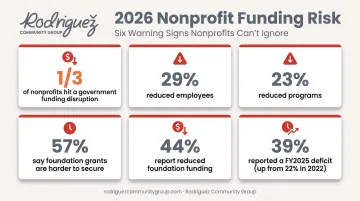
2026 planning has to reckon with funding instability that's no longer hypothetical. The Urban Institute found that one-third of nonprofits experienced at least one government-funding disruption in early 2025. Among those disrupted, 29% reduced employees and 23% reduced programs.
Foundation funding isn't offering much relief either. In CEP's 2026 survey of 380 nonprofit CEOs, 57% said foundation grants had become harder to secure since January 2025, and 44% reported reduced foundation funding over the same period. Thirty-nine percent reported a fiscal-year 2025 deficit, up sharply from 22% in 2022.
What this means for your plan:
- Build funding scenarios (best case, likely case, worst case) into your goal-setting
- Set trigger points for when to activate contingency budgets
- Revisit revenue assumptions quarterly, not annually
The AI Readiness Gap
AI is no longer optional to address in a strategic plan, even for organizations with no plans to use it heavily. TechSoup and Tapp Network's 2025 benchmark found that 76% of nonprofit respondents had no AI strategy, and 80% had no acceptable-use policy. Yet nearly three-quarters of respondents were already using AI in some capacity.
This points to a governance failure: strategic plans should assign clear ownership of AI-related decisions before staff start experimenting with tools on their own, unsupervised.
Risk Management Before It Becomes a Crisis
A strategic plan is also a risk-management tool. Leadership transitions, program pivots, funding cliffs, and economic downturns hit every organization eventually. Nonprofits with a documented plan have already asked "what happens if X changes" before it happens, which shortens the scramble when disruption hits.
The Nonprofit Strategic Planning Process: A Step-by-Step Framework
Every nonprofit's planning process looks a little different, but effective plans generally move through five stages that build on each other.
Step 1: Assemble Your Planning Team and Set the Framework
Include board members, senior staff, program leads, and key stakeholders in the process from the start. Cross-functional representation is what drives adoption later, not a box to check. A plan built by three people in a closed room rarely survives contact with the rest of the organization.
Before tackling the plan's content, settle two logistics questions:
- Timeline: Set a realistic end date. Most small nonprofit planning processes take a few months, not a few weeks.
- Decision authority: Clarify who has final sign-off (usually the board) versus who's providing input, so the process doesn't stall waiting for consensus that was never required.
Step 2: Reaffirm or Refine Mission, Vision, and Values
Mission, vision, and values aren't interchangeable, and treating them that way weakens the plan.
- Mission is your purpose, why the organization exists.
- Vision is the long-term aspiration you're working toward.
- Values are the behavioral guardrails that filter every decision along the way.
This step matters most for small nonprofits facing mission creep, where a good funding opportunity or community request pulls the organization into programs that don't actually connect to its core purpose. Revisiting these three elements before setting goals keeps expansion intentional instead of accidental.
Step 3: Conduct an Organizational and Environmental Analysis
A SWOT analysis (strengths, weaknesses, opportunities, threats) remains the most common framework here. The real goal is an honest look at internal capacity (staffing, systems, finances) alongside external conditions (funding landscape, community needs, competitive programs).
The Council of Nonprofits recommends building a measurement strategy around clear goals and learning questions, so data collection serves specific decisions rather than sitting unused. If your organization doesn't already track data consistently, this step is where that habit needs to start.
Step 4: Set SMART Goals and Build Action Plans
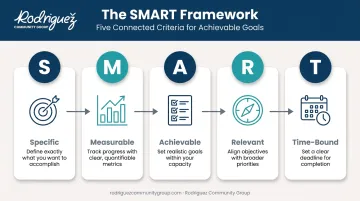
Vague goals like "expand our reach" don't survive a single budget cycle. SMART goals do:
- Specific - Name exactly what will change
- Measurable - Attach a number or clear indicator
- Achievable - Match ambition to actual capacity
- Relevant - Tie directly back to mission and strategic priorities
- Time-bound - Set a deadline, not an intention
Every goal needs an assigned owner, a timeline, and the resources required to hit it. Build a communication plan alongside the goals themselves, so staff and stakeholders understand what's changing and why before rumors fill the gap.
Step 5: Implement, Monitor, and Evaluate Progress
A plan that sits in a drawer accomplishes nothing. Tie progress reviews to a recurring cadence: quarterly board agenda items work well for most small organizations, keeping the plan active instead of letting it become shelfware.
Treat the plan as living, not fixed. Revisit and adjust it as internal capacity or external conditions change. That flexibility is the difference between a plan that guides decisions for years and one that's obsolete by month six.
Key Components of an Effective Strategic Plan Document
An effective strategic plan prioritizes usability over length, giving leadership something they'll actually pick up between meetings. Core sections typically include:
- Executive summary - A one-page overview leadership can reference quickly
- Mission, vision, and values - Restated or refined from Step 2
- Current state analysis - Summary findings from your SWOT or environmental scan
- 3-5 strategic goals - Not ten, not one; enough to focus without ignoring real priorities
- Short- and long-term metrics - Specific indicators tied to each goal
- Resource and budget alignment - How dollars and staff time map to the priorities
With these core sections drafted, define success metrics and progress indicators before the plan goes into effect. Metrics added after the fact tend to flatter the organization more than they measure it honestly.
Keep the document concise enough that board and staff actually reference it between meetings—aim for 15-20 pages, not 60. Usability matters more than comprehensiveness.
Common Strategic Planning Mistakes Small Nonprofits Should Avoid
Even well-intentioned planning processes go sideways in predictable ways:
- Goals without measurable metrics. "Improve community engagement" sounds good but can't be tracked. Attach a number or specific indicator to every goal.
- Too many competing priorities. Five ambitious initiatives spread a small team too thin to execute any of them well; fewer, better-resourced goals beat a long wish list.
- Budget and plan disconnect. If the annual budget doesn't reflect the strategic priorities, the plan is aspirational fiction — every stated priority needs a corresponding line item.
These aren't rare mistakes. They show up across organizations of nearly every size, which is exactly why Step 4's discipline around SMART goals and resource assignment matters so much.
Choosing the Right Partner for Your Strategic Planning Process
Many small nonprofits simply don't have the internal bandwidth or objectivity to run a rigorous planning process alone. That's simply a staffing reality when your team is already stretched across programs, fundraising, and operations. Outside support can accelerate the work without derailing daily operations, but the type of support matters.
Traditional consultant vs. embedded partner:
| Traditional Consultant | Embedded Partner |
|---|---|
| Delivers a report, then exits | Works alongside staff through implementation |
| Analyzes from the outside | Integrates into existing team structures |
| Single-function scope | Covers strategy, finance, governance, and operations together |
| Relationship ends at delivery | Relationship continues through execution and adjustment |
Rodriguez Community Group (RZCG) operates as the latter. Rather than handing over a document and disappearing, RZCG's team, which averages 15 years of nonprofit leadership experience, works as an extension of the client's own staff and board through planning and beyond.
That model shows up across engagements. RZCG supported The Oakland REACH through leadership transitions and operational scaling, and helped English Learners Success Forum build financial and operational structures that outlasted the initial project scope.

When evaluating any planning partner, look at their depth across multiple functional areas, not just strategy. Planning gaps rarely stay confined to one lane:
- Strategy: Can they translate mission into actionable priorities, not just a polished document?
- Finance: Do they understand how to align budgets with strategic goals, not just write about them?
- Governance: Can they advise on board structure and decision-making authority?
- Operations: Do they know whether your current systems can actually support the plan?
A partner missing any of these tends to hand you a plan that looks strong on paper but stalls in year one.
Frequently Asked Questions
What is nonprofit strategic planning?
Nonprofit strategic planning is the process of setting long-term goals, assessing available resources, and building a roadmap to advance the organization's mission. Most formal plans cover a 3-5 year period.
How often should a nonprofit update its strategic plan?
Review progress annually, and expect a full plan refresh every 3-5 years or after major organizational or environmental changes. Ongoing monitoring, monthly or quarterly, keeps the plan active between refreshes.
Who should be involved in the strategic planning process?
Board members, senior staff, program leaders, and key stakeholders such as major donors or community members should all have input. Cross-functional involvement drives buy-in once the plan is finalized.
How long does it typically take to create a nonprofit strategic plan?
Timelines vary by size and complexity, but most small nonprofit planning processes take a few months from initial framework-setting to a final document.
What's the difference between a strategic plan and an annual operating plan?
A strategic plan sets multi-year direction and priorities. An annual operating plan translates those priorities into yearly budgets, staffing decisions, and tactical activities for the next 12 months or so.
How can a small nonprofit measure strategic planning success?
Track KPIs tied directly to your SMART goals, things like program outcomes, fundraising growth, and donor retention. Review these on a regular cadence, not just at year-end.