

Introduction
Your board just approved a new executive hire. There's just one problem: nobody agrees on what this person should actually do.
This scenario plays out constantly in nonprofits. Boards and executive directors know they need operational leadership, but they're not sure how to translate that need into a job description.
So they pull a template from a for-profit job board, swap a few words, and post it.
The result? Mismatched hires, murky reporting lines, and candidates who walk away confused about what they're signing up for.
This confusion isn't limited to one bad hire. A recent Bridgespan survey of 165 nonprofit COOs found the role varies widely from organization to organization, with no universal template that works.
This guide breaks down exactly what belongs in a nonprofit COO job description, from core responsibilities and reporting structure to compensation benchmarks you can actually trust.
Key Takeaways
- A nonprofit COO owns internal execution, freeing the ED/CEO for fundraising and partnerships.
- Job titles vary widely; scope and reporting lines matter more than the label.
- Five core competencies matter most: strategic thinking, capacity building, talent development, managing uncertainty, and decision-making.
- Salary ranges vary widely by source, so benchmark against similarly sized organizations.
- Smaller nonprofits often benefit more from fractional or embedded COO support than full-time hires.
What Does a Nonprofit COO Do?
A nonprofit COO is the internal operations leader. While the executive director spends time courting donors, building partnerships, and representing the organization publicly, the COO keeps the internal engine running.
That's the simple definition. The actual scope of the role is messier, and it depends heavily on organizational size and maturity.
The Most Common Functional Responsibilities
Bridgespan's mid-2025 survey of 165 nonprofit COOs (87% US-based) found that more than 70% of respondents oversee strategy, legal compliance/risk, office management, or HR, while 44% also manage programs and services directly.
Smaller, newer nonprofits tend to load nearly everything onto the COO. Organizations with established functional teams let their COO focus on bigger-picture strategy instead of daily firefighting.
Three Roles the Job Description Won't List
Beyond the formal duties, nonprofit COOs consistently play three roles that rarely appear on paper:
- First responder: the person who gets pulled into the urgent HR complaint, the vendor contract gone sideways, or the office lease crisis before anyone else does
- Copilot to the ED: a trusted sounding board who stress-tests decisions before they reach the board
- Connector across silos: the person who links finance, programs, and operations so nothing falls through the cracks
We've seen this connector function play out directly. During Rodriguez Community Group's engagement with The Oakland REACH, our team moved from an interim Chief of Staff role into full COO functions after a senior staff transition. That shift included overseeing CFO activities alongside operations.
That kind of bridging between finance and operations is exactly what keeps growing nonprofits from stalling out.
How COOs Actually Spend Their Time
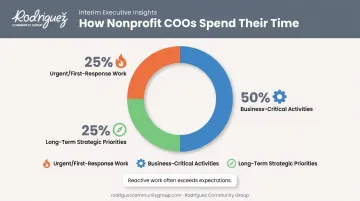
Surveyed COOs reported spending roughly 25% of their time on urgent, first-response work, 50% on business-critical activities, and only 25% on longer-term strategic priorities. If your job description promises "50% strategic planning," set that expectation carefully. Reactive work eats more time than most boards assume.
No two nonprofit COO roles look identical. Write the job description to match your organization's growth stage and leadership gaps, not a generic template pulled from a job board.
Essential Elements of a Nonprofit COO Job Description
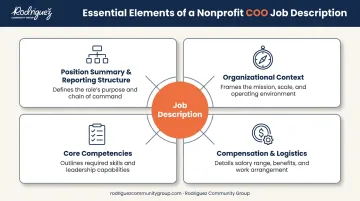
A strong job description covers four things: who the person reports to, why the role exists now, what competencies matter, and what you're willing to pay. Skip any of these and you'll get vague applicants asking vague questions.
Position Summary and Reporting Structure
Nonprofit COO-equivalent titles vary more than you'd expect:
- Chief Operating Officer (COO) — used when the role sits at a true executive level with board visibility
- Director of Operations — common in organizations under 25 staff where the role is more managerial than executive
- Deputy Director — signals succession potential alongside operational duties
- Chief Administrative Officer — often used when the role emphasizes internal accountability and staff supervision more than strategy
There's no strict rule tying title to budget size, so pick based on the authority and reporting line you're actually creating. Your position summary should run 2-3 sentences and answer one question directly: why does this role exist right now?
Organizational Context
Give candidates a brief mission and history blurb, but spend more space on the specific transition driving the hire. Are you spinning off from a fiscal sponsor? Scaling programs faster than your systems can handle? Losing a senior leader mid-growth?
At Rodriguez Community Group, fiscal sponsor spin-offs are the most common trigger we see for this hire. When organizations separate from a fiscal sponsor, they suddenly need finance, HR, and operations infrastructure built from nothing, often within a tight timeline.
Core Competencies Section
Bridgespan's nonprofit COO model identifies five competencies worth building into your selection criteria:
| Competency | What It Looks Like in Practice |
|---|---|
| Strategic thinking | Anticipates trends and converts them into actionable plans |
| Capacity building | Strengthens workforce and processes for sustainable operations |
| Talent development | Develops leaders and fosters accountability across teams |
| Managing uncertainty | Guides teams through ambiguity without losing momentum |
| Sound decision-making | Balances strategic goals against budget realities |
Compensation and Logistics Details
Include a transparent salary range, a benefits summary, and clear expectations around hybrid work or travel. Add an equal employment opportunity statement and a line or two on organizational values. Candidates increasingly screen out postings that omit salary ranges entirely, so don't skip this.
Core Responsibilities to Include in the Job Description
This is where most job descriptions either shine or fall apart. Vague bullet points like "manage operations" tell candidates nothing. Specificity does the heavy lifting here.
Financial oversight. Budgeting, cash flow monitoring, and financial reporting, typically done in partnership with a CFO or finance team. In smaller organizations, the COO may directly oversee CFO-level activities rather than partnering with a separate finance leader.
Program and operations integration. Aligning programs with strategic goals, tracking performance metrics, and ensuring program quality meets donor expectations.
Human capital and talent systems:
- Recruitment and onboarding
- Staff development and performance management
- Culture-building across departments
Risk management and compliance. Legal compliance, data privacy, cybersecurity, and catching operational risks before they escalate into crises. This function often gets built out during fiscal sponsor spin-offs, when organizations must establish compliance structures from scratch.
Governance and board engagement. Presenting updates at board meetings and supporting a healthy ED-board relationship, often through committee service as well.
Strategic partnership with the ED/CEO. Acting as a trusted sounding board, taking on proxy responsibilities when the ED is unavailable, translating the strategic plan into day-to-day operating steps, and flagging risks before they reach the board.
Not every COO handles all six areas equally. Weight the job description toward whichever functions your organization currently lacks, not the areas already well-covered by existing staff.
COO vs. CEO/Executive Director vs. CFO: Clarifying the Reporting Lines
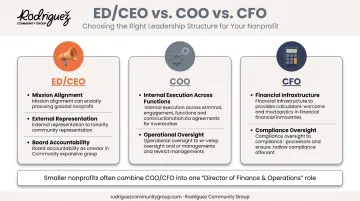
Confusion between these three roles causes more hiring mistakes than almost any other issue. Here's the clearest way to separate them:
| Role | Primary Focus |
|---|---|
| ED/CEO | Mission ownership, external representation, board accountability |
| COO | Internal execution across whatever functions the organization needs covered |
| CFO | Financial infrastructure — cash flow, investments, compliance for complex funding |
A COO isn't inherently senior to a CFO. The two roles are typically complementary, not hierarchical. In most structures, the COO reports to the CEO/ED, and the CFO reports either to the CEO or, in integrated setups, to the COO.
Depending on your org chart, the COO might partner closely with the CFO or lightly oversee the finance function, especially in organizations without a full finance department.
Rodriguez Community Group has seen these patterns firsthand:
- The Oakland REACH: Our interim COO role explicitly included oversight of CFO activities.
- English Learners Success Forum: We provided interim COO and CFO support simultaneously as coordinated functions during a spin-off.
- Smaller organizations: Skip separate C-suite titles, combining both functions into a single "Director of Finance & Operations" role.
If your organization is under roughly $3M in budget, this combined structure is often more practical than maintaining two distinct executive titles.
Salary and Compensation Benchmarks for Nonprofit COOs
Salary data for nonprofit COOs varies enough between sources that picking the wrong one can badly skew your posted range.
- PayScale reports an average base salary of $132,166, with a range of $78,000 to $219,000 based on 127 salary profiles
- ZipRecruiter reports a national average of $151,203, with state-level averages ranging from $112,993 in Florida to $171,252 in Washington
- Salary.com's estimate lands far higher, around $405,000, but the site doesn't publish its methodology or segment by nonprofit budget size, so treat it with caution rather than as a benchmark
The takeaway: don't rely on a single national number. Benchmark compensation against similarly-sized nonprofits in your region, and factor in local cost of living before finalizing your posted range.
Once you've landed on a range, publishing it matters just as much as the number itself. Doing so does more than fill a legal requirement in many states. It builds candidate trust and widens your applicant pipeline, particularly among candidates who screen out postings that hide compensation entirely.
When Your Nonprofit Is Ready to Hire (or Outsource) COO Support
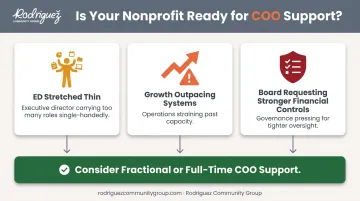
Not every organization needs a full-time COO right away. Watch for these signals first:
- Your ED is stretched across strategy, operations, and fundraising with no bandwidth left for any single area
- Growth is outpacing your systems — programs, staff, or revenue expanding faster than your infrastructure can support
- Your board is requesting stronger financial controls than your current team can deliver
If you're seeing one or more of these signs but aren't ready to commit to a full-time executive salary, a fractional or embedded COO model is worth considering. This model fits organizations with up to 50 staff and $25M in annual revenue that need senior operational leadership without the long-term overhead of a full-time hire.
Rodriguez Community Group provides this type of support, working alongside nonprofit staff as an integrated team partner rather than an outside consultant looking in.
Whichever option you choose, the next step is the same: assess your actual capacity gaps before drafting any job description. What's breaking down right now? What would break down next if you kept growing? A posting built around real answers to those questions will always outperform one built around a generic template.
Frequently Asked Questions
What does a nonprofit chief operating officer do?
A nonprofit COO oversees internal operations, including finance, HR, program integration, and risk management, so the ED can focus on fundraising and external partnerships. They also serve as a strategic sounding board to the executive director.
What is the salary for a nonprofit chief operating officer?
Salary estimates range from roughly $132,000 (PayScale) to $151,000 (ZipRecruiter) nationally, though figures shift based on organization size, budget, and region. Always benchmark against similarly-sized nonprofits before setting a range.
Is a nonprofit chief operating officer higher than a chief financial officer (CFO)?
No, the roles are generally complementary rather than hierarchical. In smaller nonprofits, the COO may oversee CFO-level activities directly, while larger organizations typically maintain separate, coordinated roles.
What's the difference between a nonprofit COO and an Executive Director?
The Executive Director owns the mission, external representation, and board accountability. The COO focuses on internal execution, turning strategy into day-to-day operations across finance, HR, and programs.
What titles are used instead of COO in small nonprofits?
Common alternatives include Director of Operations, Deputy Director, and Chief Administrative Officer. Some organizations also combine COO and CFO duties into a single Director of Finance & Operations role.
Does every nonprofit need a full-time COO?
Not necessarily. Smaller organizations often benefit more from fractional or embedded operations support before committing to the ongoing cost of a full-time executive hire.