
The idea isn't new, but it's gaining traction. In a 2015 national survey of 5,451 nonprofits, 13% of respondents said they'd launched an earned-revenue venture in the prior year, and another 20% planned to. That's a sample statistic, not a claim about every U.S. nonprofit, but it points to a real shift in thinking.
Confusion still runs deep, though. Can you actually run a business and keep your 501(c)(3) status? Do you need a separate entity? What happens tax-wise once you start selling something?
This guide breaks down what a nonprofit social enterprise actually is, how it compares to a traditional nonprofit or a for-profit social enterprise, the structural options on the table, and a practical roadmap for getting started.
Key Takeaways
- Earned-income ventures won't jeopardize 501(c)(3) status if they support your mission
- No fixed "33% rule" exists — the IRS applies a facts-and-circumstances test instead
- Four common models (customer-as-beneficiary, cross-subsidy, employment-based, supply-based) cover most nonprofit ventures
- Where you house a venture depends on liability exposure, UBIT (unrelated business income tax) risk, and funder relationships
- Diversified revenue helps only when the venture fits your mission and capacity
What Is a Nonprofit Social Enterprise?
A nonprofit social enterprise blends a charitable mission with a revenue-generating business model. Georgetown Law's summary of the Social Enterprise Alliance definition breaks it into three parts:
- The organization directly addresses an intractable social need
- Its commercial activity is a meaningful revenue driver (not a side hustle)
- The common good remains the primary purpose throughout
Think of it as a hybrid organization. Instead of relying solely on grants and donations, the nonprofit builds a product or service people will pay for, and that revenue funds (or directly delivers) the mission.
Can a nonprofit actually be a social enterprise? Yes. A 501(c)(3) can run earned-income activities and keep its tax-exempt status, as long as the activity is substantially related to its exempt purpose.
The IRS defines "substantially related" in Publication 557 as contributing importantly to accomplishing that purpose; generating income alone doesn't count. Document the connection between what you're selling and why it advances your mission, and you're on solid ground.
Social Enterprise vs. Social Entrepreneurship
These terms get used interchangeably, but they're not the same thing:
- Social enterprise: the organization or operating model itself
- Social entrepreneurship: the practice of spotting a broken system and building a better one
- Social entrepreneur: the individual doing that work
Here's a real example. World Education Services, a nonprofit, charges immigrants for credential-evaluation services that help them use overseas degrees and training in the U.S. job market. The paying customer is the beneficiary: commerce and mission happen in the same transaction. That's a nonprofit social enterprise in action.
Nonprofit Social Enterprise vs. 501(c)(3) vs. For-Profit Social Enterprise
Here's where most confusion starts. A 501(c)(3) is a federal tax status. A social enterprise is an operating model. They're not competing categories: a 501(c)(3) can operate as a social enterprise, or it can be a traditional grant-funded nonprofit that never sells anything.
For-profit social enterprises are a different animal entirely. These are businesses (often B Corps) built around a social mission, but structured to distribute profits to owners or shareholders.
| Nonprofit Social Enterprise | Traditional 501(c)(3) | For-Profit Social Enterprise | |
|---|---|---|---|
| Mission priority | Primary purpose, revenue serves it | Primary purpose | Balanced with financial return |
| Funding source | Earned revenue + grants/donations | Grants and donations | Earned revenue + investor capital |
| Tax treatment | Tax-exempt; UBIT may apply | Tax-exempt | Standard corporate taxation |
| Profit distribution | Reinvested into mission (no inurement) | N/A | Can distribute to shareholders |
The distinction that trips people up most: for-profit social enterprises can pay out profits to investors; nonprofit ones cannot. The IRS's no-inurement rule means every dollar of surplus from a nonprofit social enterprise has to go back into mission-driven work.
One more clarification worth flagging: B Corp certification and benefit corporation status are also different from each other, and neither relates to 501(c)(3) status.
- B Corp certification: A voluntary certification from B Lab
- Benefit corporation: A state-law legal structure
- A company can hold one, both, or neither; the two designations are independent
Types of Nonprofit Social Enterprises
There isn't just one way to build a nonprofit social enterprise. Kim Alter's widely cited typology breaks it into four models, organized around who pays and who benefits.
| Model | How revenue and mission connect | Example |
|---|---|---|
| Customer-as-beneficiary | The person benefiting from the mission also pays for the service | Bookshare (Benetech) sells accessible-book subscriptions to people with print disabilities |
| Cross-subsidy | Sales to an external market fund the actual social program | Essential Eldercare (IONA Senior Services) sells eldercare services to support broader programming |
| Employment-based | The business itself employs people facing labor-market barriers | Northwest Center runs manufacturing and service businesses employing people with developmental disabilities |
| Supply-based | The enterprise connects producers or beneficiaries to buyers | Aid to Artisans links artisan producers with external markets |
Beyond these four core models, nonprofits also draw on broader categories of earned activity when designing a venture:
- Commercial sales cover direct product or service sales, from subscriptions to event tickets and licensing fees
- Corporate philanthropy: contributed support from corporate partners, distinct from earned revenue
- Microfinance offers fee- or interest-based financial services delivered within the nonprofit's mission
Most real-world ventures borrow from more than one model. A job-training thrift store, for example, is both employment-based (staff gain skills) and customer-as-beneficiary (shoppers get affordable goods).
Legal and Financial Structures: Where to House Your Social Enterprise
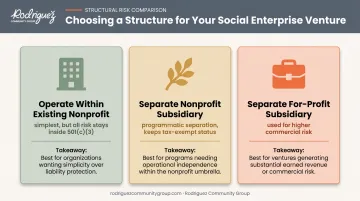
Once you know what you're building, the next question is where it should live. Nonprofits generally choose from three structures:
- Operate within the existing nonprofit: simplest option, but all revenue and risk sit inside your current 501(c)(3)
- Create a separate nonprofit subsidiary: useful for programmatic separation without giving up tax-exempt treatment
- Form a separate for-profit subsidiary: often chosen when the venture is farther from the core mission or carries more commercial risk
Related vs. Unrelated Business Income
This distinction determines your tax exposure. A "related" activity contributes to your exempt purpose, while an "unrelated" one doesn't, and if it's regularly carried on, it can trigger Unrelated Business Income Tax (UBIT).
Once gross unrelated business income hits $1,000, you're required to file Form 990-T. That's a filing threshold, not the tax bill itself, but it's the line that puts your venture on the IRS's radar.
Is There Really a "33% Rule"?
Short answer: no. There's a persistent myth that unrelated business activity can't exceed 33% of a nonprofit's total activity, but no such fixed threshold exists. IRS Publication 5833 describes a "substantiality" test based on facts and circumstances, not a percentage safe harbor.
A related 1964 revenue ruling upheld a charity's exemption even though most of its income came from a commercial office building, because its charitable grantmaking stayed "commensurate in scope" with its resources. Scope relative to mission matters more than a magic number.
When It Makes Sense to Spin Off
Common triggers for creating a separate entity include:
- Liability protection: isolating commercial risk from core programs
- Staffing differences: the venture needs different skills or compensation structures than your program team
- Funder relationships: some private foundations are cautious about grantee organizations carrying commercial risk
This is where governance and financial-control decisions get complicated fast. RZCG has guided nonprofits like the English Learners Success Forum, Climate Lead, and the Scientific Philanthropy Alliance through comparable fiscal sponsor spin-offs, defining the governance, financial, and operational structures needed before an organization stands on its own.
That same groundwork, including clear financial controls, the right board composition, and defined operating systems, applies directly to evaluating where a social enterprise should sit.
How to Start a Nonprofit Social Enterprise
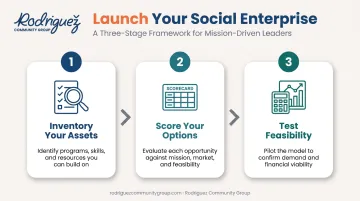
Launching a venture without a process is how nonprofits end up with a struggling side project that drains staff time. A leaner path looks like this:
Inventory your assets. Run a structured brainstorm with staff and board around what you already have: facilities, staff expertise, alumni networks, existing relationships. The best venture ideas usually come from resources you're already sitting on, not from a blank-slate business plan.
Score your options. Rank each idea against three criteria: ease of implementation, mission alignment, and profit potential. A simple 1-5 scoring grid across these three factors will surface the strongest candidates fast and rule out ideas that sound exciting but don't fit.
Test feasibility before you commit. Build a lean business plan: pricing, target customer, startup costs, and a break-even estimate. This is the stage where you want to fail early and cheaply if the numbers don't work, rather than discovering it two years in with staff and capital already committed.
Skipping straight from idea to launch is the most common mistake. A short feasibility pass costs a few weeks. A failed venture costs a lot more — in money, staff morale, and mission focus.
RZCG builds this stress-test into every spin-off engagement, helping nonprofit leaders validate an idea's fit before committing staff time and capital.
Benefits and Risks Nonprofits Should Weigh
Earned income isn't automatically a stability upgrade. It depends on fit.
The upside: diversified revenue reduces overreliance on any single grant cycle or donor. Unrestricted earned revenue also gives leadership more flexibility than restricted grant dollars.
The catch: Urban Institute research on nearly 360 nonprofits found diversified revenue portfolios associated with lower year-to-year funding swings, but also lower overall growth. Diversification isn't automatically the growth lever it's often marketed as.
The real risk: bandwidth, not just money. Standing up a venture pulls staff attention from core programs, even when the numbers look promising on paper.
RZCG has seen this dynamic play out in analogous fiscal sponsor spin-offs. With clients like the English Learners Success Forum, the goal was explicitly to keep spin-off activities from distracting staff from mission-critical work. That meant bringing in dedicated operational leadership rather than stretching existing program staff thinner.
Before scaling any venture, run an honest capacity check:
- Do you have financial systems that can track a new revenue stream separately?
- Does your board have the oversight structure to monitor a commercial activity?
- Can staff take this on without cutting into program delivery?
If the answer to any of these is shaky, an experienced operational partner can help build that capacity before you scale, rather than after something breaks.
Frequently Asked Questions
Can a nonprofit be a social enterprise?
Yes. A nonprofit can operate earned-income activities and keep its 501(c)(3) status, as long as the commercial activity supports its mission or stays insubstantial relative to overall operations.
What is the difference between a social enterprise and a 501(c)(3)?
A 501(c)(3) is a federal tax-exempt status. A social enterprise is a revenue-generating operating model that can exist inside a 501(c)(3), alongside one, or independently as a for-profit entity.
What is the 33% rule for nonprofits?
There's no fixed 33% legal threshold. The IRS applies a "substantiality" test based on facts and circumstances to judge whether unrelated business activity is too large relative to the organization's overall exempt purpose.
What are the four types of social enterprise?
The four common models are customer-as-beneficiary (the buyer directly benefits), cross-subsidy (sales fund programs), employment-based (the business employs people facing barriers), and supply-based (linking producers to markets).
Do nonprofit social enterprises have to pay taxes?
Net income from unrelated business activity is generally subject to UBIT once gross unrelated income reaches $1,000. Income from activities substantially related to the mission typically isn't taxed.
How do I know if my nonprofit is ready to launch a social enterprise?
Look for financial stability, board buy-in, and staff capacity to run a feasibility study without disrupting core programs. If any of these are shaky, a partner like RZCG can help assess your readiness before you commit resources.