Change management gives that process structure instead of chaos. Organizations with excellent change management practices are seven times more likely to meet their objectives than those with poor change management, according to Prosci's research on why change management matters. For a nonprofit running lean, that gap can mean the difference between a smooth transition and a stalled mission.
Small nonprofits feel this pressure more acutely. Limited staff, tight budgets, and team members already wearing three hats make every new initiative feel riskier. This guide walks through what change management looks like specifically for nonprofits: the core framework, the challenges unique to mission-driven organizations, a step-by-step process, and how to know when it's time to bring in outside help.
Key Takeaways
- Mission focus, board governance, and donor/volunteer stakeholders set nonprofit change management apart from corporate models
- ADKAR (Awareness, Desire, Knowledge, Ability, Reinforcement) provides a proven framework for guiding any transition
- Staff bandwidth, board alignment, and funder communication rank as the top nonprofit-specific hurdles
- A five-step process (assess, plan, engage, implement, reinforce) dramatically improves the odds of success
- Embedded outside support fills capacity gaps without pulling staff from mission-critical work
What Is Nonprofit Change Management?
Change management is the structured process of preparing, equipping, and supporting people through organizational transitions so intended outcomes actually happen. For nonprofits, that definition needs a few adjustments.
Corporate change models assume a hierarchical chain of command and profit-driven incentives. Nonprofits operate differently:
- Board governance often requires formal approval before major shifts can move forward
- Volunteers and donors are stakeholders too, not just staff and management
- Mission alignment matters as much as operational efficiency: change that feels off-mission will meet resistance no matter how logical it is on paper
These differences shape how change unfolds once it starts. Nonprofits face this kind of change constantly: leadership transitions, funding shifts, program pivots, mergers, new technology, and scaling growth all qualify.
At Rodriguez Community Group, the most frequent version we see is the fiscal sponsor spin-off, where an organization transitions from a sponsor's umbrella into full independence. That single event touches governance, finance, staffing, and operations all at once, which is exactly why it needs deliberate management rather than improvisation.
Why it matters: Unmanaged change carries real costs. Turnover's most common effects, according to nonprofit workforce surveys, include lost institutional knowledge and lower staff morale, each affecting roughly a quarter of surveyed organizations. When change is handled poorly, those effects tend to compound.
Why Nonprofits Resist Change
Resistance rarely means people oppose the change itself. More often, it signals something else:
- Distrust in leadership, especially after a rocky prior transition
- Change fatigue, when staff have absorbed too many shifts too quickly
- Exclusion from planning, so the change feels imposed rather than shaped together
- Perceived conflict with mission or culture, where the change seems to prioritize efficiency over purpose
Resistance usually points to a communication gap somewhere in the process. A structured framework closes that gap by building communication into every phase of change.
The 5 Pillars of Change Management for Nonprofits
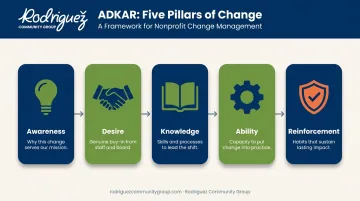
The most widely recognized framework for the "5 pillars" question is Prosci's ADKAR model, developed by founder Jeff Hiatt after studying change patterns across more than 700 organizations. It focuses on individual change, on the premise that organizations only change when the people inside them do.
That premise fits mission-driven organizations especially well, since so much of nonprofit work depends on relationships and trust. Applied to nonprofit organizations, the five ADKAR pillars break down like this:
| Pillar | What It Means for Nonprofits |
|---|---|
| Awareness | Build shared understanding of why the change is necessary, tied explicitly to the mission—not just operational logic |
| Desire | Cultivate genuine buy-in among staff, board, and volunteers rather than mandating compliance |
| Knowledge | Provide training so people understand new processes, tools, or roles before they're expected to use them |
| Ability | Translate knowledge into action through practice, resources, and realistic timelines that account for limited capacity |
| Reinforcement | Sustain the change through recognition, monitoring, and embedding new practices into daily culture |
Most stalled nonprofit change efforts break down at Ability or Reinforcement, not Awareness. Staff understand why a change is happening; they simply don't have the time or support to practice it consistently until it sticks.
Common Challenges in Nonprofit Change Management
Three obstacles show up again and again, regardless of what type of change is underway.
Limited Staff Capacity
Small teams are already juggling mission delivery with day-to-day operations. Adding a change initiative on top often stalls progress before it starts.
This isn't a minor concern. According to CEP's State of Nonprofits 2024 report, 95% of nonprofit leaders worry about staff burnout, and 79% say burnout has already hurt their organization's ability to deliver on its mission.
That's why RZCG's spin-off engagements—with clients like English Learners Success Forum and Climate Lead—are explicitly designed so transition work doesn't pull staff away from mission-critical activities.
Board and Leadership Alignment
Change that requires board approval, budget reallocation, or a shift in strategic direction can stall at the governance level. Boards aren't always ready for this. Only 29% of nonprofit boards have a written succession plan, and just 27% have an emergency executive-backup plan, per BoardSource's Leading with Intent report.
Resolving decision rights and board authority before a major transition begins avoids friction later.
Funder and Donor Communication
Transitions create uncertainty, and funders notice. Proactive, transparent communication protects the confidence that took years to build. Silence, even well-intentioned silence, tends to read as instability.
RZCG builds a funder communication plan into every transition engagement, mapping out key milestones before any announcement goes out.
A Step-by-Step Framework for Leading Change in Your Nonprofit
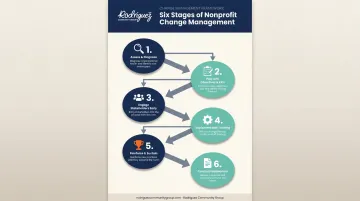
Structure beats improvisation. Here's a practical sequence that works across most nonprofit change scenarios, from leadership transitions to full organizational spin-offs.
- Assess and diagnose. Scan the environment and identify the specific need for change using data and stakeholder input—not assumptions.
- Plan with clear objectives and KPIs. Align the plan with mission priorities and set measurable success metrics before rollout begins.
- Engage stakeholders early. Build a communication plan, identify a change champion, and surface concerns before they become resistance.
- Implement with training and support. Roll out changes in phases, provide resources, and create feedback loops so problems surface quickly.
- Reinforce and sustain. Celebrate early wins, monitor adoption, and adjust the plan based on real-time feedback.
- Conduct a postmortem. Review what worked and what didn't. This step builds your organization's "change muscle" for the next transition.
A change champion doesn't need to be a senior executive. Often it's a program manager or operations lead who's trusted by peers and has the bandwidth to coordinate the details, someone embedded in daily work who can translate the plan into action.
Measuring Success and Knowing When to Seek Outside Support
Tracking a few key metrics tells you whether change is actually landing:
- Staff adoption rates — are people actually using new processes, or reverting to old habits?
- Program outcome improvements — has service quality held steady or improved through the transition?
- Stakeholder satisfaction — do staff, board members, and funders feel informed and confident?
Warning Signs You've Outgrown Internal Capacity
- Leadership bandwidth is stretched too thin to manage both daily operations and the transition
- No one on staff has dedicated change management expertise
- The stakes are unusually high, such as a merger, a funding cliff, or a fiscal sponsor spin-off
When Embedded Support Makes Sense
For organizations up to 50 staff and $25M in revenue, bringing in embedded outside support often works better than either muscling through internally or hiring a traditional consultant.
RZCG's model reflects this directly: team members like Bing Howell, Michael Hardiman, and Jana Luft bring hands-on change management expertise and work as integrated team partners, not outside consultants dropping in with a report.
That distinction matters in practice. When English Learners Success Forum needed to execute a fiscal sponsor spin-off while keeping its educational programs running, RZCG provided interim COO and CFO support to absorb the administrative burden, so staff could stay focused on serving English learners rather than standing up new back-office systems.
The Oakland REACH followed a similar path, bringing RZCG in during a senior staff transition to fill COO functions while the organization pursued growth beyond its original community.
In both cases, RZCG became part of the team long enough to get the organization safely to the other side of the change, rather than simply handing down recommendations from the outside.
Frequently Asked Questions
What are the 5 pillars of change management?
The five pillars come from Prosci's ADKAR model: Awareness, Desire, Knowledge, Ability, and Reinforcement. This sequence helps nonprofit staff, board members, and volunteers move through change without skipping the human side of the process.
What is the biggest reason nonprofit change initiatives fail?
Most failures trace back to a lack of stakeholder buy-in, poor communication early in the process, or insufficient reinforcement after rollout. Change that's announced rather than co-created rarely sticks.
How long does a nonprofit change management process typically take?
Timelines vary widely based on scope, from a few months for a process change to a year or more for a fiscal sponsor spin-off. Rushing stakeholder engagement or training almost always undermines the results.
Who should lead change management efforts in a nonprofit?
A designated change champion, often a program or operations lead, should coordinate day-to-day efforts alongside executive leadership and board support. Change led entirely from the top, without someone on the ground, tends to lose momentum.
How can small nonprofits manage change with limited staff?
Prioritize ruthlessly, roll out changes in phases rather than all at once, and consider embedded outside expertise to fill capacity gaps. This keeps mission-critical work protected while the transition unfolds.
What's the difference between change management and strategic planning?
Strategic planning sets the destination and goals; change management guides the people-focused process of actually getting there. You need both, but they answer different questions.