Many nonprofit leaders confuse this document with a strategic plan, or simply don't know where to start. That confusion costs real opportunities. Vague executive summaries, unrealistic budgets, and boards left out of the process all weaken grant applications and stall growth.
This guide walks through legal structure decisions, the core sections funders expect, and an underused prioritization tool, the 80/20 rule, that rarely gets explained in standard nonprofit templates.
Key Takeaways
- A nonprofit business plan pairs mission clarity with financial and operational rigor
- Legal structure choice shapes governance, tax status, and the Organizational Overview section
- Funders expect six core sections: summary, overview, programs, finances, operations, appendix
- The 80/20 rule flags donor concentration risk and helps prioritize high-impact programs
- Treat the plan as a living document, reviewed annually with board and staff input
Why Every Nonprofit Needs a Business Plan
For-profit business plans focus almost entirely on profitability. Nonprofit business plans have to do double duty: prove mission impact and financial viability, side by side, in the same document.
Funders pay close attention to the financial side. Candid, one of the largest nonprofit research organizations, notes that most funders require a budget as part of a grant application, and that reviewers frequently look at the budget before reading anything else. A business plan is what makes that budget credible instead of guesswork.
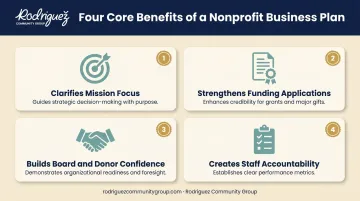
A well-built plan delivers four concrete benefits:
- Clarifies mission focus by forcing leaders to articulate what the organization actually does and for whom
- Strengthens funding applications by giving grantmakers the financial and programmatic detail they're already looking for
- Builds board and donor confidence through documented governance and financial oversight
- Creates staff accountability by tying programs to specific outcomes and budgets
Delivering on those four benefits takes real planning capacity, and small nonprofits often lack that bandwidth while running programs day to day. That's where firms like Rodriguez Community Group come in. Rather than parachuting in as outside consultants, RZCG works as an embedded partner. The team helps organizations with up to 50 staff and $25M in revenue build planning infrastructure without pulling staff off mission-critical work.
That distinction matters more than it sounds. A consultant who disappears after handing over a PDF leaves an organization with a document. A team that stays through implementation leaves an organization with a plan that actually gets used.
Choosing the Best Legal/Business Structure for a Nonprofit Organization
Your legal structure isn't a formality. It determines what governance section you'll write, what tax benefits you can offer donors, and what compliance obligations show up in your plan.
501(c)(3): The Default for Charitable Nonprofits
Most charitable organizations file for 501(c)(3) status. The IRS requires the entity to be organized and operated exclusively for exempt purposes, such as charitable, educational, religious, or scientific work. A few rules matter most:
- No private inurement (earnings can't benefit insiders)
- No substantial lobbying or political campaign involvement
- Annual Form 990 filing to maintain public transparency and compliance
In exchange, donors get tax-deductible contributions, which is often the single biggest fundraising advantage a nonprofit has.
Alternative Structures Worth Considering
| Structure | Best fit | Key tradeoff |
|---|---|---|
| 501(c)(4) | Advocacy-focused organizations | Lobbying can be the primary activity, but donations generally aren't tax-deductible |
| Fiscal sponsorship | New initiatives testing viability | Sponsor holds legal/fiduciary control; no independent incorporation needed yet |
| Unincorporated association | Very early-stage groups | Simple to form, but state law governs liability and property rights |
Fiscal sponsorship deserves a closer look if you're not ready to incorporate. Under a comprehensive sponsorship (Model A), your project becomes a program of the sponsor, who holds full legal responsibility. Under a pre-approved grant relationship (Model C), your project stays a separate entity while the sponsor manages restricted funds. RZCG works with organizations navigating exactly this shift, helping fiscally sponsored projects build the governance and financial infrastructure needed to spin off into independent nonprofits.
State incorporation and registration requirements vary widely, so check your specific state's rules before finalizing anything. Whatever structure you land on will directly shape your plan's Organizational Overview, governance model, and compliance section.
Talk to an attorney or nonprofit-focused advisor before incorporating or filing for tax-exempt status. Getting this wrong on paper is far more expensive to fix than getting advice upfront.
The Essential Components of a Nonprofit Business Plan
Regardless of size or cause area, most funders and grantmakers expect the same general structure. The National Council of Nonprofits outlines a similar set of core elements, so follow that convention closely rather than improvising.
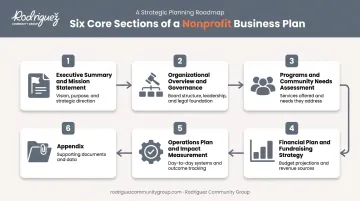
Executive Summary and Mission Statement
This section summarizes your mission, top programs, and funding needs in one to two pages. Write it last, even though readers see it first. You can't summarize a plan you haven't finished writing yet.
Organizational Overview and Governance Structure
Cover your founding history, board of directors, leadership team, and how governance responsibilities are divided between board and staff. Funders read this section to gauge stability, not just intent.
Firms like Rodriguez Community Group specialize in helping small nonprofits formalize this exact process, particularly organizations spinning off from a fiscal sponsor and standing up a board and executive structure for the first time.
Programs, Services, and Community Needs Assessment
For each program, list:
- The specific purpose it serves
- The target population
- The delivery method (in-person, virtual, hybrid)
- Measurable outcomes you're tracking
Back the section with credible data showing the community need or service gap you're addressing. A program description without evidence of need reads as an assumption, not a plan.
Financial Plan, Budget, and Fundraising Strategy
This is usually the section funders scrutinize hardest. Include:
- One-to-three-year budget projections
- Diversified funding sources: grants, individual donors, earned revenue
- Cash flow forecasts
Nonprofits should also maintain four core financial reports:
- Statement of financial position
- Statement of activities
- Statement of cash flows
- Functional expense analysis, which can appear as its own statement or within the notes depending on your accounting approach
Building these systems from scratch is exactly the gap RZCG's strategic finance work fills for smaller organizations, giving staff without a full-time CFO the forecasting tools and reporting structure funders expect to see.
Operations Plan and Impact Measurement
Describe staffing and volunteer roles, the systems that support daily work, and the KPIs and reporting cadence used to track mission impact. Funders want to see that impact measurement isn't an afterthought bolted onto the budget.
Appendix
Include supporting documents such as:
- IRS determination letter
- Board member bios
- Organizational chart
- Sample financial statements
Applying the 80/20 Rule to Strengthen Your Nonprofit Business Plan
The Pareto Principle, better known as the 80/20 rule, says a small share of inputs typically drives most outcomes. In nonprofit fundraising, that usually means a minority of donors generate the majority of contributed revenue.
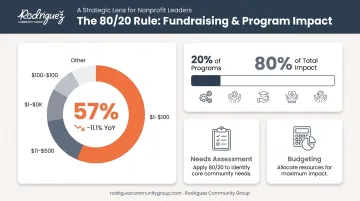
Recent data backs up the concentration concern, even without a fixed universal split. The Fundraising Effectiveness Project's Q1 2025 report found that donors giving between $1 and $100 made up 57% of all donors, yet that segment's count fell 11.1% year over year.
Translation: your small-donor base is shrinking, and your revenue is leaning harder on fewer, larger gifts.
This principle applies to programs too. Roughly 20% of your activities are probably driving 80% of your actual mission outcomes. A business plan that treats every program as equally important spreads staff time and funding too thin to be effective anywhere.
Use 80/20 analysis at two points in your planning process:
- Needs assessment: identify which programs produce the most measurable impact relative to cost
- Budgeting: analyze your own donor file for revenue concentration by gift size
If your analysis reveals heavy reliance on a handful of major donors, your financial plan needs an explicit donor-diversification strategy. Losing one or two large gifts shouldn't threaten your organization's survival, and funders will notice if your plan doesn't address that risk directly.
Common Mistakes to Avoid When Writing a Nonprofit Business Plan
Even well-intentioned plans fall into predictable traps:
- Generic mission statements. If your mission language could apply to five other organizations serving the same cause, it's not differentiating you at all.
- Unrealistic financial projections. Numbers not grounded in actual fundraising history or capacity get flagged fast by experienced grant reviewers.
- Treating the plan as a one-time document. Programs, funding, and community needs shift, so a plan shelved after one draft goes stale within a year.
- Skipping board and staff input. A plan drafted in isolation, without buy-in from the people who'll execute it, tends to sit unused.
That same financial-projection mistake extends past the planning stage. Budgets are financial plans, not guarantees, so compare actual results against budget throughout the year and adjust as conditions change.
Frequently Asked Questions
What is the best legal/business structure for a nonprofit organization?
501(c)(3) status is most common for charitable nonprofits and enables tax-deductible donations. Fiscal sponsorship or 501(c)(4) status may suit advocacy-focused or early-stage groups better. Consult an attorney before filing.
What is the 80/20 rule for nonprofits?
It typically describes how a small share of donors or programs drives the majority of revenue or mission impact. Recognizing this pattern helps leaders prioritize resources and address donor concentration risk.
How long should a nonprofit business plan be?
Length varies by organization size, but most nonprofit business plans run 10-20 pages plus appendices, with the executive summary kept to one or two pages.
How often should a nonprofit update its business plan?
Review it annually, ideally tied to your fiscal year and board budget approval process. Programs and funding sources change too quickly for a plan to stay accurate longer than that.
What's the difference between a nonprofit business plan and a strategic plan?
A strategic plan sets long-term direction, values, and goals. A business plan operationalizes those goals with financial projections, staffing detail, and program specifics.
Do I need a business plan to apply for 501(c)(3) status?
The IRS doesn't explicitly require a document titled "business plan," but Form 1023 does require detailed activity narratives and financial projections. Many funders separately request a full plan regardless.