
That's where the fractional CFO model comes in. A fractional CFO provides executive-level financial guidance on a part-time or contract basis, giving mission-driven organizations access to strategic finance leadership without the commitment of a permanent hire.
This post answers the questions nonprofit leaders most commonly face: what a fractional CFO actually does, how to know when your organization is ready, what the engagement typically looks like, and how to find the right partner.
Key Takeaways
- A fractional CFO brings senior-level financial strategy to your organization on a part-time basis, including forecasting, financial controls, and leadership, not bookkeeping
- The right time to bring one in is typically during rapid growth, ahead of a major funding cycle, or when financial complexity is pulling focus from your mission
- Engagement scope typically depends on organizational size and financial complexity
- Core responsibilities include forecasting, cash flow management, board reporting, and compliance oversight
- Strong fractional CFOs embed within your team: they operate as internal partners, not outside consultants
What Is a Fractional CFO?
A fractional CFO is a senior finance executive who provides CFO-level strategic guidance on a part-time or contract basis. They typically work with several organizations at once, which lets nonprofits and mission-driven organizations access executive-caliber financial leadership without a full-time hire.
How the Role Differs from Controller and Bookkeeper
These three roles are frequently confused, and conflating them can leave an organization with the wrong level of support at a critical moment.
| Role | Primary Focus |
|---|---|
| Bookkeeper | Records day-to-day transactions; accounts payable and receivable |
| Controller | Manages accounting accuracy, financial records, and the close process |
| Fractional CFO | Forward-looking strategy: forecasting, cash flow, funding, and organizational decision-making |
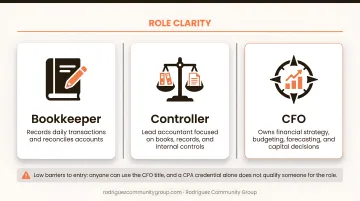
As NetSuite describes it, controllers are lead accountants focused on books and records, while CFOs are responsible for overall financial strategy and forward-looking activities like budgeting, forecasting, and capital decisions.
That distinction matters when vetting candidates. The fractional CFO market has low barriers to entry: anyone can use the title, and a CPA credential alone does not qualify someone for the role.
What to Look For Beyond the Title
Look past credentials and assess actual career history:
- Prior CFO-level roles (not just controller or accounting positions)
- Experience with small nonprofits or mission-driven organizations
- Ability to communicate financial strategy clearly to non-financial board members and funders
Signs Your Nonprofit Is Ready for a Fractional CFO
Most organizations wait too long. Here's what to watch for before the gap becomes a crisis.
1. Growth Is Outpacing Your Financial Infrastructure
When program expansion is moving faster than your team's ability to forecast cash flow, build budgets, or report to your board, that gap creates real risk. A fractional CFO can build the structure without requiring a permanent hire.
2. You're Preparing for Major Fundraising
Approaching major donors, applying for government grants, or launching a capital campaign all require financial models and reporting systems that instill funder confidence. This is a high-stakes moment where financial presentation directly affects outcomes.
3. You Can't Answer Basic Liquidity Questions
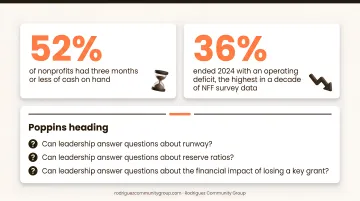
According to the Nonprofit Finance Fund's 2025 State of the Nonprofit Sector Survey, 52% of nonprofits had three months or less of cash on hand, and 36% ended 2024 with an operating deficit, the highest in a decade of NFF survey data. If your leadership can't quickly answer questions about runway, reserve ratios, or the financial impact of losing a key grant, your organization is making decisions without the information it needs.
4. You're Approaching an Audit or Compliance Threshold
Organizations expending significant amounts in federal awards in a fiscal year must complete a Single Audit under federal Uniform Guidance. State thresholds vary: California and New York each set their own gross revenue triggers.
IRS Form 990 requirements also step up once gross receipts or assets reach certain levels. A fractional CFO can establish the internal controls and governance frameworks that protect your organization before you cross these lines.
5. Financial Questions Are Consuming Executive Time
If you're spending significant hours each week on financial questions instead of programs and stakeholder relationships, your highest-value work is getting crowded out. Financial leadership support puts you back where you're needed: with your programs, your donors, and your team.
What a Fractional CFO Does for Mission-Driven Organizations
A fractional CFO's work falls into four core areas. None of them involve recording transactions or filing taxes.
Financial Strategy and Planning
This means developing multi-year financial plans, scenario models, and budgets that align with the organization's program goals. A strong fractional CFO integrates the mission and theory of change into the financial model, not just standard accounting templates. The goal is a financial plan that reflects what the organization is trying to accomplish.
Cash Flow Management
In a nonprofit context, this includes monitoring liquidity, timing grant drawdowns, managing restricted and unrestricted fund allocations, and ensuring the organization never hits a cash crunch mid-program. With 85% of nonprofits expecting service demand to increase and 86% reporting high costs due to inflation, according to NFF's 2025 survey, cash flow visibility is non-negotiable.
Board Reporting and Communications
Non-financial board members can't govern what they can't understand. A fractional CFO builds reporting cadences and dashboards that translate numbers into narrative, connecting financial data to organizational performance and mission impact. Good board reporting supports governance and demonstrates accountability to funders.
Risk Management, Compliance, and Team-Building
Beyond strategy and reporting, fractional CFOs address the operational foundations that protect an organization's long-term health:
- Identify internal control gaps and support audit preparation
- Ensure regulatory compliance with IRS Form 990 requirements, grant covenants, and funder reporting timelines
- Right-size the finance function by recommending the right tools and helping hire or develop internal staff at each growth stage
Rodriguez Community Group (RZCG) applies this model directly. The team embeds experienced financial and operational leaders into client organizations, working as integrated partners rather than outside consultants, so CFO-level guidance connects to broader strategic planning and operations.
Clients like English Learners Success Forum and The Oakland REACH have received strategic finance support alongside interim executive leadership, with financial systems built to sustain the organization's independence long after the engagement ends.
Fractional CFO vs. Full-Time CFO: Scope and Commitment
Here's a direct comparison of the two models:
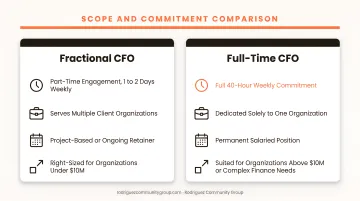
| Factor | Fractional CFO | Full-Time CFO |
|---|---|---|
| Commitment | Part-time, flexible scope | Permanent executive |
| Flexibility | Scales to organizational stage | Fixed role |
| Availability | Typically immediate | Recruitment timeline |
| Best for | Smaller and mid-sized nonprofits | Sustained growth with daily finance needs |
What Does the Engagement Actually Look Like?
For fractional arrangements, current market benchmarks from providers including Forbes and provider guides point to a typical range of engagement models: hourly billing for smaller or ad hoc needs, and monthly retainers for ongoing strategic support.
Compare that to full-time CFO compensation. According to the 2026 Career Blazers Nonprofit Compensation Report, CFO/VP Finance salaries scale meaningfully with organizational revenue size, before factoring in employer taxes and benefits costs.
For a smaller nonprofit, the gap between a fractional engagement and a full-time hire can represent substantial annual savings: money that stays in the mission. That math is also what makes the transition decision worth thinking through carefully.
When to Transition to a Full-Time Hire
Moving from fractional to full-time isn't a sign the fractional model failed. It's a sign the organization has grown. Consider a full-time CFO when:
- Revenue has sustained at a level requiring daily financial oversight
- The finance team has grown large enough to need a permanent manager
- Reporting complexity has increased significantly (multiple funding streams, major federal grants)
- You're preparing for a merger, major expansion, or structural transition
How to Find, Vet, and Hire the Right Financial Partner
The right fractional CFO engagement starts before you ever review a single resume. Two decisions made upfront, what you actually need and where to look, determine whether the hire succeeds or stalls.
Defining Your Needs First
Before starting any search, clarify what you actually need:
- Is the priority strategic (fundraising modeling, scenario planning) or operational (audit prep, cash flow systems)?
- How many hours per month is realistic given your capacity?
- Is this a short-term project or an ongoing advisory relationship?
Clear answers to these questions prevent scope creep and wasted time on both sides.
Where to Find Qualified Candidates
- Referrals from trusted advisors, board members, or peer nonprofit leaders
- Specialty firms that provide fractional executive leadership specifically to mission-driven organizations: RZCG provides this kind of embedded fractional support to nonprofits and small mission-driven organizations, operating as a team partner rather than an external advisor
- Professional networks and platforms that vet executive-level candidates
Red Flags to Avoid
Watch for these common hiring mistakes:
- Unusually low rates often signal controller- or bookkeeper-level service, not CFO-level strategy, so don't hire on cost alone
- No defined KPIs means neither side knows if the engagement is working, so set measurable goals before signing anything
- If your fractional CFO is handling transaction-level work, you're paying for CFO-level strategy but getting bookkeeper-level output, so protect their time for strategic decisions
- A fractional CFO who isn't connected to your executive director and board can't do the work that matters, so integrate them with leadership from day one
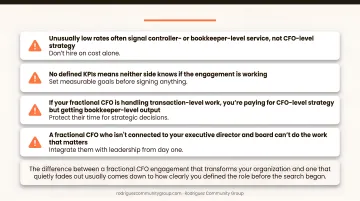
The difference between a fractional CFO engagement that transforms your organization and one that quietly fades out usually comes down to how clearly you defined the role before the search began.
Frequently Asked Questions
Is a fractional CFO worth it?
For early-stage nonprofits and mission-driven startups, yes. A fractional CFO requires a far smaller commitment than a full-time hire, while the consequences of financial mismanagement, including lost grants, failed audits, and damaged funder relationships, far exceed the value of that engagement.
What does a fractional CFO do for a nonprofit?
Core functions include:
- Building budgets and financial models
- Managing restricted and unrestricted fund reporting
- Preparing for audits and supporting funder communications
- Helping executive leadership make data-informed decisions
When is the right time to hire a fractional CFO?
The right time is typically when the organization is scaling rapidly, approaching an audit threshold, preparing for a major fundraising campaign, or when financial questions are consuming more executive leadership time than program work.
What's the difference between a fractional CFO and a financial controller?
A controller manages the accuracy and integrity of financial records and the close process. A fractional CFO operates at the strategic level, using those records to guide planning, forecasting, fundraising decisions, and board governance. They're complementary roles, not interchangeable ones.
Can a fractional CFO help with grant management and restricted fund compliance?
Yes. Experienced nonprofit fractional CFOs handle restricted fund tracking, funder reporting timelines, and grant covenant compliance, areas where financial missteps can directly cost an organization future funding.