
In every case, the question is the same: what happens next?
Many nonprofits treat this moment as a crisis rather than a milestone. Staff scramble, boards panic, and funders lose confidence, all because there was no documented plan for the transition. A nonprofit exit strategy solves this problem before it becomes one.
This isn't just about leadership succession. It covers how an organization plans to conclude a program, merge with another nonprofit, spin off a business unit, or wind down entirely, all while protecting the impact already built. This guide walks through the exit strategy types available, a practical framework for preparing one, a realistic five-year timeline, and real examples of nonprofits that got it right.
Key Takeaways
- An exit strategy is a documented plan, not a scramble from a funding cliff or sudden departure
- Five exit paths: program graduation, merger, spin-off, leadership succession, and dissolution
- Start planning 2-5 years before an anticipated transition, not months
- Stakeholder-inclusive planning protects community trust, staff morale, and program continuity
What Is a Nonprofit Exit Strategy (and Why It Matters)?
A nonprofit exit strategy is a documented plan describing how an organization, program, or leader will conclude their involvement while preserving sustainability for the community served. It's proactive by design, built and revisited well before the actual transition date arrives.
There's an important distinction most nonprofits miss:
| Exit Type | What It Involves |
|---|---|
| Organizational or program exit | Sunsetting a program, merging with another entity, spinning off a division, or dissolving entirely |
| Leadership exit | An Executive Director or CEO transition, which requires its own succession policy separate from any broader organizational exit |
Conflating the two creates confusion. A board preparing for an ED's retirement needs a succession policy. A board deciding whether to close a program after its funding ends needs an entirely different set of financial and legal considerations.
The planning gap is significant. BoardSource's 2021 Leading with Intent report found that only 29% of surveyed organizations had a written succession plan or policy to guide the board through a CEO/ED transition. That leaves roughly 71% without one, meaning most boards are improvising during one of the highest-stakes moments an organization will face.
Closing that gap means giving exit planning the same rigor nonprofits already apply to program design and fundraising.
Common Nonprofit Exit Strategy Options
Exit strategies exist on a spectrum. On one end, a graceful handoff where local partners take over seamlessly. On the other, full closure. The right choice depends on your theory of change and funding model, not just your bank balance.
Program Graduation or Sustainability Handoff
This model applies when a nonprofit exits a community or program once local capacity, infrastructure, or governance is strong enough to sustain the work independently. The goal is a deliberate transfer of ownership once the receiving community or institution can carry the mission forward without the original sponsor.
Merger or Acquisition by Another Mission-Aligned Nonprofit
Merging with another organization can preserve programs and jobs while solving capacity, funding, or scale problems that neither organization could solve alone. This happens more often than most people assume. Bridgespan's study of nonprofit mergers and acquisitions reviewed 11 years of filings across four states and identified more than 3,300 nonprofit M&A deals, confirming mergers function as a routine strategic tool rather than a last resort.
Spin-Off or Independent Incorporation
A program housed within a parent institution or fiscal sponsor becomes its own separate legal nonprofit once it reaches sufficient scale or complexity. This is one of the most common transitions RZCG supports. Fiscal sponsorship works well early on, but at a certain point, a program outgrows the arrangement and needs its own governance, finance structure, and staffing model.
Leadership Succession or Executive Transition
ED or CEO transition is the most common "exit" nonprofits plan for, and it requires its own succession policy, separate from a full organizational exit. This includes both planned departures (retirement, new opportunity) and unplanned ones (sudden resignation, medical leave).
Voluntary Dissolution or Wind-Down
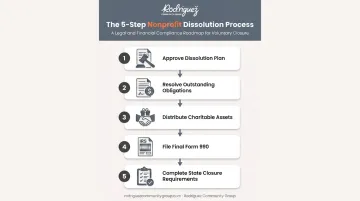
Full closure is appropriate when the mission has been achieved or funding is no longer sustainable. Basic steps include:
- Approve a dissolution plan following your governing documents and state law
- Resolve outstanding obligations, including debts, contracts, and restricted funds, before distributing any remaining assets
- Distribute charitable assets properly to another 501(c)(3) or government entity for a public purpose
- File a final Form 990 with the "final return/terminated" box checked, generally due by the 15th day of the fifth month after termination
- Complete state closure requirements, which vary by state and may include attorney general notice and articles of dissolution
None of this replaces legal counsel. Confirm your specific state and organizational requirements before filing anything.
How to Prepare a Nonprofit Exit Strategy: A Step-by-Step Framework
Effective exit preparation works like a flexible, indicator-based checklist, not a rigid date on a calendar. Here's how to build one.
Step 1: Define the Trigger and Desired End State
Is this exit planned (mission completion, a leadership change you've seen coming) or unplanned (funding loss, a crisis)? Define what a "good exit" looks like in measurable terms before you do anything else.
Step 2: Assess Organizational, Financial, and Program Readiness
Evaluate three things honestly:
- Financial reserves: Can the organization or a successor absorb the transition without a service gap?
- Program sustainability: Will the outcome hold without your continued direct involvement?
- Staff and board capacity: Identify who carries institutional knowledge forward, and confirm they're ready for it.
Step 3: Build a Flexible Exit Checklist With Clear Indicators
Rather than betting everything on a single date, create measurable indicators across governance, finance, and service delivery. The C-SAFE exit-strategy framework, created for international aid programs, recommends starting this work early in a program's life, not at the end. For a five-year program, it recommends having the exit strategy drafted within the first six months.
Step 4: Engage Board, Staff, Funders, and Community Stakeholders Early
Communicate transparently and in phases, starting with the board and moving outward to staff, then funders, then the broader community. This is where small nonprofits often stumble; there's simply no internal capacity to run a communication plan on top of daily operations.
This is the gap an embedded advisory partner fills. RZCG's team-based model integrates directly into the client's operations, absorbing the coordination workload so staff can keep their attention on programs rather than transition logistics.
Step 5: Document Institutional Knowledge and Monitor the Transition
Build a transition binder covering key contacts, financial processes, program data, and vendor relationships. Then don't walk away immediately. Build in a post-exit monitoring period to confirm sustainability actually holds once you've stepped back.
What Does a 5-Year Nonprofit Exit Strategy Timeline Look Like?
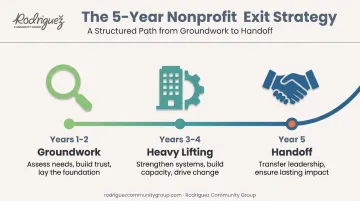
A realistic timeline unfolds in three phases:
- Years 1-2 (Groundwork): Conduct capacity assessments, develop exit-readiness indicators, and begin confidential conversations with key stakeholders. Nothing goes public yet.
- Years 3-4 (Heavy Lifting): Build capacity in successor leadership, partner organizations, or local authorities while phasing down direct involvement.
- Year 5 (Handoff): Execute the formal transition, merger, or leadership change, then monitor to confirm the shift holds long-term.
For leadership transitions specifically, Bridgespan's guidance for departing nonprofit CEOs recommends beginning succession planning two to three years before departure, with one year as an absolute minimum. That timeline overlaps with the shift from Phase 1 to Phase 2 above: departure-specific planning should start around Year 2 or 3 if the departure date is already known.
Nonprofit Exit Strategy Example in Action
Program spin-off: The English Learners Success Forum needed both short-term operational leadership and a fiscal sponsorship spin-off executed quickly. RZCG helped define the organization's staffing needs, then ran a search for a permanent COO while building the spin-off's operational systems in parallel.
Follow-on interim CFO support continued once the transition was complete. This dual-track approach, hiring permanent leadership while standing up new infrastructure, kept ELSF's programmatic work moving without interruption.
Comprehensive spin-off with leadership handoff: The Scientific Philanthropy Alliance needed a full spin-off covering organizational formation, governance, finance, human capital, operations, and change management. RZCG also ran an executive search for SPA's first-ever COO, structuring the engagement so the incoming leader could take ownership of the spin-off with RZCG's continued support. The result was a genuine leadership handoff, with the incoming COO taking full ownership of the spin-off going forward.
Leadership transition under pressure: When The Oakland REACH experienced a senior staff departure, RZCG's role expanded from an interim Chief of Staff position into a full interim COO function, including oversight of CFO activities. That flexibility kept operations stable while the organization pursued growth beyond its original footprint.
Organizations without in-house transition expertise often lean on an integrated advisory team precisely because these transitions touch legal, financial, governance, and staffing domains simultaneously. Trying to run all four in-house, on top of daily mission work, is where most exit plans stall out.

Frequently Asked Questions
How do you prepare an exit strategy for a nonprofit?
Start with a readiness assessment covering finances, program sustainability, and staff capacity. Then build a checklist with measurable indicators and engage your board, staff, and funders early and transparently.
What does a 5-year exit strategy for a nonprofit look like?
Years 1-2 focus on assessment and early stakeholder conversations. Years 3-4 build successor capacity while phasing down involvement. Year 5 executes the handoff with a monitoring period afterward.
What are common exit strategy options for nonprofits?
The five main paths are program graduation or handoff, merger with another nonprofit, spin-off into an independent entity, leadership succession, and voluntary dissolution.
What is an example of an exit strategy for a nonprofit?
The English Learners Success Forum's fiscal sponsorship spin-off is one example, where operational systems and a permanent COO search ran in parallel to complete the transition quickly without disrupting program work.
When should a nonprofit start planning its exit strategy?
Best practice is 2-5 years ahead of an anticipated program, funding, or leadership change. For leadership transitions specifically, two to three years is the recommended minimum runway.
Does closing or exiting a program mean the nonprofit failed?
No. A well-planned exit, especially one triggered by mission achievement or a successful local handoff, reflects sustainability and success rather than failure. What matters is the outcome achieved, not whether the organization itself continues to exist.