

Without written criteria, feedback tends to arrive as ambush — a list of grievances nobody mentioned during the year, delivered all at once. Worse, many boards disconnect the evaluation from compensation decisions entirely, leaving raises and bonuses to guesswork or inertia.
This guide breaks down exactly what belongs in an Executive Director Performance Evaluation Form and how to run the process fairly, from self-assessment through the final compensation conversation.
Key Takeaways
- A formal written review protects both the ED and the board from legal and operational risk.
- Four core categories should anchor every form: mission impact, financial stewardship, leadership, and board relations.
- Self-evaluation comes first, followed by board synthesis, then a structured discussion meeting.
- Compensation decisions need separate benchmarking data, not gut instinct.
Why a Formal Executive Director Performance Evaluation Form Matters
Overseeing the executive director is one of the board's core governance duties, not an optional extra. A written evaluation form creates a paper trail that protects the organization if a personnel dispute ever escalates, and it gives the ED clear, documented expectations to work against.
The gap here is bigger than most board members realize. According to BoardSource's 2021 Leading with Intent survey:
- 53% of chief executives reported receiving a formal, written evaluation in the prior 12 months
- 21% said they'd never received one at all
- 87% of organizations had a written job description for their ED
- Only 53% said the board's expectations for future performance were actually clear
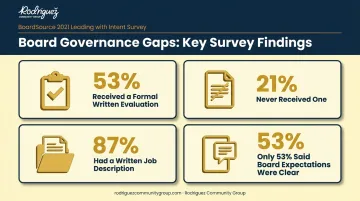
Most boards write down what the job is but never translate it into what "doing it well" looks like year over year.
Small nonprofits feel this gap acutely. They rarely have an HR department to build an evaluation process from scratch, and the board chair is often a volunteer juggling a full-time job elsewhere.
Rodriguez Community Group (RZCG) helps small nonprofit boards build exactly this kind of governance infrastructure, acting as an embedded partner to create the systems that should have existed from day one.
Key Categories to Include in Your Evaluation Form
A strong evaluation form organizes criteria into distinct categories instead of asking board members to rate a vague overall impression. Each category should map directly back to the ED's job description and the organization's current strategic plan.
Mission Impact and Program Outcomes
This section should ask the ED to report progress against specific strategic plan goals set at the start of the year, paired with program outcome data. Leave room for narrative context — a missed target because of a funding delay reads very differently than one caused by poor execution.
Good line items include:
- Progress against each strategic plan objective (rated individually, not averaged)
- Program outcome metrics tied to the organization's own theory of change
- Narrative space explaining variance between goal and result
Financial Stewardship and Fiscal Management
This is where board members without a finance background often struggle to assess objectively. A budget surplus doesn't automatically mean good stewardship, and a deficit doesn't automatically mean poor management. Context matters.
Include line items for:
- Budget-to-actual performance and trend lines over multiple years, not a single snapshot
- Audit status and resolution of any prior findings
- Funding diversification (dependency on any single funder or revenue stream)
- Internal financial controls and reporting timeliness
Boards evaluating this category without comparative data are guessing. RZCG's finance practice, led by team members with backgrounds in financial management and compliance, works with boards to build the forecasting and reporting structures that make this section assessable. Without that groundwork, it's often the section board members quietly skip.
Leadership, Staff Management, and Organizational Health
Cover staff retention, culture, and the state of internal systems here. Include a dedicated field asking board members to distinguish between conditions the ED inherited (a toxic culture left by a predecessor, for example) and outcomes the ED directly owns through their own decisions. Skipping this distinction is one of the fastest ways to produce an unfair review.
Board Relations and External/Community Relations
The final two rated categories should cover communication responsiveness and quality of board reporting, along with presence and relationship management with funders, partners, and the community.
Across every category, use a consistent 1-5 rating scale paired with a mandatory comment field next to every score. A number alone tells you nothing about whether the board is scoring documented performance or just a feeling.
Step-by-Step Process for Using the Evaluation Form
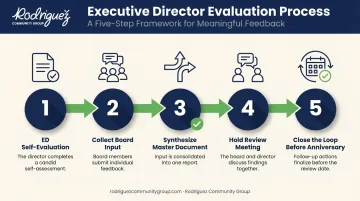
Standard governance practice delegates the evaluation to a small committee or the board chair, not the full board acting directly. That committee coordinates the process and synthesizes input before anyone sits down with the ED.
- ED self-evaluation first. The ED completes the identical form, referencing the prior year's goals and their job description, before the board's version is even drafted.
- Collect individual board input. Each board member completes the form independently. Some organizations add structured 360 feedback from senior staff, but BoardSource notes this should stay a confidential, separate input stream rather than being merged into the board's official score.
- Synthesize into one master document. The committee combines individual responses, flags where scores diverge sharply, and drafts a single narrative report.
- Hold the review meeting. Compare the self-evaluation against the board's synthesis. Discuss where the two align and where they diverge, then agree on SMART goals for the coming year.
- Close the loop before the anniversary date. Complete the full cycle, including any compensation decision, before the ED's employment anniversary. Delays here erode trust fast.
Choosing the Right Rating Scale and Evaluation Format
Effective forms blend two types of metrics, and boards that rely on only one type end up with a distorted picture.
| Metric type | Examples | Why it matters |
|---|---|---|
| Quantitative | Fundraising goals met, donor growth, program enrollment numbers | Easy to track year over year, but tells only part of the story |
| Qualitative | Leadership judgment, relationship-building, decision-making under pressure | Captures how results were achieved, not just whether they were |
Require written evidence behind every numeric rating. A "4" with no supporting comment is a guess dressed up as data. A "4" with a sentence explaining the specific decision or outcome behind it is something the board can actually defend later.
This same discipline applies to the form's structure itself. Keep these elements consistent year over year:
- Rating scale definitions and numeric ranges
- Core competency categories being assessed
- Weighting between quantitative and qualitative measures
Changing these elements annually makes it impossible to see whether the ED is genuinely improving, plateauing, or declining in specific areas.
Common Mistakes Boards Make When Evaluating an Executive Director
Crediting or blaming the ED for everything. Organizational results depend on staff, market conditions, and funding cycles — not the ED alone. BoardSource explicitly separates organizational performance from individual executive performance for this reason. A board that conflates the two either overpraises or unfairly punishes the person in the chair.
Saving up grievances for the annual meeting. If a board member has a concern in March, that concern belongs in a March conversation, not a November ambush. The evaluation meeting should confirm what the board has already discussed throughout the year, not introduce it for the first time.
Writing vague or unsubstantiated comments. Compare these two board comments:
- ❌ "Communication has felt off this year."
- ✅ "Board updates arrived late for three of four quarterly meetings, and the March budget report omitted the reserve fund balance."
The second version is specific, documented, and gives the ED something concrete to act on. The first is just a feeling with a byline.
Connecting the Evaluation to Compensation Decisions
The annual evaluation cycle is the natural container for the compensation conversation, but performance discussion and pay decisions should still function as two distinct steps within that meeting. Finish evaluating performance completely before anyone raises numbers.
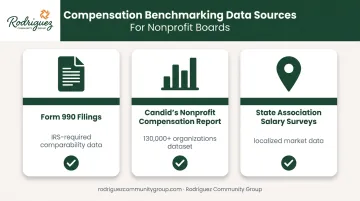
When it's time to talk pay, anchor the decision in external data rather than instinct:
- Form 990 filings from comparable organizations, which the IRS instructs nonprofits to complete using independent approval and documented comparability data
- Candid's Nonprofit Compensation Report, which draws on data from more than 130,000 organizations segmented by budget size and location
- State nonprofit association salary surveys, which often reflect more localized market conditions than national data
Boards should document who approved the decision, what comparable data they reviewed, and when the decision was finalized. RZCG helps small nonprofit boards build this kind of defensible compensation and financial controls process alongside their evaluation cycle. The payoff: a raise or bonus decision that holds up to scrutiny from funders, auditors, or the IRS.
Frequently Asked Questions
How do you evaluate a nonprofit executive director's performance?
Boards use a written form covering mission impact, financial stewardship, leadership, and board relations. Combine that with an ED self-evaluation and a documented in-person discussion to compare perspectives and set goals.
What should you avoid saying in a nonprofit executive director performance evaluation?
Avoid vague, personal, or unsubstantiated comments like "communication felt off." Stick to specific, evidence-backed feedback tied to documented outcomes and agreed-upon criteria.
What is a typical severance package for a small nonprofit executive director?
Severance varies widely by tenure, organization size, and circumstances of departure, with no reliable universal benchmark. Reference the ED's employment contract and comparable sector data rather than an arbitrary figure.
How often should an executive director be evaluated?
Conduct one formal, written annual review, supplemented by brief check-ins throughout the year. Regular informal conversations prevent the annual review from becoming a surprise session.
Who should conduct the executive director's performance evaluation?
A small evaluation committee or the board chair typically leads the process. They gather input from the full board and synthesize it into one master document before meeting with the ED.
Should the executive director complete a self-evaluation as part of the process?
Yes. The ED's self-evaluation should be submitted before or alongside the board's assessment, using the identical form. This ensures the discussion reflects two-sided, balanced input rather than the board's view alone.