The numbers back up the anxiety. In Nonprofit Finance Fund's 2025 State of the Nonprofit Sector Survey, 18% of respondent organizations reported having one month or less of cash on hand, and 52% had three months or less. Separately, a nationally representative survey of 501(c)(3) public charities found that 21% lost government funding in early 2025, with 27% experiencing a delay, pause, or freeze.
This guide breaks down what financial sustainability actually means, why it matters beyond the balance sheet, and the concrete steps nonprofit leaders can take to build it.
Key Takeaways
- Financial stability means paying today's bills; sustainability means surviving a five-year funding shock.
- Organizations that experienced government funding disruptions were far more likely to cut staff, programs, or services.
- A commonly used reserve goal is 3-6 months of operating expenses, adjusted for revenue reliability.
- Board oversight, revenue diversification, and mission-aligned budgeting work together, not in isolation.
- Most small and mid-sized nonprofits need embedded financial expertise to execute a plan, not just a report.
What Is Nonprofit Financial Sustainability?
Financial sustainability is an organization's ongoing, strategic ability to maintain financial health, manage risk, and fund its mission over the long haul. It's not about covering this month's payroll. It's about knowing you'll still be operating five years from now, regardless of what happens to any single funding source.
That distinction matters more than most nonprofits realize.
Financial Stability vs. Financial Sustainability: What's the Difference?
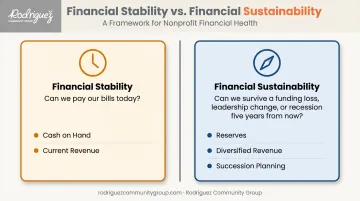
The difference comes down to two questions:
- Stability: Can we pay our bills today?
- Sustainability: Can we weather a funding loss, a leadership departure, or a recession five years from now?
Here's where this distinction gets real. An organization can look financially stable with a healthy bank balance today, while being deeply unsustainable if 90% of that revenue comes from a single grant expiring next year.
Researcher Woods Bowman's foundational framework on nonprofit financial capacity draws this same line: short-term financial health measures resiliency to immediate shocks, while long-term sustainability measures the ability to maintain services and assets over time.
Every financial decision your organization makes, whether it's starting a reserve fund, setting a spending policy, or negotiating a multi-year grant, should tie back to mission and community alignment. Donors and boards trust organizations that can explain why a financial choice serves the mission, not just the bottom line.
Why Financial Sustainability Matters for Nonprofit Impact
Sustainability isn't an abstract finance concept; it directly shapes whether programs survive a bad year.
Consider what happened when federal funding got disrupted in early 2025. Among nonprofits that experienced funding disruptions, 29% reduced total employees, 23% reduced programs, and 21% served fewer people. Planned layoffs jumped to 15% among disrupted organizations, compared to just 7% across all organizations surveyed.
Sustainable nonprofits absorb these shocks differently:
- They draw on operating reserves instead of laying off staff mid-crisis
- They pivot programming without abandoning core services
- They keep leadership focused on mission, not emergency fundraising
There's also a trust dimension: Independent Sector's research found public trust in nonprofits rose to 57% in 2024, with 74% of Americans saying transparency about fund usage positively affects their trust. Boards and major donors want the same reassurance: proof the organization will exist long enough to deliver on its promises.
Without that stability, organizations slide into what practitioners call "survival mode." Staff spend disproportionate time firefighting cash-flow gaps instead of running programs. That's delayed collapse, and it erodes the community impact the organization exists to create.
Key Components of a Financially Sustainable Nonprofit
Nonprofit sustainability comes from several interlocking practices that reinforce each other, not any single initiative.
Revenue Diversification
Relying on one government grant or one major donor creates a single point of failure. If that source disappears, so does your budget.
Diversifying across grants, individual giving, corporate partnerships, and earned revenue reduces this vulnerability. That said, diversification isn't automatically protective.
Research using the Hirschman-Herfindahl Index on nonprofit revenue found mixed results depending on how streams were categorized. For some organizations, adding revenue types increased financial volatility instead of reducing it.
The takeaway: diversify deliberately, not reflexively. Weigh each new revenue source's reliability, restrictions, and administrative cost before adding it.
Healthy Operating Reserves
Propel Nonprofits recommends a commonly used goal of three to six months of operating expenses held in reserve, roughly 25-50% of your annual budget.
The right number depends on how reliable your revenue is. Organizations with steady contract or fee income can likely run leaner; those dependent on grants, events, or seasonal giving need more cushion.
One clarification: the "5% rule" sometimes mentioned in nonprofit finance conversations actually refers to the IRS minimum distribution requirement for private foundations, not an operating reserve benchmark for public charities.
Foundations that fail to distribute their required amount face a 30% excise tax, rising to 100% if uncorrected. Don't confuse the two.
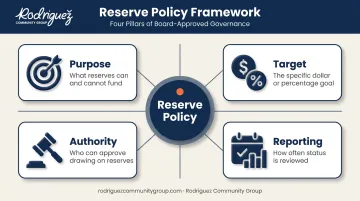
A board-approved reserve policy should define:
- Purpose – what reserves can and can't be used for
- Target – the specific dollar or percentage goal
- Authority – who can approve drawing on reserves
- Reporting – how often reserve status gets reviewed
Strong Governance and Board Financial Oversight
The board carries fiduciary responsibility for financial health. That means monitoring performance, setting reserve and investment policies, and holding leadership accountable through regular reporting, not rubber-stamping numbers once a year.
Boards without deep financial expertise in-house often bring in interim CFO support or outside advisors to strengthen this oversight, particularly during growth phases or leadership transitions.
Strategic Budgeting Tied to Mission
Budgets built on wishful thinking, rather than realistic revenue forecasts, feed what's known as the nonprofit starvation cycle. Funders expect artificially low overhead, so nonprofits underreport costs to match, leaving infrastructure underfunded. One analysis found four organizations reporting overhead rates of 13-22%, when their actual costs ran 17-35%.
A practical benchmark some finance practitioners use is keeping any single revenue source under roughly one-third of total income.
This figure often gets conflated with IRS public-support thresholds for 501(c)(3) classification, which are a separate legal test, not a general financial management rule. Either way, the underlying discipline, budgeting for the full cost of your mission, holds up.
Common Roadblocks to Nonprofit Financial Sustainability
Most organizations don't lack the desire to be sustainable. They run into structural obstacles.
- Over-dependence on one or two funding sources – particularly a single government grant or major donor whose renewal isn't guaranteed
- Leadership and board turnover without a continuity plan – BoardSource's 2021 Leading with Intent research found only 27% of organizations had a written executive succession plan
- Limited financial literacy among staff and board – leading to reactive decisions instead of strategic ones
- Weak retention systems – despite tracking retention metrics, only 23% of nonprofits maintain a formal retention strategy
These roadblocks compound. An organization without a succession plan that also lacks financial literacy at the board level is often the last to notice a revenue problem until it's already a crisis.
How to Build a Nonprofit Financial Sustainability Plan
A sustainability plan isn't a single document. It's a repeatable process.
Assess your current financial position: Review every revenue source, expense category, reserve balance, and outstanding debt to establish a clear, honest baseline. Skip this step, and every later decision rests on guesswork.
Set concrete diversification and reserve targets: Decide, based on your organization's actual risk tolerance, that no single source will exceed a set percentage of revenue and that reserves will reach a specific number of months' expenses.
Strengthen governance: Clarify exactly what the board oversees versus what staff execute, and build a leadership succession plan that includes financial continuity, not just a name on a list.
Align budgeting with strategic planning: Financial goals should directly support programmatic priorities. If your strategic plan calls for expansion but your budget doesn't reflect it, one of the two documents is wrong.
Establish regular financial reporting and KPI reviews: Monthly or quarterly check-ins let leadership catch an underperforming revenue stream while there's still time to course-correct, not six months after the damage is done.
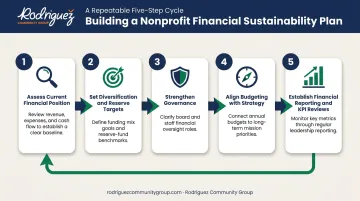
Each step depends on the one before it. An organization that skips the baseline assessment and jumps straight to setting reserve targets is guessing at a number that feels good rather than one grounded in its actual risk profile.
When Outside Expertise Accelerates Sustainability
Small and mid-sized nonprofits frequently know what they need to do. What they lack is the in-house capacity—a dedicated CFO, a governance specialist, an operations lead—to actually execute it while running programs day to day.
This is where Rodriguez Community Group works differently than a traditional consulting firm. RZCG embeds within an organization's team rather than delivering a report and walking away. The firm supports nonprofits and mission-driven organizations with up to 50 staff and $25M in revenue on strategic finance, governance structures, and operations planning.
A couple of examples from RZCG's client work:
- The Oakland REACH – RZCG served as interim Chief of Staff, then interim COO overseeing CFO activities during a leadership transition, strengthening operations as the organization grew beyond its home community.
- Climate Lead – RZCG planned and executed a fiscal sponsor spin-off, defining new financial, operational, and compliance structures while guiding governance board development for long-term needs.
In both cases, RZCG provided hands-on execution alongside existing staff instead of outside advice, delivering the kind of embedded support that turns a sustainability plan from a slide deck into an operating reality.
Frequently Asked Questions
What is nonprofit financial sustainability?
It's an organization's long-term ability to maintain financial health, diversify revenue, and fund its mission despite economic shocks or funding disruptions. It goes beyond covering short-term expenses to building lasting strategic capacity.
What is an example of financial sustainability for a nonprofit?
A nonprofit with diversified revenue across grants, donors, and earned income, six months of operating reserves, and transparent board oversight that continues operating smoothly even after losing a major grant. The loss disrupts a budget line, not the mission.
What is the 33% rule for nonprofits?
This is a commonly referenced guideline suggesting no single funding source should account for more than roughly one-third of total revenue. It helps organizations avoid over-dependence, though it's a practical benchmark rather than a formal legal or accounting standard.
What is the 5% rule for nonprofits?
This refers to the IRS minimum distribution requirement for private foundations, generally around 5% of investment assets each year, not an operating reserve guideline for public charities. Confusing the two can lead to misapplied financial planning.
How much should a nonprofit keep in reserve funds?
General guidance suggests three to six months of operating expenses, roughly 25-50% of your annual budget. Organizations with volatile or seasonal revenue should aim toward the higher end.
What is the difference between financial stability and financial sustainability?
Stability is short-term solvency: can you pay this month's bills? Sustainability is the long-term strategic capacity to endure a funding loss, leadership change, or economic downturn years from now.