Introduction
For years, community foundations operated in crisis mode. Racial equity commitments, social justice funds, and pandemic relief dollars dominated grantmaking calendars. That reactive posture served its purpose, but it wasn't a strategy.
Heading into 2026, the sector is shifting toward something more deliberate: proactive, community-informed direction setting.
A 2019 CFLeads survey of 152 community foundation leaders found that 98% planned to deepen or expand their community leadership role in the years ahead. That's a clear signal: foundations want to lead, not just react.
Turning that ambition into a workable plan starts with resolving one core tension: donor-centric fundraising versus community-centric priorities. Treating these as competing forces, rather than complementary ones, is a costly mistake that stalls both fund growth and mission impact.
This guide covers the seven essential elements your plan needs, the five strategic pillars unique to community foundations, and a step-by-step planning process. It also shows how to avoid building a plan that gathers dust after the board retreat.
Key Takeaways
- A strong 2026 plan blends community-informed vision with disciplined donor relationship-building.
- Seven core elements separate a working plan from a wish list.
- Five sequential pillars (operations, fair grantmaking, awareness, fund development, community leadership) drive momentum.
- Execution capacity gaps, not strategy quality, most often derail a plan.
What Is a Community Foundation Strategic Plan (and Why 2026 Matters)?
A community foundation strategic plan is a 3-5 year decision-making framework. Unlike a typical nonprofit plan, it must serve three audiences simultaneously: donors, the community, and a defined geographic region.
That's a harder balancing act than most strategic planning guides acknowledge.
The Mission Behind the Plan
The Council on Foundations defines community foundations as grantmaking public charities dedicated to improving a defined local area. They pool resources from individuals, families, and businesses to fund effective nonprofits and solve community problems.
In practice, this means your strategic plan must position the foundation as three things at once:
- Convener: bringing together donors, nonprofits, and residents
- Grantmaker: deploying pooled capital where it matters most
- Trusted community leader: with credibility beyond the checkbook
Why 2026 Specifically
Momentum is building. CFLeads found that nearly all surveyed leaders intend to expand their community leadership footprint, not retreat from it. Layer on a shifting economic landscape, tighter donor expectations, and growing scrutiny of nonprofit impact. Together, these pressures make 2026 the year foundations either formalize their direction or fall behind peers who already have.
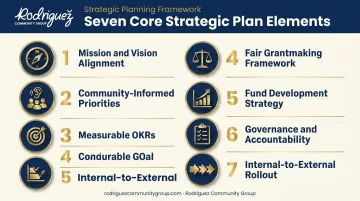
The 7 Core Elements Every 2026 Strategic Plan Needs
A plan without these seven elements is a mission statement with extra pages. Here's what belongs in yours:
Mission and vision alignment. Before setting new priorities, test whether your existing mission still fits the community you serve today. Communities change faster than mission statements typically get revisited.
Community-informed strategic priorities. Ground your priorities in listening tours, surveys, and internal data rather than staff assumptions. The St. Louis Community Foundation's 2024 plan drew on donor-giving analysis, community-needs assessments, and site visits to peer foundations in other regions.
Measurable goals and OKRs. Translating broad priorities into Objectives and Key Results turns an aspirational document into something you can actually track quarter by quarter.
A fair, transparent grantmaking framework. This is trust infrastructure. Applicants and nonprofit partners need clear, accessible criteria, not a black box.
A fund development and donor engagement strategy. Define how you'll grow assets while treating donors as co-investors and partners, not just checkbooks.
Governance and implementation accountability. Assign clear ownership for each priority and set a review cadence, then build dashboards so the plan survives past the retreat.
A rollout sequence. Internal alignment first, external campaign messaging second. Skipping this order is one of the most common planning mistakes.
The Five Strategic Priority Pillars Shaping 2026 Plans
Beyond the seven elements, five sequential pillars give community foundations their unique planning architecture. Each builds on the one before it.
1. Efficient internal operations
This is the foundation everything else rests on. Well-trained staff, smooth internal processes, and functioning systems determine whether the next four pillars are even possible. A foundation with disorganized grant tracking or manual finance processes can't credibly promise donors measurable community impact.
2. Fair and unbiased grantmaking
Trust with nonprofit partners hinges on documented, consistent decision-making. This pillar reinforces element four above and remains the credibility backbone of the entire plan.
3. Widespread awareness and community understanding
Many foundations are the best-kept secret in their own region. Visibility can't be an afterthought bolted onto a communications budget; it needs to be a deliberate strategic pillar with its own goals and metrics.
4. Successful fund development
Fund development has evolved beyond one-off asks. Storytelling and relationship-building now drive structured campaigns that weave together donor engagement, planned giving, and community initiatives, a shift foundations are doubling down on for their 2026 planning.
5. Strong community leadership
This is the top pillar, where foundations move from grantmaker to convener. The St. Louis Community Foundation's five-year plan named Economic Mobility and Youth Connections as signature priorities, covering housing, financial empowerment, job creation, early-childhood development, and scholarships. That's community leadership in action: picking a defined regional challenge and organizing the entire foundation around it.
A Step-by-Step Process for Building Your 2026 Plan
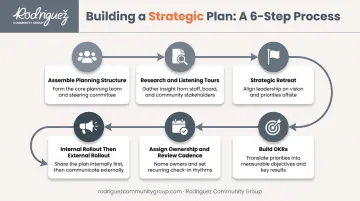
Building the plan matters as much as what's in it. Follow this sequence:
Assemble a planning structure. Form a core staff committee, a focused board subcommittee, and a stakeholder group representing donors, grantees, and community members.
Conduct research and listening tours. Gather survey, interview, and internal alignment data before setting priorities. This step gets skipped more often than any other because staff assume they already know what the board and community want.
Host a strategic retreat. Define a small number of thematic pillars and vision statements. A five-page wish list isn't a strategy; three to five focused priorities are.
Build measurable OKRs for each pillar. This lets you track progress quarterly instead of waiting five years to discover the plan didn't work.
Assign ownership and a review cadence. Name who owns each priority and how progress is reported to the board and community. Without a name attached, priorities default to no one.
Roll out internally first, then externally. Align staff and volunteer leadership as ambassadors before the plan shows up in donor conversations or campaign materials.
One caution worth stating plainly: internal alignment gaps kill more plans than bad strategy does. If staff aren't unified on the vision before launch, external rollout amplifies confusion instead of momentum.
Avoiding Common Pitfalls: Turning Your Plan From a PDF Into Action
Here's the failure mode nearly every foundation leader recognizes: the plan reads beautifully at the retreat, gets a polished PDF treatment, and then stalls because no one actually owns implementation.
The fix isn't complicated, but it does require discipline:
- Build accountability and dashboards into the plan itself, not as an afterthought six months later
- Name an owner for every priority before the retreat ends, not after
- Set a recurring review cadence (quarterly, at minimum) and stick to it even when other fires demand attention
Internal alignment gaps deserve special attention. Staff silos, where the development team, program staff, and finance office each interpret the plan differently, undermine execution just as much as external strategy missteps. Address this before launching any new priority or campaign.
Foundations without the internal bandwidth to manage governance restructuring, financial controls, or operations planning alongside daily work often need outside capacity. An embedded execution partner can close that gap.
Rodriguez Community Group works this way, joining client teams as an integrated member rather than an outside consultant. Recent engagements have included:
- Building governance boards designed for both compliance and strategic support
- Standing up financial forecasting and performance-monitoring systems
- Running operations assessments that turn strategic priorities into workable processes
A rewritten strategy document won't create that shift. Hands-on capacity is what separates foundations that execute their plans from those that revisit the same priorities every five years without progress.
Frequently Asked Questions
What are the 7 basic elements of a strategic plan?
The seven elements are mission and vision alignment, community-informed priorities, measurable OKRs, a fair grantmaking framework, a fund development strategy, governance and accountability structures, and a phased internal-then-external rollout.
What is a community strategic plan?
Unlike a standard business plan, a community strategic plan is built with direct community input and centers shared regional or organizational outcomes rather than internal growth metrics alone.
What is the mission of a community foundation?
A community foundation's mission is to pool and steward philanthropic capital to strengthen a specific geographic community through grantmaking, convening, and donor partnership.
How long should a community foundation strategic plan span?
Most plans span three to five years, with shorter annual OKR cycles nested inside that longer strategic horizon to keep progress trackable.
Who should be involved in creating a community foundation's strategic plan?
Staff leadership, board members, donors and fundholders, grantee partners, and community stakeholders all bring essential perspective to the process.
How often should a community foundation revisit its strategic plan?
Best practice calls for quarterly progress reviews, an annual check-in against OKRs, and a full strategic refresh every three to five years or after major community shifts.