
This confusion isn't rare. In small or growing nonprofits, founders frequently wear two hats: they run programs and sit on the board. That dual role blurs the lines of authority fast.
Who approves the budget? Who's accountable if something goes wrong? Who actually has the legal power to fire the executive director?
This guide breaks down what a nonprofit board of directors is, what it's legally responsible for, how it's structured, and answers the questions founders ask most: How big should our board be? What are our legal duties? Do officers have more power than regular members?
Key Takeaways
- A nonprofit board is legally accountable for strategy, finances, and executive oversight.
- Governance (big-picture oversight) is the board's job; day-to-day management belongs to staff.
- Every board member owes three fiduciary duties: care, loyalty, and obedience.
- Most states require a minimum of three directors, though effective boards are usually larger.
- The President, Secretary, and Treasurer each hold specific duties beyond regular board membership.
What Is a Nonprofit Board of Directors?
A nonprofit board of directors is the elected governing body legally responsible for an organization's mission, strategy, financial health, and compliance with both law and its own bylaws. It carries ultimate accountability, exercising real decision-making authority rather than serving as an advisory or ceremonial body.
Here's the part many people miss: the board is legally on the hook even when it delegates tasks to staff or committees. If the Executive Director mismanages funds, the board can't simply point fingers and walk away. Oversight was their job, and if it failed, that failure traces back to them.
That same accountability standard applies almost universally: virtually every nonprofit has a board. Even member-led or grassroots organizations rely on some version of this governing structure, whether they call it a board, a steering committee, or a council of trustees.
The IRS defines a director or trustee as a voting member of the organization's governing body. That voting authority is what separates a board member from everyone else in the room.
Governance vs. Management
Governance and management sound similar. They're not.
| Role | Focus | Examples |
|---|---|---|
| Governance (Board) | Setting direction | Approving mission, reviewing strategy, overseeing finances, holding leadership accountable |
| Management (Staff) | Executing direction | Running programs, managing staff, handling payroll, delivering services day to day |
The board governs. The Executive Director and staff manage.
In a startup nonprofit, this line gets messy fast. A founder might be writing grant proposals in the morning and chairing a board meeting in the afternoon. That's normal early on. But as the organization grows, mixing these roles creates real problems: who evaluates the ED's performance if the ED is also on the board deciding their own review?
The goal is separation, not immediately, but deliberately, as capacity allows.
Core Responsibilities and Roles of a Nonprofit Board
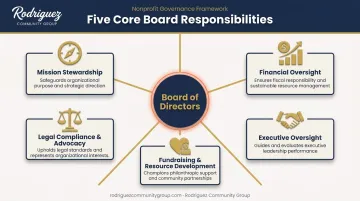
So what does a board actually do all year? BoardSource's widely referenced Ten Basic Responsibilities of Nonprofit Boards breaks it into functions like determining mission, selecting and evaluating the chief executive, ensuring financial resources, and protecting the organization's legal integrity. Here's how that plays out in practice.
Mission Stewardship The board makes sure every program, partnership, and dollar spent aligns with the organization's founding purpose. Mission drift, where a nonprofit slowly wanders from its original goals, happens when nobody's watching this closely.
Financial Oversight Boards approve annual budgets, review financial statements regularly, and oversee external audits. This requires continuous fiscal guardianship throughout the year.
Executive Oversight The board hires the Executive Director, sets their compensation, evaluates performance annually, and, if necessary, makes the call to replace them. This is one of the board's most consequential powers.
Fundraising and Resource Development Board members must give personally and help cultivate donor relationships. A board that doesn't fundraise sends a signal to major donors that even insiders aren't invested.
Legal Compliance and Advocacy Beyond following bylaws and IRS filings, and employment law, board members act as public ambassadors, building relationships with funders, policymakers, and community stakeholders who can advance the mission. Organizations navigating major transitions, such as a fiscal sponsor spin-off, often lean on partners like Rodriguez Community Group to help build these governance structures from scratch.
Board Structure: Size, Officers, and Committees
How many people should sit on a nonprofit board? The honest answer: it depends on your state law and your organization's stage.
Most states set a legal minimum of three directors (New York and Texas both require this). California is an outlier, permitting boards with as few as one director. But legal minimums and effective governance aren't the same thing.
BoardSource's practice data shows the average nonprofit board has 15 members, with a median of 13. Boards with fewer than five members often struggle to cover the range of skills, perspectives, and capacity a growing organization needs.
Terms matter too. Most organizations set board terms between two and four years, often staggered so the entire board doesn't turn over at once. This balances institutional memory with fresh perspective.
Key Officer Roles
Officers hold specific delegated authority beyond general board membership:
- President/Chair – Leads board meetings, sets agendas, coordinates the ED's performance evaluation, and serves as board spokesperson—distinct from the Executive Director role, even if one person sometimes holds both titles.
- Secretary – Records and maintains meeting minutes, ensures bylaws compliance, and safeguards official board documents.
- Treasurer – Oversees financial records, often chairs the finance committee, presents budgets for board approval, and typically holds bank signatory authority.
Common Board Committees
Committees let a board dig deeper into specific areas without bogging down every meeting. Standard committees include:
- Executive Committee – Small group authorized to act on the board's behalf between meetings
- Finance/Audit Committee – Oversees budgeting, financial planning, and the annual audit
- Governance/Nominating Committee – Leads board recruitment, onboarding, and self-assessment
- Development/Fundraising Committee – Builds fundraising strategy alongside leadership
Committees make recommendations. They don't replace the full board's accountability. Getting this structure right—sizing the board, defining officer duties, and building committees that actually function—is often where RZCG works alongside growing nonprofits to move from legal minimums to boards that operate effectively.
Legal Duties and Fiduciary Responsibilities
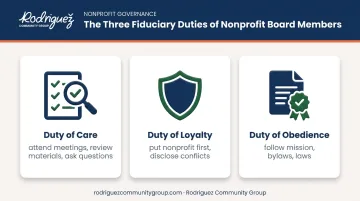
Every board member, regardless of title, owes the organization three fiduciary duties:
- Duty of Care – Act with the diligence a reasonably prudent person would use: attend meetings, review materials, ask questions before voting.
- Duty of Loyalty – Put the nonprofit's interests ahead of personal gain, and disclose any conflicts of interest.
- Duty of Obedience – Follow the mission, bylaws, and applicable laws without deviation.
Breach these duties, and individual board members can face personal liability. That risk is often mitigated through Directors & Officers (D&O) insurance and indemnification clauses in the bylaws, though not every small nonprofit budgets for this coverage early on.
RZCG saw this firsthand while guiding Climate Lead through a fiscal sponsor spin-off. The team facilitated a governance board designed for the organization's immediate needs and its long-term growth, not just for compliance.
Building a Strong, Engaged Nonprofit Board
Good governance doesn't happen by accident. It requires ongoing maintenance:
- Term limits – 72% of nonprofit boards surveyed by BoardSource reported having term limits in place, a practice that brings in fresh perspective and prevents stagnation.
- Self-assessments – Regular board evaluations catch disengagement before it becomes dysfunction.
- Structured onboarding – New members should understand fiduciary duties and organizational context before their first vote.
As nonprofits grow, they typically shift from a working board (hands-on, filling operational gaps) to a governing board (strategic, oversight-focused). This shift requires professionalizing structures and recruiting members with complementary skills, such as financial acumen, legal background, and sector expertise.
That transition rarely happens smoothly without support. RZCG partners with small nonprofits and mission-driven organizations as an embedded team member, handling governance work directly alongside staff and board leaders.
In the Denver Lab School engagement, for example, RZCG wove governance work into mission alignment and business planning, since boards don't operate separately from the rest of the organization. For founders navigating this shift, that kind of hands-on partnership helps build a board equipped to sustain long-term impact.
Frequently Asked Questions
What are the responsibilities of the board of directors for a nonprofit organization?
The board's core duties include mission stewardship, financial oversight, executive oversight, fundraising support, legal compliance, and public ambassadorship for the organization.
What is the minimum number of board members required for a nonprofit organization?
Most states require a minimum of three directors, though California permits as few as one. Best practice recommends larger boards for diversity of skills and perspective.
Who holds the most power in a nonprofit organization?
The board of directors, as a collective body, holds ultimate legal authority. Individual board members have no unilateral power outside formal board action.
Can nonprofit board members be paid?
The vast majority serve as unpaid volunteers. Compensation is legally permissible in limited circumstances, but it must be reasonable, properly disclosed, and reviewed for conflicts of interest.
How often should a nonprofit board meet?
An annual meeting is the legal minimum in most states, but effective boards typically meet more often, quarterly or beyond, to properly fulfill their oversight duties.
What is the difference between a board member and a board officer?
All officers are board members, but officers such as President, Secretary, and Treasurer hold additional delegated authority and specific responsibilities defined in the bylaws.