Introduction
Small nonprofit teams face a familiar squeeze: a handful of staff, a tight budget, and a board that expects growing impact every year. Many organizations struggle to bridge that gap because they're reacting to whatever crosses their desk instead of working from a shared plan.
Strategic planning fixes that. It's a structured, forward-looking process, usually spanning three to five years, that sets priorities, aligns resources, and creates a way to measure progress toward the mission.
This article covers why strategic planning matters, the core components every plan needs, and a step-by-step process for building one. It also covers the mistakes that sink plans before they start and how an embedded partner like RZCG helps nonprofits turn strategy into something the organization actually runs on.
Key Takeaways
- Strategic planning gives leaders a roadmap for directing limited time, talent, and funding toward mission-critical priorities
- 78% of nonprofit CEOs have a formal strategic plan or framework, per BoardSource's 2021 Leading with Intent report
- A strong plan includes mission, vision, values, an organizational analysis, SMART goals, financial alignment, and accountability
- Plans fail most often without measurable metrics, stakeholder buy-in, budget alignment, or consistent follow-through
Why Strategic Planning Matters for Nonprofits
A written plan does more than sit in a shared drive. It becomes the lens the whole organization uses to make decisions.
Mission, vision, and values as a shared filter. When staff, board members, and volunteers all work from the same definition of purpose and direction, prioritization gets easier. Instead of debating every new opportunity from scratch, teams can ask: does this serve what we already agreed to pursue?
Better resource allocation. The Nonprofit Finance Fund recommends that executive directors use the strategic plan to determine where time, energy, and money should go, then build the budget around that thinking rather than the reverse.
Bridgespan agrees: planning exists to make hard tradeoffs and direct scarce resources toward the outcomes that matter most.
Stronger fundraising conversations. Giving USA's research notes that successful grant seeking starts with a strategic plan. Funders want to see that a nonprofit knows its direction and can align grant opportunities with real priorities, not chase every available dollar.
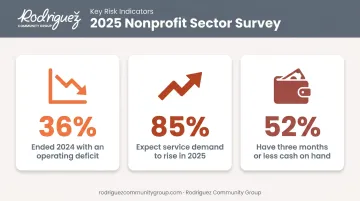
Proactive risk management. This is where planning earns its keep. The Nonprofit Finance Fund's 2025 survey of 2,206 organizations found that:
- 36% ended 2024 with an operating deficit, the highest share in a decade of the survey
- 85% expected demand for services to rise in 2025
- 52% had three months or less of cash on hand
A plan built with these pressures in mind forces conversations about funding diversification and staffing contingencies before a crisis hits, not during one.
Built-in resilience. Plans with scheduled review cycles adapt faster when community needs or funding conditions shift. Static plans don't.
Key Components of a Nonprofit Strategic Plan
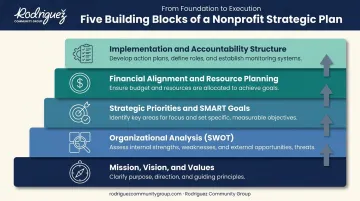
Every strong nonprofit strategic plan shares the same five building blocks, regardless of sector or size.
Mission, Vision, and Values
These three elements play distinct roles. Mission explains why the organization exists today. Vision describes the long-term future the organization is working toward. Values guide how people behave while getting there.
Too many planning processes assume these are already settled and skip straight to goal-setting. That's a mistake. Revisiting mission, vision, and values at the start of every planning cycle, even briefly, ensures the rest of the plan is built on current reality, not a five-year-old assumption.
Organizational Analysis (SWOT/Environmental Scan)
Before setting priorities, ground the plan in evidence. A SWOT analysis, examining internal strengths and weaknesses alongside external opportunities and threats, keeps the plan honest.
This means looking at:
- Internal capacity: staffing, systems, financial health
- Funding landscape shifts and donor trends
- Community needs assessments and program data
- Competitive or complementary organizations in the same space
Skip this step, and the plan reflects what leadership thinks is true instead of what's actually happening.
Strategic Priorities and SMART Goals
Ambition is easy. Focus is hard. The strongest plans narrow down to a handful of strategic pillars rather than trying to advance a dozen initiatives at once.
Each pillar then needs SMART goals attached: Specific, Measurable, Achievable, Relevant, and Time-bound. Vague language like "improve program quality" doesn't tell anyone what success looks like, but a target such as "Increase program completion rates from 68% to 80% by June 2026" does.
Financial Alignment and Resource Planning
A plan is only as strong as the budget behind it. If the strategic priorities call for expanding a program but the budget doesn't shift a dollar toward it, the plan is aspirational at best.
This is where finance and controls expertise matters most. RZCG's team works with clients to run financial assessments, build forecasting tools, and evaluate whether budgets genuinely reflect stated strategic outcomes rather than running on autopilot from last year's numbers.
That connective work between strategy and fiscal reality is often the missing link in nonprofit planning.
Implementation and Accountability Structure
The final component is the one most plans skip: who owns what, by when, and how progress gets tracked. Without assigned ownership, timelines, and KPIs, a strategic plan becomes what practitioners call "shelfware," a document nobody looks at after the launch meeting.
A working accountability structure needs:
- Named owners for each strategic priority, not just a department
- Timelines with interim checkpoints, not just a final deadline
- KPIs tied to each goal that someone actually reviews
- A communication plan so staff and board stay informed on progress
How to Develop a Nonprofit Strategic Plan: A Step-by-Step Process
Building a plan doesn't require a rigid template, but it does benefit from a consistent sequence.
Step 1: Assemble the planning team. Bring together board members, senior staff, and key stakeholders early. Diverse perspectives at the outset build buy-in that's nearly impossible to retrofit later.
Step 2: Conduct research and listening. Gather input through staff and donor surveys, community interviews, and a review of program data. This step grounds priorities in evidence instead of whoever spoke loudest in the room.
Step 3: Revisit mission, vision, and values. Use them as filters. If a proposed priority doesn't fit the mission, it doesn't belong in this plan, no matter how appealing it sounds.
Step 4: Develop action plans with SMART goals. For each strategic priority, assign:
- Specific, measurable goals with target dates
- A responsible owner
- The budget and staff time required to execute
Step 5: Build a monitoring rhythm. Tie strategic updates to recurring board meeting agendas, quarterly at minimum. Bridgespan's research on plan implementation recommends exactly this cadence: quarterly progress check-ins paired with a full annual strategic review. Without a scheduled rhythm, even a well-built plan stalls.
Common Strategic Planning Mistakes Nonprofits Should Avoid
Even well-intentioned plans fail for predictable reasons.
- No measurable metrics or clear ownership. If nobody can say whether a goal was met, progress becomes impossible to track or defend to a board or funder.
- Budget misalignment. Bridgespan's review of 120+ nonprofits found strategy-implementation capacity rated 10% below other organizational capabilities—stated goals and actual spending routinely drift apart.
- Treating the plan as a static document. Funding shifts, staff turnover, and changing needs make unrevised plans stale within a year, so schedule regular check-ins instead of a five-year hibernation.
How RZCG Supports Nonprofit Strategic Planning
RZCG works differently than a typical outside consulting firm. Rather than delivering a plan and walking away, the team embeds directly inside client organizations, working as part of the team rather than an external advisor looking in.
That model matters for strategic planning specifically because a plan built by outsiders rarely survives contact with daily operations. RZCG's team brings expertise across:
- Strategic planning and organizational growth
- Finance and controls, translating strategy into a workable budget
- Governance and board structures
- Operations planning and change management
This breadth means a client doesn't need to hire separate specialists to turn a strategic plan into an executable, fully-resourced roadmap. One embedded team handles the mission alignment conversation, the SWOT analysis, the budget modeling, and the accountability structure together.
RZCG focuses on organizations with up to 50 staff and up to $25 million in annual revenue, working across education, climate, and community empowerment sectors. As a result, the team understands the real constraints small nonprofit staff operate under and builds plans sized to match.

Frequently Asked Questions
What should a nonprofit strategic plan include?
A strong plan includes your mission, vision, and values, findings from stakeholder research, a focused set of priorities, SMART goals with timelines and owners, and a plan for ongoing review.
How often should a nonprofit revisit or update its strategic plan?
Most organizations benefit from an annual check-in on progress, with a full plan refresh every three to five years or sooner if major organizational or funding changes occur.
Who should be involved in the nonprofit strategic planning process?
Board members, senior staff, and program leaders should be core participants, along with stakeholders such as donors and community members who understand real needs.
How long does it typically take to develop a strategic plan?
Timelines vary by organization size and complexity, but most nonprofits should expect the process to take several months from initial research through final plan approval.
What's the difference between a strategic plan and an annual operating plan?
A strategic plan sets three-to-five-year direction and priorities. An annual operating plan translates those priorities into specific, tactical actions and budgets for the coming year.
Should a small nonprofit hire outside help for strategic planning?
Many small nonprofits benefit from embedded partner support, especially for facilitation, financial alignment, and accountability structures, particularly when internal staff capacity is already stretched thin.