Introduction
Foundation boards control charitable assets that often run into the millions, a scale that carries real fiduciary and legal weight. Weak governance can expose board members to compliance risk, mission drift, and personal liability, not just an unflattering audit finding.
Foundations range from a single-family trust with $2 million in assets to national grantmakers managing nine-figure endowments. The size varies. The governance obligations do not. Every foundation board, regardless of scale, should revisit its governing documents, financial controls, and compliance posture at least once a year.
This guide covers what that revisit should include: the core pillars of good governance, the IRS's 5% minimum distribution rule, board composition and succession planning, and the compliance essentials that keep a foundation out of trouble with the IRS and state regulators.
Key Takeaways
- Board members owe duties of care, loyalty, and obedience—breaches can trigger personal liability.
- Private foundations must distribute about 5% of net investment assets yearly or face excise taxes.
- Governance policies, including conflict-of-interest rules and bylaws, need annual review to stay compliant.
- Family-run foundations often show gaps in formal oversight versus staffed foundations.
- Embedded governance partners strengthen internal controls without diverting staff from mission work.
What Is Governance for Foundation Boards?
Foundation board governance is the framework of policies, structures, and oversight practices that guide how a foundation fulfills its mission, makes decisions, and answers for the results. Rather than a single document, it operates as a system: legal structure, written policies, financial controls, and the board behavior that puts all of it into practice.
Foundational Governance Defined
"Foundational governance" is the baseline layer underneath that system. Before a foundation can operate responsibly, it needs:
- Articles of incorporation establishing its legal existence
- Bylaws spelling out how the board operates
- An IRS determination letter confirming tax-exempt status
- A written mission statement anchoring every grant and expenditure decision
Skip any of these, and everything built on top, from grantmaking strategy to financial oversight, rests on unstable ground. Once that foundation is secure, attention turns to the people responsible for upholding it: the board members themselves.
Fiduciary Duties of Board Members
Every foundation director carries three fiduciary duties under state nonprofit law:
- Duty of care: Review financial statements, ask hard questions, and act with the diligence a prudent person would use managing their own affairs.
- Duty of loyalty: Personal or family interests never outrank the foundation's interests. This is where conflict-of-interest policies do their work.
- Duty of obedience: Follow the foundation's mission, bylaws, and applicable law rather than pursuing pet projects.
These aren't aspirational lines in a handbook. Directors and officers face personal liability exposure for "wrongful acts," which is why most foundations carry directors and officers (D&O) insurance, typically with a base coverage limit around $1 million.
Governance gaps show up more often at smaller and family-run foundations. A 2004 study by the Center for Effective Philanthropy found that only 69% of family foundations conducted formal, consistent CEO evaluations, compared with 85% of foundations without family board members. The same research found that in a third of family foundations, directors made grants with little or no staff involvement.
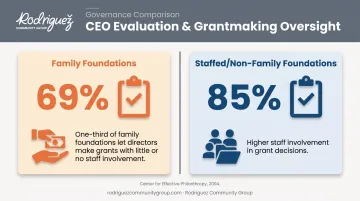
That data is two decades old, but the pattern it points to, thin staffing translating into thinner oversight, still shows up in under-resourced foundations today.
The Four Pillars of Good Foundation Governance
Governance experts often describe effective foundation oversight through four recurring themes: accountability, transparency, fairness and equity, and responsibility. Frameworks vary by source, but these four show up consistently enough to serve as a working checklist.
Accountability shows up as documented decision-making: meeting minutes that capture the reasoning behind grant approvals, regular financial reporting, and clear role definitions between board and staff.
Role clarity matters more than most boards assume. Bridgespan's research on nonprofit board effectiveness found that shared clarity about the board's role in driving change is the single biggest factor separating high-performing boards from underperforming ones. Vague job descriptions produce vague oversight.
Transparency matters even without shareholders demanding it. Form 990-PF is public record, so timely filing counts as a disclosure practice. Add direct grantee communication about funding decisions and a website that reflects current priorities, not a five-year-old strategy.
Fairness and equity rest on a written conflict-of-interest policy, reviewed and signed annually by every director, plus consistent grantmaking guidelines so decisions follow criteria, not relationships.
Responsibility is where mission meets measurement: specific goals, metrics tied to those goals, and a succession plan so leadership changes don't derail programs.
| Pillar | Shows up in practice as |
|---|---|
| Accountability | Documented minutes, defined roles, regular reporting |
| Transparency | Public 990-PF filings, grantee communication, current website |
| Fairness & Equity | Signed conflict policy, consistent grant criteria |
| Responsibility | Measurable goals, succession plan, mission-linked metrics |
Financial Stewardship & the 5% Minimum Distribution Rule
Every private foundation board eventually asks: how much do we actually have to give away? The IRS answer is a minimum distribution requirement, commonly shortened to "the 5% rule."
Nonoperating private foundations must make qualifying distributions equal to their distributable amount. That figure is roughly 5% of the fair market value of assets not used directly for exempt purposes, minus acquisition debt, with statutory adjustments.
What Counts Toward the Minimum
Not every expenditure qualifies. Distributions that count include:
- Grants paid to charitable organizations or individuals
- Reasonable and necessary administrative expenses tied to grantmaking
- Program-related investments made for charitable purposes
- Amounts paid to acquire assets used directly for exempt activities
Returned or recovered grant funds work differently. A recovery doesn't automatically become a new qualifying distribution; it generally gets added back to the distributable amount in the year it's recovered, which boards need to track carefully.
The Cost of Falling Short
Missing the distribution requirement isn't a slap on the wrist. Section 4942 imposes an initial excise tax of 30% of undistributed income, and if the shortfall isn't corrected by the end of the taxable period, an additional 100% tax applies. That's a real dollar cost pulled straight from assets meant for charitable purposes.
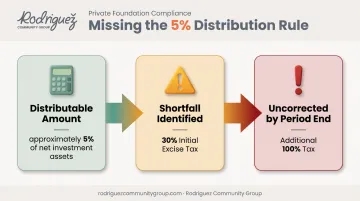
Calculate the distribution requirement well before fiscal year-end, not in the final weeks, to leave room for corrective grants if the foundation is behind.
The Board's Ongoing Role
Meeting the 5% figure isn't a once-a-year math exercise. Boards need to:
- Approve the annual operating budget with the distribution requirement built in
- Review the investment policy statement at least annually
- Meet periodically with investment managers to assess performance against payout needs
Treat the 5% figure as a baseline for payout planning, then build from there. Foundations serious about mission impact often pay out more, aligning payout strategy with long-term goals rather than chasing the statutory minimum.
Board Composition, Succession & Key Governing Documents
Building a foundation board isn't about filling seats with family members or friends of the founder. Strong boards deliberately recruit for:
- Financial and investment expertise
- Legal or compliance background
- Program or sector knowledge relevant to the mission
- Generational and community perspectives that reflect the foundation's reach
A documented succession plan matters just as much as who currently sits at the table. Without one, a single unplanned departure — a founder's illness, a sudden resignation — can leave a foundation without clear leadership for months.
Term limits help create deadlines for recruiting new trustees, but they alone don't build a succession process. Boards still need onboarding, mentorship, and knowledge transfer built in.
Succession planning only works if it's backed by clear documentation. Every board should maintain, and review annually, these documents:
- Bylaws
- A written statement of board member responsibilities
- Conflict-of-interest policy
- Gift acceptance policy
- Trustee compensation policy, if directors are compensated
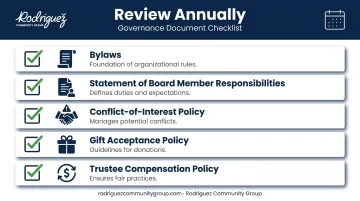
Compensating a trustee is generally treated as self-dealing under federal rules unless it's reasonable payment for necessary personal services. That makes a written, board-approved compensation policy essential, not optional.
Compliance, Grantmaking & Administrative Essentials
Compliance for private foundations runs through both federal and state channels.
Federal filing requirements:
- Form 990-PF, filed annually regardless of asset size, due the 15th day of the fifth month after the fiscal year ends (May 15 for calendar-year filers)
- Mandatory electronic filing, with limited exceptions
- Form 8868 for an automatic six-month extension, though it doesn't extend the deadline to pay any tax owed
State requirements vary by jurisdiction. Charitable solicitation registration, state tax filings, and employment or property tax obligations depend on where the foundation is based and where it operates, so boards shouldn't assume one state's rules apply everywhere.
Compliance keeps the foundation in good standing, but grantmaking decisions carry their own scrutiny. Strong grantmaking practices give a board something concrete to point to if a grant decision is ever questioned:
- Written grant guidelines outlining eligibility and priorities
- A defined review and approval process, not ad hoc decisions
- Regular grantee reporting requirements and periodic site visits
On the administrative side, boards should maintain:
- Record retention policies for financial and governance documents
- Data security practices protecting donor and grantee information
- Periodic comparisons of administrative expenses against peer foundations
Research on larger independent foundations found administrative expense ratios ranging from roughly 3% of qualifying distributions for single-staff foundations up to 13-15% for foundations with larger teams. There's no single "right" number here, only a range tied to staffing model.
When to Bring in Outside Governance Expertise
Some signs point clearly toward needing outside governance support:
- Rapid growth in assets or grantmaking volume outpacing existing board structures
- Leadership transitions, whether a departing executive director or an aging founder-led board
- Staff stretched thin, managing programs and governance administration at the same time
When these signs appear, foundations don't necessarily need a traditional consultant who delivers a report and leaves implementation to already-stretched staff.
Rodriguez Community Group (RZCG) works differently. Its team, led by Founder Luis Rodriguez, whose focus areas include governance and executive structures, functions as an embedded partner rather than an outside advisor.
In one engagement with Climate Lead, a climate philanthropy advisory organization, RZCG's team helped define financial, operations, and compliance structures during a fiscal sponsor spin-off.
The organization described the process as a creative approach to building the right governance board for both current and future needs.
This collaborative model helps foundation and nonprofit boards, generally those with up to $25 million in annual revenue, strengthen financial controls and governance structures without diverting staff attention away from mission-critical work.

Frequently Asked Questions
What are the 4 pillars of good governance?
Accountability, transparency, fairness/equity, and responsibility. In practice, they show up as documented decisions, public disclosures, conflict-of-interest policies, and mission-linked goals with succession plans.
What is foundational governance?
It's the baseline layer of governing documents and structures every foundation needs before operating responsibly, including articles of incorporation, bylaws, an IRS determination letter, and a written mission statement.
What is the 5% rule for foundations?
Private foundations must distribute roughly 5% of their net investment assets annually for charitable purposes. Grants, qualifying administrative expenses, and program-related investments all count toward that requirement.
What is the difference between a nonprofit board and a foundation board?
Foundation boards focus primarily on grantmaking strategy and asset stewardship, while typical nonprofit boards oversee operating programs and resource development. Both carry the same core fiduciary duties.
How often should a foundation board review its governance policies?
At least annually, with conflict-of-interest policies requiring a signed disclosure from every director each year. Many boards tie this review to fiscal year planning.
Who is legally responsible for governance failures at a foundation?
Individual board members and officers can bear personal liability for breaches of fiduciary duty. That exposure is exactly why most foundations carry D&O insurance.