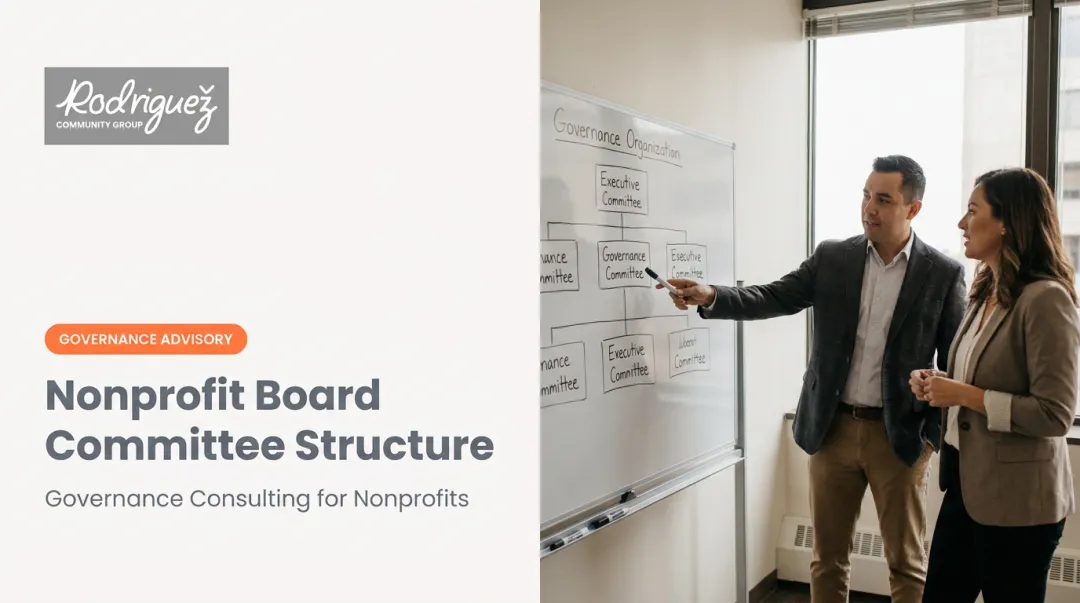
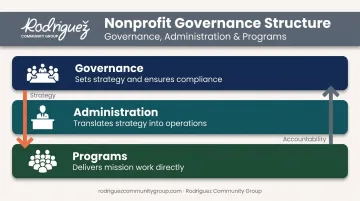
A nonprofit organizational structure is the formal arrangement of governance (the board), administration (executive leadership), and programs (staff and volunteers) that dictates who holds authority, who's accountable, and how work flows toward the mission. Without it, even a well-funded nonprofit can grind to a halt over simple approvals.
This guide breaks down the core building blocks, the most common structure types, the key roles every nonprofit needs, and how to evolve your model as your organization grows.
Key Takeaways
- Every nonprofit structure rests on three pillars: governance, administration, and programs
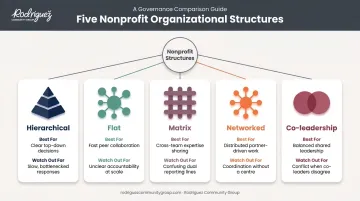
- Hierarchical, flat, matrix, and networked models each fit different sizes and missions
- Co-executive leadership and shared-power models are gaining traction in the sector
- Structure should shift as funding, staff size, and leadership change — not stay frozen
The Three Core Elements of Every Nonprofit Structure
Regardless of mission or budget size, every nonprofit organizes itself around three interconnected layers. Blur the lines between them, and you get duplicated effort, unclear ownership, and decisions that bounce between people who all assume someone else made the call.
Governance: The Board of Directors
The board sets strategic direction, approves budgets, hires and evaluates the Executive Director, and ensures the organization stays legally and financially compliant. State law, not federal tax law, typically governs board size — and most states set the minimum at three directors, according to BoardSource, though a handful allow one or two.
The IRS doesn't mandate a specific meeting frequency either. It simply recommends an active, informed board that documents its decisions. In practice, a board that meets once a year rarely has enough contact with the organization to govern well.
Administration: Executive Leadership
The Executive Director translates board strategy into an operating plan, an annual budget, and staffing decisions. In larger nonprofits, chiefs, VPs, or directors sit under the ED, each owning a functional area. A 40-person nonprofit, for example, might split this layer into a CFO, a director of programs, and an HR lead, all reporting to the ED. This layer answers directly to the board, executing strategy rather than setting it.
Programs: Mission Delivery
Program staff, mid-level managers, and volunteers make up the largest group in most nonprofits. They run the advancement work, community relations, HR, and finance functions that actually deliver the mission, reporting up through administration.
Role clarity here matters more than most founders assume. Gallup found that on-site employee clarity about job expectations fell from 59% in 2020 to 50% in 2023, and that improving clarity is linked to meaningful productivity gains. When program staff don't know who owns what, work gets duplicated or dropped entirely.
Common Types of Nonprofit Organizational Structures
There's no universal "right" structure. The best fit depends on your size, program complexity, and how decisions actually need to flow.
Hierarchical (Top-Down)
The traditional pyramid: board, then ED, then department heads, then staff. This works well for larger nonprofits with distinct departments and clear specialization. The tradeoff is speed: the more layers you add, the slower approvals and communication move.
Flat
Common in small or new nonprofits, this model minimizes hierarchy. Staff wear multiple hats, and decisions get made close to the work rather than routed up a chain. East Yard Communities for Environmental Justice, for example, runs co-executive directors and equal staff pay to flatten authority as much as its legal filing requirements allow.
Matrix
Some nonprofits organize staff by both function and program, creating dual-reporting relationships: a development officer might report to both a Development Director and a specific Program Manager. This suits organizations running several cross-functional initiatives at once, but it can muddy accountability if reporting lines aren't documented clearly.
Networked/Collective
Loosely coordinated models (local affiliates plus a national office, for instance) let chapters or partner organizations retain autonomy while sharing a mission. Advocacy coalitions favor this approach. The tradeoff, per Bridgespan's research on nonprofit networks, is a constant balancing act between local independence and network-wide consistency.
Emerging Non-Traditional Models
Co-executive directorships and distributed leadership are no longer fringe experiments. Building Movement Project's survey of more than 3,000 nonprofit staff found that reported co-directorships grew from 7% in 2019 to 11% in 2022. The rise was even sharper among BIPOC-led organizations, climbing from 6% to 12%.
Worker self-directed nonprofits, where staff influence programs and working conditions directly, are following a similar trajectory. Many cite reduced burnout as the driver.
Which structure fits your organization?
| Structure | Best For | Watch Out For |
|---|---|---|
| Hierarchical | Larger nonprofits, multiple departments | Slower approvals as layers grow |
| Flat | Small teams, startups, all-volunteer groups | Roles overlap; decisions can stall without a tiebreaker |
| Matrix | Multi-program nonprofits with shared functions | Dual-reporting confusion without clear rules |
| Networked | Coalitions, chapters, federated affiliates | Coordinating standards across autonomous units |
| Co-leadership | Equity-focused or burnout-prone teams | Requires strong alignment mechanisms |
Key Roles Within a Nonprofit Structure
Every structure, however it's drawn, needs these functions covered:
- Board of Directors: the volunteer governance body responsible for mission oversight, financial approval, and legal compliance
- Executive Director: the top staff authority, managing operations, fundraising visibility, and staff supervision while reporting to the board
- Program Managers: own the design, budget, and outcomes tracking for specific programs
- Development and Finance staff: manage donor relationships, grant writing, budgeting, and financial compliance
- Volunteers and Communications staff: extend capacity and carry the mission's story to funders and the community
In very small nonprofits, one person often holds three or four of these roles simultaneously. That's normal in year one. What matters is naming the responsibilities explicitly (even informally) so that when you hire your second or third staff member, you're not reverse-engineering who does what. For organizations navigating that transition, embedding an experienced interim program manager or finance lead can fill the gap without the cost of a full-time hire.
How to Choose and Build the Right Structure for Your Nonprofit
Your structure should follow your strategy. Factors that should drive the decision include:
- Mission complexity and number of active programs
- Staff and budget size
- Funding sources (a single major grant behaves differently than diversified individual giving)
- Geographic scope, from a single site to multiple chapters or regions
With these factors in mind, follow these steps to build (or rebuild) your org chart:
- Inventory every role currently performed, paid or unpaid
- Group roles by function, separating governance, administration, and program delivery
- Map reporting lines so every person has one clear supervisor
- Visualize the chart and share it with staff and board
- Review it regularly, at minimum after major funding shifts or leadership changes
Structure isn't a one-time exercise. A founder transition, a new multi-year grant, or a sudden growth spurt are common triggers that should send you back to step one. These moments are also when nonprofits often bring in interim leadership, such as RZCG's embedded executives, to guide the redesign.
When Restructuring Makes Sense (and How to Get It Right)
A few warning signs tend to show up before a nonprofit realizes it has outgrown its structure:
- The founder is doing five jobs and burning out
- Staff can't say who has final decision rights on common issues
- Programs are hard to scale because systems weren't built for growth
- A leadership transition is approaching with no succession plan in place
The mistake many small nonprofits make when they try a DIY overhaul is treating governance, finance, and operations as separate projects. In reality, these three pieces move together. A new board structure without matching financial controls just creates a different kind of confusion.
Rodriguez Community Group (RZCG) operates as an embedded team partner, working directly alongside staff instead of delivering an outside report. RZCG helps small nonprofits and mission-driven organizations (up to 50 staff, $25M in revenue) with governance redesigns, finance structuring, and operations planning, backed by a team averaging 15 years of nonprofit leadership experience.
RZCG's work with Climate Lead, for instance, involved facilitating a creative governance board-building process while simultaneously defining financial and operational structures, all before the fiscal sponsor spin-off was finalized. That coordinated approach, rather than sequential fixes, is what tends to hold up under future growth.

Frequently Asked Questions
What is the best organizational structure for a nonprofit organization?
There's no single best model. A hierarchical structure suits small, newer nonprofits needing clear chains of command, while flat, matrix, or networked models fit organizations running cross-functional programs or multiple sites.
What is the 80/20 rule for nonprofits?
It's a version of the Pareto principle applied to fundraising: a small share of donors typically generates most donation revenue. This ratio helps guide development staffing and donor cultivation priorities, though exact figures vary by organization.
What should a nonprofit org chart include?
It should show paid staff, board members, volunteers, and any grant-funded contractors, with clear reporting lines connecting governance to staff levels.
How often should a nonprofit update its organizational structure?
Most organizations should revisit their structure after major funding changes, leadership transitions, or program shifts, rather than on a fixed calendar.
How is a nonprofit organizational structure different from a for-profit one?
Nonprofits add a governance layer (the board) that oversees executive leadership, prioritizing mission impact and compliance instead of profit distribution to owners.
Can a very small nonprofit operate without a formal structure?
No. Even solo-founder or all-volunteer nonprofits need a compliant board and clearly assigned responsibilities, even if one person temporarily holds several of those roles.