Introduction
A new board member joins a nonprofit excited to help. Six months later, they're still not sure if they're allowed to talk to staff directly, approve a budget line, or weigh in on a hiring decision.
This confusion is common, and it's costly. When governance and management blur, organizations face compliance gaps and strained staff relationships, often missing strategic opportunities along the way — especially at small nonprofits without a dedicated compliance officer or HR department to catch the mistakes.
The good news: board roles aren't actually murky once you break them down. This guide covers what boards are legally responsible for, how accountability works, how to structure officers and committees, and what separates a functional board from a struggling one.
Key Takeaways
- The board governs (strategy, oversight, accountability); staff manages daily operations
- Every director owes fiduciary duties of care, loyalty, and obedience, with no exceptions permitted
- Boards answer to state Attorneys General, the IRS, and the public, not just themselves
- Clear officer roles, committees, and onboarding practices separate high-performing boards from reactive ones
What Is a Nonprofit Board of Directors?
A nonprofit board of directors is the legal governing body responsible for the organization's mission, strategy, and oversight. Staff, led by the executive director or CEO, handle execution.
This distinction matters legally, not just operationally. The board can only act collectively, through duly held meetings or unanimous written consent. An individual board member showing up to direct a staff member or sign a contract has no unilateral authority unless the board has specifically delegated it.
Governance vs. Management: Understanding the Divide
Governance sets the destination and the guardrails; management drives the vehicle.
| Governance (Board) | Management (Staff) |
|---|---|
| Approves strategy and policy | Implements programs |
| Sets and monitors the budget | Manages daily spending |
| Hires and evaluates the CEO | Hires and supervises other staff |
| Oversees organizational risk | Handles operational risk day-to-day |
In very small or startup nonprofits, board members sometimes double as unpaid staff, running events, managing social media, even answering the phone. That's common in year one. But the longer this blurring continues, the more it erodes independent oversight. The people supposed to evaluate the work end up doing the work, and nobody's left to ask hard questions.
Board Size and Legal Structure Variations
Nonprofit boards vary widely in size, and most state laws set only a minimum, usually three directors, though a few states permit one or two. BoardSource's research found the average nonprofit board has 15 directors, with a median of 13.
Smaller organizations under $1 million in budget average around 13 members, while those above $10 million average closer to 18.
Member-based nonprofits add another layer. Statutory or voting members may hold specific reserved rights, such as electing directors or approving bylaw amendments. Everything else defaults to the board's authority.
Core Responsibilities of a Nonprofit Board of Directors
So what does a board actually owe the organization? Four categories cover it: fiduciary duty, financial oversight, executive oversight, and strategic direction.
Fiduciary Duties: The Legal Foundation of Board Service
Every director, regardless of experience or title, owes three fiduciary duties:
- Duty of Care: Attend meetings, review materials, and ask questions before voting, acting as an ordinarily prudent person would. The "business judgment rule" protects good-faith decisions, but not recklessness or self-dealing.
- Duty of Loyalty: Put the nonprofit's interests ahead of personal or professional ones. Disclose conflicts of interest before they become problems, and never use board position for personal gain.
- Duty of Obedience: Follow the bylaws, protect the mission, and comply with applicable law, including honoring donor-restricted gifts.
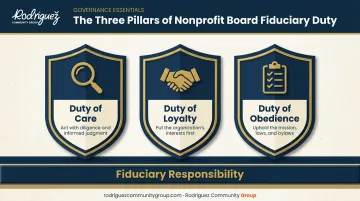
These aren't abstract legal concepts. A board that skips financial review, ignores a conflict disclosure, or lets the mission drift without discussion is exposed on all three fronts simultaneously.
Financial Oversight and Resource Development
Financial stewardship is where fiduciary duty becomes concrete. The board approves annual budgets, reviews financial statements and audits, and monitors fiscal sustainability throughout the year, not just at year-end.
Fundraising responsibility falls here too. Most boards expect members to give personally and often to help raise funds.
A 2015 survey by Stanford's Graduate School of Business, conducted with BoardSource and GuideStar found that 42% of responding nonprofits had a formal give-or-get policy requiring each director to donate or raise a set minimum. BoardSource separately recommends 100% board participation in giving, even without a formal dollar requirement.
Executive Leadership Oversight
Financial oversight naturally extends into personnel decisions, starting with the board's most direct staffing responsibility. The board hires, sets compensation for, and formally evaluates the executive director or CEO. This is the one staff relationship the board directly owns, and it's not optional or delegable: a board can't ethically let the CEO set their own pay or skip their own review.
Good oversight looks like support paired with accountability:
- Written CEO job description with clear expectations
- Annual performance evaluation tied to those expectations
- Independent compensation review using comparability data
- Documented decisions that hold up if questioned later
What it shouldn't look like: board members emailing staff directly, rewriting program plans, or second-guessing operational calls the CEO was hired to make.
Strategic Direction and Risk Management
Beyond finances and personnel, the board sets the mission and vision, monitors progress against the strategic plan, and oversees organizational risk: legal, financial, reputational, and operational. This means asking "are we still doing what we said we'd do, and are we doing it responsibly?" at every meeting, not just at the annual retreat.
Board Accountability: The CEO Relationship and Who Answers to Whom
The governance hierarchy is straightforward once stated plainly: the board hires, supervises, and can remove the CEO. That makes the board the higher governing authority, even though the CEO leads daily execution and typically manages every other staff member.
Many boards keep the CEO involved as a non-voting, ex-officio member. BoardSource recommends this structure specifically to preserve the CEO's voice in discussions without blurring the accountability line. The CEO shouldn't vote on their own performance review or compensation.
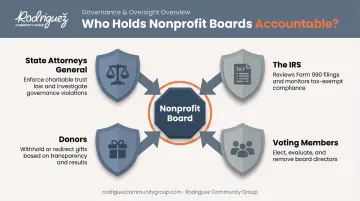
But who holds the board itself accountable? Four groups, each with different tools:
- State Attorneys General: protect charitable assets and can investigate breaches of fiduciary duty
- The IRS: reviews Form 990 disclosures and can impose intermediate sanctions for excess-benefit transactions
- Donors: can file complaints and expect restricted gifts used as intended
- Voting members (where applicable): may have inspection, voting, or removal rights under the bylaws
Documentation is the board's paper trail when questions arise. Accurate meeting minutes, conflict-of-interest disclosures, and financial reports serve a practical purpose: they document that the board acted in good faith.
Liability protection exists too, but it isn't a blanket shield. Directors typically rely on three tools together:
- Indemnification: the nonprofit covers qualifying defense costs
- D&O insurance: contract-specific coverage with its own exclusions
- Volunteer protection statutes: federal and state laws shielding uncompensated volunteers from ordinary negligence claims, though not gross negligence or willful misconduct
Board Structure: Officers and Committees
Most boards run on three standard officer roles:
- President/Chair : leads meetings, sets agendas, and serves as the primary liaison to the CEO
- Secretary : maintains minutes and official corporate records
- Treasurer : oversees financial reporting and typically chairs the finance committee
Committees distribute the workload so the full board isn't reviewing every detail line by line. Common structures include:
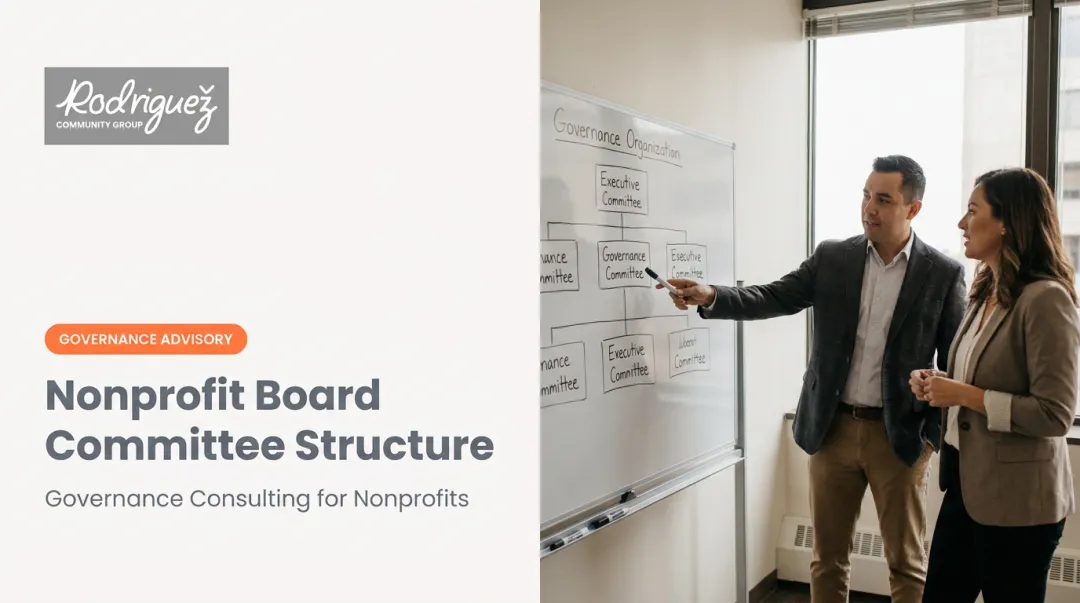
- Governance committee (board development, recruitment, self-assessment)
- Finance or audit committee (budget review, financial controls)
- External affairs or fundraising committee (development strategy, community relations)
Meeting and term requirements round out board structure. State law usually requires at least one meeting annually, but that's rarely enough for real oversight, so most boards meet more often based on size and complexity.
Term lengths commonly range from one to five years, with two consecutive three-year terms being a frequent pattern. Firms like Rodriguez Community Group often help nonprofits design this structure to fit their size and mission.
Building a High-Performing Nonprofit Board
Strong boards start with deliberate recruitment.
Skills-based recruitment means prioritizing mission alignment, relevant competence, and diverse lived experience over simply filling seats with connected or wealthy candidates. A finance background, legal expertise, or direct experience with the population served often matters more than a big Rolodex.
Once recruited, structured onboarding keeps new members engaged instead of lost:
- Written board member job descriptions
- A real orientation covering finances, programs, and governing documents
- Periodic self-assessment to surface gaps before they become problems
For small nonprofits, the challenge is often capacity, not intent. A five-person staff team rarely has bandwidth to build governance infrastructure from scratch while also running programs. This is where embedding experienced governance and financial oversight support helps.
Rodriguez Community Group (RZCG) has worked directly on this problem. When Climate Lead transitioned out of its fiscal sponsor to become an independent nonprofit, RZCG facilitated the design of a governance board built for its needs then and going forward. Staff stayed focused on strategic work instead of getting pulled into governance logistics.
A similar engagement with Denver Lab School paired board structuring with mission alignment and business planning support. In both cases, the goal was the same: strengthen oversight without adding administrative weight to already-stretched teams.

Frequently Asked Questions
What are the responsibilities of the board of directors at a nonprofit?
Boards owe fiduciary duties of care, loyalty, and obedience, and oversee financial health, executive performance, and strategic direction. They govern; staff manage the daily work.
Who is higher, CEO or board of directors?
The board holds ultimate governing authority — it hires, evaluates, and can remove the CEO. The CEO leads daily operations and staff but reports to the board.
Who holds a board of directors accountable?
State Attorneys General, the IRS, donors, and in some cases voting members all have mechanisms to enforce breaches of fiduciary duty or misuse of charitable assets.
Can nonprofit board members be paid?
Most board members serve as unpaid volunteers. Limited exceptions exist depending on state law and bylaws, but compensation must be reasonable and properly documented.
How often should a nonprofit board meet?
State law usually requires at least one annual meeting, but that's rarely sufficient for real oversight. Most effective boards meet more frequently, often quarterly.
What is the ideal size for a nonprofit board?
There's no universal number. BoardSource data shows an average of 15 members and a median of 13, though the right size depends on organizational budget and complexity.