For nonprofits, the appeal is straightforward: access senior financial leadership without a full-time salary, benefits package, and equity stake. But "fractional CFO" covers a wide range, from a generalist doing monthly reconciliations to a seasoned executive managing board reporting, grant compliance, and capital strategy.
Engagement scope reflects that range. This guide breaks down what drives those differences, what to expect by geography, and how to evaluate engagement models so your organization makes a well-informed decision.
Key Takeaways
- Fractional CFO engagement scope varies widely depending on experience level and specialization
- Strategic CFOs command a significant premium over operational CFOs focused on compliance and reporting
- Nonprofits typically see more accessible engagement terms than the general market mid-tier
- Remote engagements are narrowing geographic gaps, though major metros still command the highest rates
- Choosing between retainer, hourly, and project-based pricing matters as much as the rate itself
Fractional CFO Engagement Scope in 2026: What to Expect
No single rate standard exists for fractional CFOs. Rates vary by engagement model, the CFO's background, and what the organization actually needs. Three common mistakes when budgeting:
- Underestimating scope: assuming a light monthly touchpoint when significantly more hands-on time is more realistic
- Confusing service levels: bookkeeper or controller-level work marketed as CFO strategy
- Ignoring model fit: choosing hourly billing when a retainer would deliver more consistency
Typical Engagement Tiers
Multiple independent sources, including Graphite Financial, CFO Hub, The Expert CFO, KORE1, and FINCY, converge on a similar tiering for 2026:
| Tier | What's Typically Included |
|---|---|
| Entry-level / Generalist (5–10 years) | Basic financial reporting, bookkeeping oversight, back-office review |
| Mid-tier / Experienced (10–20 years) | Budgeting, forecasting, board reporting, cash flow management |
| Senior / Specialized (20+ years) | M&A advisory, fundraising strategy, scenario modeling, investor relations |
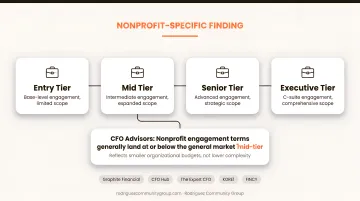
For nonprofits specifically, CFO Advisors reports engagement terms that generally land at or below the general market mid-tier, reflecting smaller organizational budgets rather than lower complexity.
Fractional vs. Full-Time CFO Comparison
A full-time CFO represents a significant compensation commitment once salary, benefits, and bonuses are included. Investopedia's nonprofit-specific figure is notably lower, but still well beyond what most small nonprofits can sustain.
Even at the high end of retainer arrangements, fractional engagement delivers substantial savings versus a full-time hire, per The Expert CFO and NowCFO.
Strategic CFO vs. Operational CFO Scope
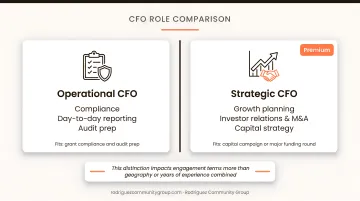
This distinction has the largest impact on engagement terms, more than geography or years of experience combined. Before locking in a plan, it's worth knowing which type of CFO your organization actually needs.
CFO-Recruit's 2026 guide puts the difference clearly:
- Operational CFOs focus on compliance, day-to-day reporting, and audit prep
- Strategic CFOs focus on growth planning, investor relations, M&A, and capital strategy
Strategic scope commands a substantial premium. A nonprofit hiring for grant compliance and audit prep sits firmly in the operational tier. One preparing for a capital campaign or a major funding round needs strategic expertise and should plan accordingly.
Key Factors That Drive Fractional CFO Engagement Scope
Engagement terms are shaped by the CFO's qualifications, the organization's complexity, and how frequently and deeply they're engaged.
Experience, Credentials, and Track Record
CFOs with specialized credentials, such as CPA or CMA, or proven results in areas like fundraising, M&A, or nonprofit compliance command a premium. That premium is often worth it. A generalist who misses a grant compliance issue or produces board reports that don't hold up to funder scrutiny can create costs far exceeding the rate differential.
Organization Size and Financial Complexity
Larger budgets, multiple funding streams, complex grant structures, and multi-entity operations all increase the hours and strategic depth required. A smaller nonprofit with a couple of unrestricted grants needs different support than a larger organization managing a dozen restricted grants across multiple programs.
In fiscal sponsorship transitions, where organizations are building financial infrastructure from the ground up, the engagement is consistently broader and more intensive than for organizations with existing systems already in place. Rodriguez Community Group sees this pattern regularly across its nonprofit CFO work.
Scope and Frequency of Engagement
A monthly financial review is not the same as:
- Weekly cash flow check-ins
- Full annual budget cycle support
- Board presentation preparation
- Financial systems implementation
Each adds hours. Defining scope clearly upfront, in writing, prevents billing surprises and ensures both parties understand what "fractional CFO support" actually means for your organization.
Industry Specialization: Nonprofit-Specific Needs
Nonprofits require a distinct skill set that not every fractional CFO has. Relevant competencies include:
- Fund accounting and restricted vs. unrestricted fund management
- Grant compliance and reporting
- IRS Form 990 oversight
- Audit preparation
- Donor financial reporting
- Mission-aligned budget strategy
Citrin Cooperman notes that fractional CFO services for nonprofits represent a strategic investment in compliance, transparency, and financial sustainability. A CFO without nonprofit-specific experience may underestimate grant restrictions, mishandle fund accounting, or produce 990-incompatible financial statements, all of which create downstream risk that far exceeds any rate differential.
Tools, Systems, and Current State of Financials
Organizations with disorganized books, outdated software, or no integrated financial systems often require their CFO to spend the first several months on cleanup rather than strategy. That means more hours and a larger engagement before any forward-looking work, such as forecasting, board reporting, or strategic planning, can even begin. Clean, integrated financials from the start change the equation entirely.
How Fractional CFO Engagement Terms Vary by State
Geography remains a factor, though the remote work shift has compressed some of the gaps. Cost of living, local talent market demand, and proximity to financial hubs all influence engagement terms.
High-Cost States and Major Metro Markets
Salary.com's state-level CFO data (June–July 2026) shows California and Massachusetts among the states with the highest full-time CFO compensation, well above the national average. These full-time salary premiums translate to higher fractional engagement terms in the same markets.
Fractional CFOs in New York City, San Francisco, Los Angeles, Boston, and Seattle typically command terms at the upper end of the national range for experienced practitioners. Demand is high, competition for senior financial talent is intense, and clients in these markets expect this.
Mid-Range States and Regional Markets
The picture looks different in mid-cost markets. Texas sits close to the national baseline, while Illinois runs somewhat above it, pulled upward by Chicago's financial ecosystem.
In mid-cost markets, including Texas, Colorado, Illinois, Georgia, and Florida, fractional CFO engagement terms typically land in a moderate range. Growing nonprofit and startup ecosystems in Austin, Denver, Chicago, and Atlanta have increased demand in recent years, but these markets still offer stronger value than coastal hubs.
Lower-Cost States and Rural Markets
States in the Midwest and Southeast outside major metros, such as Ohio, Indiana, Tennessee, Alabama, and similar states, see fractional CFO engagement terms that generally sit at the lower end of the national range for experienced practitioners. Full-time CFO salaries in these states run below the national average, which flows through to fractional engagement terms.
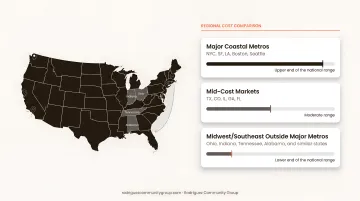
Here's a quick summary of where terms typically land by region:
- Major coastal metros (NYC, SF, LA, Boston, Seattle): upper end of the national range
- Mid-cost markets (TX, CO, IL, GA, FL): moderate range
- Midwest/Southeast outside major metros: lower end of the national range
Remote Engagement and Geographic Compression
Remote-first fractional CFO engagements have changed the equation. A nonprofit in rural Ohio can now access a Boston-trained CFO with deep nonprofit finance experience, often at terms closer to the national mid-range than the premium Boston tier.
Some CFOs still price by client location or add a premium for in-person and hybrid engagements. If you're in a lower-cost market and open to fully remote support, it's worth negotiating on that basis: the terms you'd expect for local talent are no longer your ceiling.
Hourly Rate vs. Monthly Retainer vs. Project-Based Pricing
The billing model shapes the entire engagement, and choosing the wrong structure can mean overpaying for flexibility you don't need, or under-budgeting for support you do.
Hourly Billing
The most flexible option: you pay only for time used, typically billed in 30- or 60-minute increments. Fractional CFO hourly engagement for nonprofit-focused work generally sits at a more modest range, depending on experience level and scope.
Hourly works well for low-volume or unpredictable needs, such as a one-time financial review, answering a specific board question, or spot-checking a grant budget. It carries no ongoing commitment, which makes it easy to start. The trade-off is less continuity and a higher effective rate compared to retainer arrangements.
Monthly Retainer
The most common structure for ongoing fractional CFO relationships. The organization commits to a fixed monthly scope or hour block, with most mid-sized nonprofit engagements landing in a moderate ongoing range.
Retainers suit organizations that need consistent strategic support across budget cycles, board reporting, audit prep, and cash flow oversight.
Project-Based Pricing
A defined scope negotiated for a specific deliverable: audit preparation, financial systems implementation, board presentation development, or grant budget creation. Scope is agreed upfront; the engagement ends when the project is complete.
This model fits organizations with a specific, time-bounded need that doesn't justify an ongoing retainer.
Choosing the Right Model
| Situation | Recommended Model |
|---|---|
| Unpredictable or low-volume needs | Hourly |
| Consistent ongoing support | Monthly retainer |
| Defined deliverable, clear timeline | Project-based |
| Testing the relationship first | Scoped introductory project |
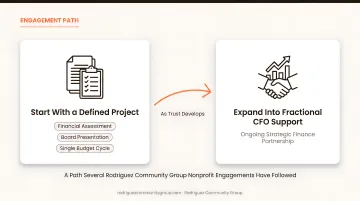
For nonprofits with limited or fluctuating budgets, starting with a defined project, such as a financial assessment, a board presentation, or a single budget cycle, is a practical way to test the relationship before committing to a retainer.
Several of Rodriguez Community Group's nonprofit engagements have followed exactly this path: beginning with a scoped assessment or interim role, then expanding into ongoing fractional CFO support as trust developed.
Is a Fractional CFO Worth It for Nonprofits?
The question isn't whether the engagement is affordable. It's whether the return, in risk reduction, funder confidence, cleaner audits, and freed-up leadership capacity, justifies the investment.
For most nonprofits past a certain stage of growth, it does.
Concrete value a fractional CFO delivers:
- Funder-ready financial reporting that holds up to scrutiny
- Stronger cash flow visibility and forecasting
- Cleaner audits with fewer findings
- Strategic budget alignment with organizational mission
- Reduced burden on program staff pressed into financial roles they weren't hired for
Signs your nonprofit is ready:
- Growing revenue alongside increasing financial complexity
- A portfolio of restricted grants requiring separate tracking
- An upcoming audit or compliance deadline
- Leadership transitions that left a financial gap
- Scaling operations or a major funding ask on the horizon
California provides a useful regulatory trigger: nonprofits above a certain gross revenue threshold are required by state law to undergo an independent audit. That threshold alone often creates the need for CFO-level oversight where none existed before.
Waiting too long carries real costs: financial errors, missed funder requirements, and lost opportunities that don't show up on a balance sheet until it's too late.
That's the gap Rodriguez Community Group is built to fill. Their team works inside client organizations rather than advising from the outside, embedded alongside staff on financial assessments, forecasting tools, performance monitoring, and decision-making frameworks. The goal is to leave the organization more capable, not more reliant on outside help.
Clients like English Learners Success Forum and Edgility have received full interim CFO support through this model, with financial strategy woven into day-to-day operations from the start.
Frequently Asked Questions
Is a fractional CFO worth it?
For organizations that need strategic financial leadership but can't justify a full-time hire, fractional CFOs typically deliver measurable value through improved cash flow management, cleaner audits, and stronger financial decision-making, at a fraction of a full-time CFO's total compensation.
How many hours per month does a fractional CFO typically work?
Early-stage or smaller organizations may need modest monthly hours. Growth-stage or more complex organizations often require significantly more. Defining scope upfront, and revisiting it during high-demand periods like audit season, helps keep the engagement predictable.
What is the difference between a fractional CFO and a bookkeeper or CPA?
Bookkeepers and CPAs focus on recording and reporting past financial activity. A fractional CFO provides forward-looking strategy: forecasting, risk management, growth planning, and board-level financial guidance. Many firms market CFO services but deliver controller- or bookkeeper-level work, so vetting experience and references is essential.
How do fractional CFO engagement terms vary by state?
Terms are generally highest in major coastal metros, such as New York, San Francisco, and Boston, where experienced CFOs command the top of the national range. Mid-range markets like Texas, Colorado, and Illinois typically see moderate terms. Rural and lower-cost Midwest markets often fall toward the lower end of the range, though remote engagements have narrowed some of these gaps.
Should nonprofits use hourly or retainer pricing for fractional CFO services?
Retainer arrangements often work better for nonprofits with consistent ongoing needs, such as budget cycles, board reporting, and audit prep. Hourly or project-based pricing suits organizations with one-time or unpredictable needs. Starting with a defined project is a practical, lower-risk way to evaluate fit before committing to a longer engagement.