Introduction
A nonprofit's mission rarely fails because the cause wasn't worthy. It fails because the governance behind it wasn't strong enough to carry the weight.
Boards that understand their role make a measurable difference. According to BoardSource's 2021 Leading with Intent report, 91% of chief executives whose board members strongly understood their roles reported a positive impact on organizational performance.
Among executives who said their board had weak role clarity, that number dropped to just 33%.
Many nonprofit leaders can't quite articulate what "effective governance" looks like day to day. That vagueness creates role confusion, stalled decisions, and boards that meet but don't move anything forward.
This guide breaks down what a board is actually responsible for and the traits that separate high-performing boards from stagnant ones. It also covers how to build the right team and who really holds power when the board and staff disagree.
Key Takeaways
- Effective boards balance legal duties with strategic, mission-driven guidance
- Board size and skills should be intentional, not accidental
- Defining clear board and executive director authority prevents power struggles and mission drift
- Regular self-assessment separates high-performing boards from stagnant ones
What Are the Core Responsibilities of a Nonprofit Board of Directors?
A nonprofit board's job breaks into four connected buckets: legal oversight, strategic guidance, executive leadership management, and resource development. Miss one, and the others tend to wobble too.
Legal and Fiduciary Duties
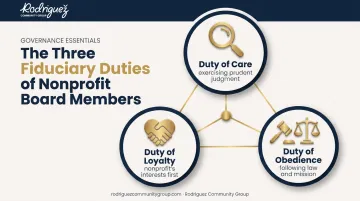
Every board member carries three legal duties, whether they realize it or not:
- Duty of care - exercising the judgment a reasonably prudent person would use, and actually paying attention to what's happening in the organization
- Duty of loyalty - putting the nonprofit's interests ahead of personal or professional gain, and disclosing conflicts of interest before they become problems
- Duty of obedience - following the law, the bylaws, and the organization's stated mission, as detailed in BoardSource's guide to nonprofit board legal duties
In practice, this means the board approves annual budgets, reviews audits, and signs off on major financial decisions before they happen, not after.
Strategic and Mission Oversight
Boards set the long-term direction and then check progress against it. That's different from managing the operational details of how programs get delivered week to week. For example, a growing enrollment number means little if it comes from sites drifting away from the founding student population the mission targets.
The healthiest boards ask "are we still moving toward the mission?" at every meeting, rather than getting absorbed in logistics that belong to staff. When that discipline slips, so does organizational focus.
Executive Leadership Oversight
The board hires, evaluates, and, when necessary, replaces the Executive Director. This isn't a once-a-decade task. It includes:
- Setting clear performance expectations tied to strategic goals
- Conducting regular, documented ED evaluations
- Maintaining a succession plan before a transition becomes urgent
Succession planning in particular gets overlooked until an ED resigns unexpectedly, leaving programs to stall for months while the board scrambles for interim leadership. Boards that build a plan proactively avoid that scramble and keep momentum during the transition.
Fundraising and Resource Development
Most boards operate under some version of a "give-or-get" expectation: contribute personally, or open doors to others who can. The real value board members bring isn't usually their own checkbook. It's their network.
BoardSource's research found that fundraising is where boards most often underperform, with roughly half of chief executives and board chairs rating their board's fundraising work as below average. Boards that actively introduce staff to donors, rather than treating fundraising as someone else's job, tend to see stronger results.
What Makes a Nonprofit Board Truly Effective?
How well a board functions together matters more than the resumes of its members. Five traits show up consistently across high-performing boards.
Mission Focus, Defined Roles, and Meeting Discipline
Three additional habits reinforce strong governance:
- Return to the mission at every decision point. Skipping this step invites "mission drift," where boards chase opportunities that don't actually serve their purpose.
- Document committee charters and individual role expectations, then reinforce them through structured onboarding and ongoing training for new members.
- Use consent agendas to free up meeting time for real strategic discussion, and cultivate a culture that welcomes respectful, healthy dissent over automatic agreement.
Together, these habits keep boards focused on mission, clear on responsibilities, and comfortable challenging each other's thinking.
Diverse, Well-Rounded Composition
A skills matrix helps boards see gaps before they become problems. Beyond professional skills, diversity of background, demographics, and lived experience strengthens how a board makes decisions.
Peer-reviewed research backs this up. A study published in Public Administration Quarterly found that nonprofit boards with more diverse membership had more inclusive governance practices, and that diversity-focused board practices were positively linked to organizational performance.
Separately, 84% of chief executives who felt their board had the right people for financial oversight reported a positive impact on performance, compared to just 48% among those who didn't.
Regular Evaluation and Accountability
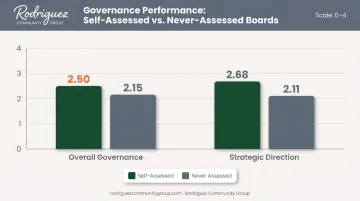
Boards that complete annual self-assessments consistently outperform those that don't. BoardSource found boards assessed within the past two years scored 2.50 on a 0-to-4 governance scale, versus 2.15 for boards that had never assessed themselves. The gap was even wider for strategic direction: 2.68 versus 2.11.
Board Composition and Size: Building the Right Team
There's no single "correct" board size; what matters is matching size to organizational complexity.
That said, a few benchmarks are worth knowing: the average nonprofit board has 15 members, with a median of 13. Larger budgets tend to correlate with larger boards: organizations above $10M in budget average 17.5 members, compared to 13.1 for organizations under $1M, according to BoardSource.
A few practical notes:
- Odd numbers help avoid tie votes on close decisions
- Term limits matter: 95% of nonprofit boards set term lengths, and most common structure is two consecutive three-year terms
- Rotating members balances institutional memory with fresh thinking
Right-sizing the board is only half the equation: who fills those seats matters just as much. When recruiting, the three Ts framework keeps things practical:
- Time - Can this person actually show up and engage?
- Talent - What specific skill or expertise fills a current gap?
- Treasure - Can they contribute financially, or connect the org to those who can?
Governance Power Dynamics: Who Really Runs a Nonprofit?
Here's a common misconception: that the Executive Director, or maybe the Board Chair, "runs" the organization. Neither does. Legal and fiduciary authority rests with the board collectively, not any single individual.
The Board Chair and the Executive Director hold complementary, not competing, roles:
| Role | Focus |
|---|---|
| Board Chair | Leads governance, facilitates board meetings, supervises the ED |
| Executive Director | Manages daily operations, implements strategy, leads staff |
The board's job is to evaluate the ED and hold them accountable, not to micromanage how programs get delivered on a Tuesday afternoon.
Boards typically blur that line in a few common ways:
- Rubber-stamping: Approving every ED proposal without real discussion, leaving no meaningful oversight
- Micromanaging: Second-guessing hiring decisions, vendor contracts, or program logistics that belong to staff
- Role confusion: Individual board members or the chair acting unilaterally instead of through board consensus
Each pattern costs the organization differently: rubber-stamp boards miss warning signs before a crisis hits, while micromanaging boards burn out EDs and slow decisions that don't need board sign-off. RZCG frequently helps boards resolve this exact tension.
Common Barriers to Board Effectiveness (and How to Overcome Them)
Even well-intentioned boards run into the same handful of problems. The usual suspects:
- Role ambiguity between board members and staff, especially around who decides what
- Weak or inactive committees that exist on paper but don't actually meet
- Staying too small to be effective, without enough hands to cover fiduciary, strategic, and fundraising duties
- Limited capacity for ongoing board development and training
Warning signs your board structure is holding you back:
- Meetings run long without decisions getting made
- Committees haven't met in over a year
- The ED is quietly making board-level calls because nobody else is
For many small nonprofits, especially those spinning off from a fiscal sponsor or scaling past their original structure, the more effective fix is an embedded partner who works alongside leadership rather than a one-time consulting report.
That's the model Rodriguez Community Group uses with organizations up to 50 staff and $25M in revenue. Working alongside Climate Lead during a fiscal sponsor spin-off, RZCG helped build a governance board suited to the organization's near-term and long-term needs.
The team kept staff focused on mission work instead of transition logistics. That kind of embedded involvement, instead of a report delivered at the end of an engagement, is what makes governance changes stick.

Frequently Asked Questions
What are the responsibilities of a nonprofit board of directors?
A nonprofit board oversees legal and fiduciary duties, sets strategic direction, manages the Executive Director's performance, and supports fundraising through personal networks and financial contributions.
What makes an effective board of directors for a nonprofit?
Effective boards stay anchored to mission, recruit for skills and diverse perspectives, define roles clearly, and conduct regular self-assessments to catch blind spots before they become bigger problems.
What is the optimal board size for a nonprofit?
Most effective boards range from 5 to 15 members, though larger organizations with bigger budgets often run closer to 15 to 18. Size should match organizational complexity, not follow a fixed rule.
Who holds the most power in a nonprofit organization?
The board holds ultimate legal and fiduciary authority collectively. The Executive Director manages daily operations under the board's oversight, but no single person unilaterally controls the organization.
How often should a nonprofit board meet?
Quarterly meetings are the most common cadence, with committees convening as needed between full board sessions. The right frequency depends on how much strategic and fiduciary work the board needs to cover.
How is nonprofit board effectiveness measured?
Boards typically use annual self-assessments and KPIs tied to strategic goals, alongside engagement metrics like meeting attendance and committee participation, to gauge whether governance is working.