Common pain points show up again and again:
- Teams too resource-constrained to step back and plan
- Unclear priorities that leave staff pulled in five directions
- Strategic plans built once, filed away, and never revisited
- Difficulty proving impact when funders ask for hard numbers
This guide walks through what a modern strategic plan should include, a step-by-step process built for 2026's realities, the mistakes that sink most plans, and how to know when outside support makes sense.
Key Takeaways
- Strategic planning sharpens focus, aligns resources, and strengthens your 2026 fundraising position
- A strong plan covers mission/vision, organizational analysis, priorities, measurable goals, and an implementation system
- Planning works best as a recurring, stakeholder-driven cycle, not a document you write once
- Most plans fail from weak execution and budget misalignment, not bad strategy
What Is Nonprofit Strategic Planning and Why It Matters More in 2026
Strategic planning is the process of building a 3-5 year roadmap that aligns your mission, resources, and measurable goals. It's different from annual or operational planning, which focuses on the next 12 months of execution. Think of strategy as the destination and operations as the driving directions.
According to the National Council of Nonprofits, strategic planning works when staff and board commit to measurable goals, approve implementation priorities, and revisit the plan as conditions change. That last part is where most organizations fall short.
Why 2026 Raises the Stakes
The financial pressure is real. 36% of nonprofits ended 2024 with an operating deficit, the highest share in ten years of tracking, according to the Nonprofit Finance Fund's 2025 State of the Nonprofit Sector Survey. Eighty-five percent of those same organizations expect service demand to keep climbing in 2025.
Layer on government funding risk, and the picture gets tighter still. Independent Sector's 2025 research found 81% of organizations struggled to raise enough money to cover all their costs, with a third experiencing funding disruption in just the first half of the year.
AI adds another layer of pressure. A 2025 Salesforce global survey of nonprofits found that organizations with 0-24 staff had the lowest AI adoption at 28% and the lowest openness to it at 40%, even as 55% of nonprofits overall were using or piloting AI tools. Small teams are being asked to modernize without the bandwidth to figure out how.
Key Benefits of a Nonprofit Strategic Plan
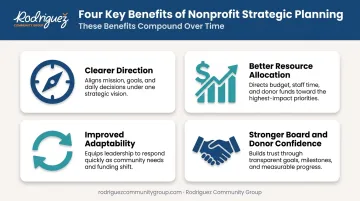
Facing these pressures, organizations with a clear strategic plan are better positioned to adapt than those without one. A well-run planning process delivers benefits that compound over time:
- Clearer direction: Everyone from the board to frontline staff knows what matters most this year
- Better resource allocation: Budget and staff time go toward priorities instead of whatever feels urgent that week
- Improved adaptability: A defined strategic framework makes it easier to respond when funding or community needs shift
- Stronger board and donor confidence: Funders want to see a plan, not just a mission statement
That last point matters more than most boards realize. In BoardSource's benchmarking research, boards averaged a 2.87 out of 4, roughly a C grade, on effective strategic planning practices. Only 20% earned an A from their chief executive for actually adopting and following through on a plan. Having a plan and living by one are two different things.
What Should a Nonprofit Strategic Plan Include?
A strategic plan isn't just a mission statement with extra pages. It's a working document with six essential components.
- Mission, Vision, and Values: These three statements anchor every prioritization and budget decision you make throughout the plan. Skip this step, and every later decision becomes a debate about first principles.
- Organizational and Environmental Analysis: A SWOT or landscape assessment covering internal capacity, program effectiveness, and external trends. The National Council of Nonprofits stresses that SWOT informs the strategy—it isn't the plan itself.
- Strategic Priorities or Pillars: Narrow your focus to 3-5 thematic priorities. A plan with twelve priorities is really a wish list, and wish lists don't get executed.
- SMART Goals: Each priority needs specific, measurable objectives tied to realistic timelines. Vague goals like "improve fundraising" don't give staff anything to act on.
- Implementation and Ownership Structure: Every goal needs an assigned owner, a budget line, and a communication plan. Without ownership, goals sit unclaimed.
- Accountability and Review Cadence: Build in quarterly check-ins and simple dashboards so the plan stays a living document instead of shelfware.
Bridgespan's research backs this structure up directly, recommending monthly program reviews, quarterly strategic check-ins, and a more thorough annual review that resets goals and realigns budgets. This is the same cadence RZCG builds into its engagements, embedding with client teams to keep goals moving and owners accountable between check-ins.
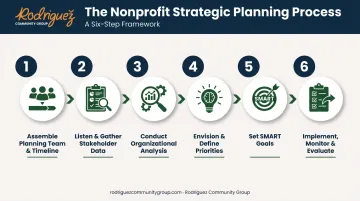
The Nonprofit Strategic Planning Process: Step-by-Step for 2026
This sequence works for organizations of nearly any size, though the depth of each step should scale to your capacity and staff count.
Step 1: Assemble Your Planning Team and Set a Timeline
Bring together board members, senior staff, and a few key stakeholders early. Bridgespan recommends forming a planning task force that includes both board leadership and top executives, because participation early on builds the understanding and ownership needed later. Set a realistic timeline; Bridgespan notes that developing an effective plan typically takes at least several months, not weeks.
Step 2: Listen — Engage Stakeholders and Gather Data
Use surveys, interviews, and community input to understand internal capacity and external needs before setting a single priority. Bridgespan's stakeholder engagement research found that involving staff, funders, and community members fills blind spots and builds shared ownership of whatever plan gets adopted.
Step 3: Conduct a Full Organizational Analysis
Assess your programs, your financial model, and your organizational capacity honestly. Digital maturity plays a bigger role here than most leaders assume. A Salesforce.org study found that 64% of highly digitally mature organizations could accurately forecast income, compared to zero percent among low-maturity organizations. If your data practices are weak, your forecasts probably are too.
Step 4: Envision — Reaffirm Mission and Define Strategic Priorities
Test whether your existing mission and vision statements still hold true given today's landscape. Then narrow your organizational focus into 3-5 strategic pillars — few enough to fund and staff well.
This is where many boards want to keep every program on the list. Resist that urge, or nothing gets adequate resources.
Step 5: Plan — Set SMART Goals and Action Plans
Translate each pillar into measurable goals with an assigned owner, a timeline, and the resources required to hit it. For example, "grow individual giving" becomes "increase the donor base 15% by Q4, owned by the development director, with $10,000 for donor outreach."
Without an assigned owner, goals rarely move past the planning binder.
Step 6: Implement, Monitor, and Evaluate
Build review rhythms into your existing calendar. Add strategic priorities to board meeting agendas, and track KPIs like donor retention or program outcomes on a simple dashboard.
Fundraising trends make this non-negotiable. Recent data from the Fundraising Effectiveness Project shows:
- Total donor counts fell 3.6% in 2025, even as total dollars raised rose 5.0% — fewer, larger gifts are propping up revenue
- Retention sat at just 18.1% year-to-date in Q1 2025
If you're not tracking these numbers quarterly, you'll find out too late that your model is shifting under you.
Common Nonprofit Strategic Planning Mistakes to Avoid
Even well-intentioned plans fail for predictable reasons:
- No clear metrics or SMART goals: A plan full of aspirational language but no measurable targets gives staff nothing to act on
- Skipping stakeholder buy-in: Plans built behind closed doors without board or staff input rarely survive contact with implementation
- Treating the plan as static: Filing the plan away for three years and never revisiting it as conditions change
- Budget misalignment: Approving a strategic plan and then building an annual budget that ignores it entirely
BoardSource's data illustrates just how common this last issue is. Boards averaged 2.76 out of 4 on tracking progress toward strategic goals, with only 13% receiving an A for monitoring performance and impact. A plan without monitoring is just a document.
Choosing the Right Support for Your Nonprofit's Strategic Plan
Many small nonprofits have the vision but not the internal bandwidth, financial expertise, or governance structure to execute a plan well. That gap is exactly where outside support earns its value, provided it's the right kind of support.
Rodriguez Community Group (RZCG) works differently than a traditional outside consulting firm. Its team of experienced executives, averaging 15 years in nonprofit leadership, embeds directly within client teams instead of delivering a report and walking away.
This hands-on model supports strategic planning, financial controls, governance, and operations from the inside.
This model shows up in practice across RZCG's client work:
- The Oakland REACH: An interim Chief of Staff role expanded into full COO functions during a leadership transition, pairing strategic finance with operational improvements to support growth beyond Oakland
- English Learners Success Forum needed to move quickly without diverting staff from mission-critical work, so RZCG provided interim COO and CFO support while facilitating its fiscal sponsorship spin-off
- For Climate Lead, RZCG led governance design and organizational structuring during a spin-off, building a board suited to both current and future needs

RZCG serves organizations with up to 50 staff and $25M in annual revenue, which shapes how it approaches every engagement. Strategic planning isn't treated as an abstract exercise disconnected from finance and operations.
Instead, it's built alongside the executive functions your organization may not have in-house. That's why these plans tend to translate into sustainable outcomes rather than sitting on a shelf.
Frequently Asked Questions
What should a nonprofit strategic plan include?
A strong plan includes mission, vision, and values; an organizational and environmental analysis; 3-5 strategic priorities; SMART goals; and an implementation structure with clear ownership and review cadence.
How often should a nonprofit update its strategic plan?
Review progress annually, with a full plan refresh every 3-5 years or sooner if your organization experiences major change, such as a leadership transition or funding shift.
Who should be involved in the nonprofit strategic planning process?
Board members, senior staff, program leaders, and key community stakeholders should all have a voice. Early involvement from these groups builds the buy-in needed for successful implementation.
How long does it take to create a nonprofit strategic plan?
Timelines typically range from a few months to a year, depending on organizational size and how broadly you engage stakeholders. Most effective plans take at least several months to develop properly, especially when stakeholder input is built into the process.
What's the difference between a strategic plan and an annual operating plan?
A strategic plan sets your 3-5 year direction and priorities. An annual operating plan details the year-to-year execution, budget, and tasks needed to move that strategy forward.
Does a small nonprofit need outside help to build a strategic plan?
Many small nonprofits lack the internal bandwidth or specialized financial and governance expertise to execute a plan well on their own. Embedded interim executives can fill that gap on a temporary basis, without adding permanent headcount.