
Introduction
The nonprofit sector is enormous. America's 1.3 million charitable nonprofits deliver services that touch nearly every community in the country, according to the National Council of Nonprofits. But scale doesn't equal security.
A recent survey of 380 U.S. nonprofit leaders found that 73% reported increased demand for services, while 66% expressed concern about their organization's financial stability, according to the Council of Nonprofits' 2026 State of Nonprofits findings. Grants are tightening, donor competition is fiercer than ever, and staff burnout is pushing teams to the brink.
Against that backdrop, more nonprofit boards are asking a question that used to feel taboo: should we combine with another organization?
Nonprofit mergers and acquisitions aren't just a rescue plan for organizations in trouble anymore. Many healthy nonprofits pursue combinations proactively, chasing scale, complementary expertise, or a stronger funding base. This article covers the different types of nonprofit combinations, the factors leaders must weigh before merging, and the step-by-step process for getting it right.
Key Takeaways
- Four legal structures govern nonprofit combinations, each with distinct liability and governance implications
- Financial pressure rarely drives mergers alone — mission expansion and capacity building matter just as much
- Merger success depends on due diligence, cultural alignment, and stakeholder communication long after signing
- Shared services and fiscal sponsorship can deliver similar benefits with less disruption than a full merger
What Are the Different Types of Nonprofit Combinations?
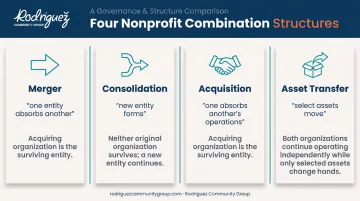
"Merger" gets used as a catch-all term, but it's not accurate. Four distinct legal structures exist, and each carries different consequences for governance, liability, and branding. State law also doesn't always define these terms consistently, so the label you use matters less than confirming the correct structure with legal counsel in your state.
Here's how the four structures compare:
| Structure | What happens | Who survives |
|---|---|---|
| Merger | One entity absorbs another; assets, programs, and liabilities transfer | Surviving organization |
| Consolidation | Both entities dissolve; a new organization forms | Brand-new entity |
| Acquisition | One nonprofit absorbs another's operations | Acquiring organization |
| Asset Transfer | Selected assets/programs move; liabilities often stay behind | Receiving organization |
Merger
A merger combines two or more corporations into a single surviving entity. The organization that disappears transfers its assets, programs, and liabilities to the survivor. This is the most common structure when one organization is significantly larger or more established than the other.
Consolidation
In a consolidation, all participating organizations dissolve and form a brand-new third entity. Nonprofits often choose this route for branding reasons or to signal political parity between two roughly equal partners — neither organization is seen as "winning" or "losing" its identity.
Acquisition
An acquisition happens when one nonprofit absorbs another's assets, programs, and operations. The acquired organization typically stops operating independently. Unlike a merger, the framing here is less about combining as equals and more about one organization taking over another's work.
Asset Transfer
An asset transfer involves moving specific assets or programs, often followed by the transferring organization's dissolution. This structure lets the receiving organization pick up valuable programs while avoiding the transferor's existing liabilities, a meaningful protection when the transferring nonprofit has debt or legal exposure.
Why Nonprofits Pursue Mergers and Acquisitions
Financial strain gets most of the attention, but it's rarely the whole story. A study of 41 Minnesota nonprofit mergers found that 93% of organizations cited increased service delivery as a driver, and 93% cited long-term viability. Only 37% pointed to avoiding an imminent financial crisis, according to SeaChange Capital Partners' research. In other words, most mergers are growth decisions, not last resorts.
Common drivers include:
- Persistent funding pressure and shrinking grant pools
- Capacity limits that cap program growth
- Complementary strengths between two organizations
- Opportunities to expand mission reach into new communities
The efficiency case: Combining back-office functions like HR, finance, and IT cuts overhead. A merged organization also draws from a broader, more diversified funding base, which reduces dependence on any single grant or donor.
The mission case: Beyond efficiency, combinations expand what's possible programmatically:
- Wider geographic reach without building new infrastructure from scratch
- Access to combined technical expertise
- Stronger, more unified community impact under one banner
Critical Considerations Before Merging Your Nonprofit
Before committing to any of the four structures above, leaders need to evaluate several interconnected factors. Skipping any one of them tends to surface as a problem later, usually during integration when it's much harder to fix.
Mission and Values Alignment
Compatible missions matter more than compatible balance sheets. The goal of any combination should be strengthening the combined mission, not diluting it. If two organizations serve overlapping populations with genuinely different theories of change, that mismatch will surface in board meetings, program decisions, and staff morale within the first year.
Financial Health and Due Diligence
Both organizations need a rigorous financial review covering:
- Assets and liabilities on both balance sheets
- Restricted funds and their original donor terms
- Grant obligations and reporting commitments
- Debt, leases, and contingent liabilities
This is where many nonprofits stumble, not because the numbers are bad, but because the systems tracking them are weak or inconsistent between organizations.
Rodriguez Community Group (RZCG) helps nonprofits strengthen financial management and controls before a deal is on the table. Leaders then enter due diligence with clarity instead of scrambling to reconstruct records under deadline pressure.
Leadership, Governance and Culture
Leadership style compatibility, board composition decisions, and organizational culture directly shape whether a merger holds together post-close.
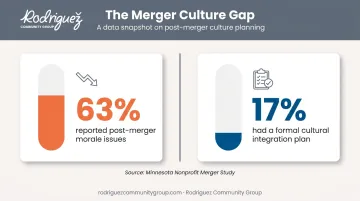
In the Minnesota study cited above, 63% of merged organizations reported post-merger morale issues, yet only 17% had a formal plan for cultural integration. That gap is worth sitting with: culture problems are predictable, but most organizations don't plan for them.
Legal and Regulatory Compliance
Every combination requires:
- Board approval from each participating organization, per its bylaws and state law
- Compliance with state nonprofit merger or consolidation statutes
- Proper handling of donor-restricted asset transfer rules
- Confirmation that 501(c)(3) tax-exempt status carries forward correctly
The IRS generally doesn't require a new exemption application for qualifying restructurings, but the conditions are specific. Confirm your transaction actually qualifies before assuming tax-exempt status carries forward.
Stakeholder Support and Communication
Staff, donors, board members, and beneficiaries all need early, transparent engagement. Waiting until a deal is signed to communicate breeds resistance and rumor. Build buy-in before you need it.
How Do You Merge Two Nonprofits? The Step-by-Step Process
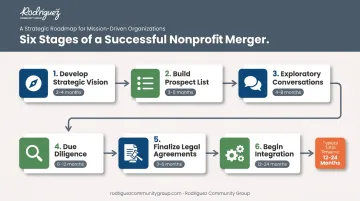
Nonprofit combinations follow a fairly consistent sequence, even though timelines vary widely by organization size and complexity.
- Develop a strategic vision with the board. Determine whether a merger, acquisition, consolidation, or asset transfer actually fits your organizational goals. Don't default to "merger" just because it's the familiar term.
- Build and narrow a prospect list. Identify potential partner organizations, then filter based on mission fit and strategic benefit rather than convenience or familiarity.
- Hold exploratory conversations before formal commitment. Test compatibility through smaller collaborations, like a joint program, before signing anything binding.
- Conduct comprehensive due diligence. This covers financial, legal, operational, and cultural factors. Successful collaborations average 8 months for exploration and 12 months for planning, according to a SeaChange Capital Partners and NYMAC review of 52 nonprofit combinations; full integration takes longer still.
- Finalize legal agreements. This includes the plan of merger, board approvals from both organizations, and required state filings.
- Begin integration. Combine systems, staff, and programs, with sustained change management and communication continuing well into the following year.
Common Challenges Nonprofits Face During M&A
Even well-planned combinations run into friction. Three areas cause the most trouble:
People and culture. Staff face genuine uncertainty about leadership roles, job security, and whether the combined organization's identity still reflects their values. This uncertainty doesn't resolve on its own, and it needs active management from leadership.
Communication breakdowns. Inconsistent messaging before, during, and after the transaction erodes stakeholder trust fast. Donors who hear conflicting stories from board members and staff start to worry about organizational stability.
Technology and systems integration. Combining or migrating financial and data systems can disrupt operations if it's treated as an afterthought rather than addressed early in due diligence.
When a Merger Might Not Be the Right Answer
Not every organization needs a merger. If your nonprofit has strong financials, an effective board, and a clear growth trajectory on its own, a full legal combination may create more disruption than it solves.
Lower-commitment alternatives can deliver similar benefits:
- Joint operating agreements for shared program delivery
- Shared administrative services (HR, finance, IT) without merging corporate structures
- Fiscal sponsorship, which extends legal and tax-exempt status to a project without requiring a separate 501(c)(3)
These structures preserve independence while still capturing efficiency gains. RZCG has guided organizations including English Learners Success Forum, Scientific Philanthropy Alliance, and Climate Lead through fiscal sponsorship transitions. Each engagement focused on building the financial, governance, and operational infrastructure needed to operate independently, without the complexity of a full merger.
Whichever path fits best, the decision deserves outside scrutiny before it's finalized. Partner with an advisor who can objectively assess organizational readiness, financial health, and mission fit. An outside (or embedded) perspective often catches costly missteps that internal teams, close to the situation, tend to miss.
Frequently Asked Questions
How do you merge two nonprofits?
Start by establishing a strategic vision with your board, then identify and vet a compatible partner. From there, conduct thorough due diligence before formally integrating operations, systems, and staff.
What are the 4 types of mergers?
The four primary structures are merger, consolidation, acquisition, and asset transfer. Each differs in whether a new entity forms, which organization survives, and how liabilities transfer.
How long does a nonprofit merger typically take?
Most mergers take one to two years or more from initial conversations through full integration. Exploration and planning phases alone often average close to 20 months combined.
Do nonprofit mergers require board approval?
Yes. Each organization's board must approve the transaction according to its bylaws and applicable state nonprofit law, and some states require additional approvals.
What happens to donor-restricted funds during a merger?
Restricted funds must continue honoring the original donor's intent after the merger. This often requires formal transfer agreements, and in some cases, direct donor notification or consent.
Is a nonprofit merger the same as an acquisition?
No. A merger creates one unified entity from two or more organizations. An acquisition, in contrast, involves one nonprofit absorbing another's assets and programs, with the acquired organization typically ceasing independent operation.