

Introduction
Most small nonprofits and mission-driven organizations need serious financial leadership, not just someone to close the books each month. But a full-time CFO's salary alone puts that hire out of reach for most organizations under $25M in revenue.
Virtual CFO services bridge that gap, giving organizations access to experienced financial leadership on a part-time or fractional basis. Demand is rising: according to a 2025 BTQ Financial survey of 100 nonprofit leaders, **30% of nonprofits now outsource finance and accounting**, and among those that do, 55% use staff augmentation and fractional CFO services specifically.
The challenge is that engagement scope varies enormously, and choosing the wrong tier leads to either overpaying for services you don't need or underinvesting when it counts most.
This guide breaks down virtual CFO service tiers, what's included at each level, and how to find the right fit for your organization's size and stage.
Key Takeaways
- Engagement scope depends on organizational size, complexity, engagement model, and provider type (individual vs. team)
- Virtual CFO and fractional CFO are largely interchangeable: both provide senior financial leadership without a full-time hire
- Nonprofits with complex grant portfolios or leadership transitions get the most value from this model
- Choosing a provider with sector-specific experience reduces onboarding time and the risk of misaligned advice
What Do Virtual CFO Services Include?
Virtual CFO services don't have a fixed scope. What's included is shaped by engagement model, provider type, and organizational complexity. Two organizations at the same revenue level can land in very different service tiers based on what they actually need.
Two common pitfalls: underbudgeting for a basic bookkeeper when CFO-level strategy is the actual need, and overpaying for a premium package when light advisory would suffice.
Entry-Level / Basic Virtual CFO Services
Entry-level engagements cover the fundamentals:
- Basic financial reporting and budget review
- Forecasting support with limited hours
- Ad hoc advisory access (a few hours per month)
- A single point of contact, often a solo practitioner
What's typically excluded: deep strategic planning, multi-entity compliance, fundraising support, board-ready packages, and audit preparation.
Best for: Organizations with straightforward finances and smaller revenue, or those testing the model before committing to a deeper engagement.
Mid-Range / Standard Virtual CFO Services
Most growing organizations land here. The scope expands meaningfully:
- Monthly financial analysis and cash flow management
- KPI dashboards and variance reporting
- Board-ready financial packages
- Some strategic advisory (scenario planning, budget development)
- Consistent financial oversight aligned with programmatic goals
Best for: Growing nonprofits or organizations with mid-sized revenue managing multiple funding streams, preparing for audits, or needing ongoing financial oversight.
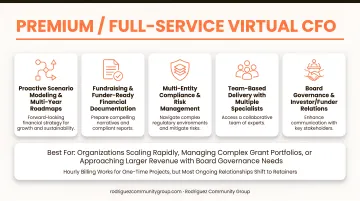
Premium / Full-Service Virtual CFO
This tier functions as a true strategic finance partnership, not just oversight, but active leadership:
- Proactive scenario modeling and multi-year financial roadmaps
- Fundraising and funder-ready financial documentation
- Multi-entity compliance and risk management
- Team-based delivery with multiple specialists
- Board governance support and investor/funder relations
Best for: Organizations scaling rapidly, managing complex grant portfolios, or approaching larger revenue with board governance needs.
Hourly billing works for one-time projects, but most ongoing relationships shift to retainers.
What's Included in Virtual CFO Services?
Virtual CFO services span from transactional oversight to forward-looking strategy. Unlike bookkeepers or controllers who focus on historical data, a virtual CFO is primarily concerned with where the organization is heading financially. Most engagements cover four core areas.
Financial Strategy and Planning
This is the foundation of CFO-level work:
- Multi-year financial roadmaps aligned to organizational goals
- Cash flow forecasting and scenario modeling
- Budget development and variance analysis
- Stress-testing financial assumptions against different growth or funding outcomes
Financial Reporting and Performance Monitoring
- Monthly and quarterly management reports
- KPI dashboards tracking financial health against organizational benchmarks
- Board-ready financial packages that build stakeholder confidence
- Translating complex financial data into actionable leadership insights
Compliance, Risk Management, and Governance
For nonprofits especially, this area carries real stakes. Federal rules require any nonprofit expending $1,000,000 or more in federal awards to undergo a Single Audit, and that threshold includes pass-through funds from other entities. A virtual CFO helps organizations track this exposure and prepare accordingly.
Typical services include:
- Internal controls and audit preparation
- Regulatory compliance oversight
- Fund accounting and grant reporting (nonprofit-specific)
- Donor restriction tracking
Integrated Finance + Operations Support
Team-based virtual CFO models go further than finance alone. Rodriguez Community Group, for example, embeds experienced finance and operations professionals directly within nonprofit organizations, integrating strategic planning, governance support, and operational performance into one engagement. For small nonprofits, this matters because finance decisions rarely exist in isolation from programmatic ones: a budget cut affects staffing, a new grant shapes program design, and a funding gap can stall entire initiatives.
This integrated model is particularly relevant for organizations at a growth inflection point, where financial decisions and operational ones need to move in lockstep:
- Aligning budget cycles with programmatic planning timelines
- Surfacing financial risks before they become operational ones
- Connecting grant compliance requirements to day-to-day workflows
Key Factors That Affect the Scope of Virtual CFO Services
Scope is shaped by organizational complexity, depth of engagement, provider type, and engagement structure, not just hours worked.
Scope and Depth of Services
A narrow engagement focused on monthly reporting requires significantly less than a full strategic advisory retainer that includes scenario planning, compliance oversight, and board preparation. Requirements scale directly with the breadth of what the provider is expected to cover.
One useful benchmark: the 2024 CPA.com/AICPA CAS Benchmark Survey found that 84% of advisory accounting practices have shifted to fixed-fee billing, with 55% charging separate fees for technology setup and system integration. Both points matter when you're comparing proposals.
Organization Size and Financial Complexity
More complexity means a broader engagement. Key drivers include:
- Annual revenue and growth stage
- Number of funding streams (especially multiple grants with different restrictions)
- Staff size and multi-entity structures
- Board reporting frequency and governance requirements
Engagement Model: Hourly vs. Retainer vs. Project-Based
| Model | Best For |
|---|---|
| Hourly | One-time projects, ad hoc needs |
| Monthly retainer | Ongoing strategic support |
| Project-based | Audit prep, fundraising documentation |
Monthly retainers deliver more value for ongoing relationships. Hourly billing can create unpredictability and often discourages the proactive conversations that make CFO relationships valuable.
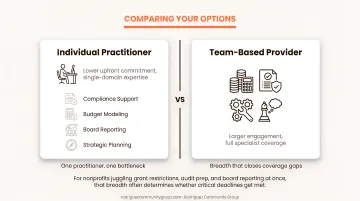
Individual Practitioner vs. Team-Based Provider
A solo virtual CFO may require less upfront commitment but offers limited bandwidth and single-domain expertise. When you need compliance support, budget modeling, board reporting, and strategic planning simultaneously, a single practitioner becomes a bottleneck.
A team-based firm provides access to specialists across finance, compliance, operations, and strategy, which typically requires a larger engagement but eliminates coverage gaps. For nonprofits juggling grant restrictions, audit prep, and board reporting at once, that breadth often determines whether critical deadlines get met.
Provider Experience and Sector Specialization
Providers with deep nonprofit experience, including fund accounting, grant compliance, fiscal sponsorship structures, and board governance, represent a premium tier of support. The tradeoff is faster onboarding and advice that fits how nonprofits actually operate, rather than guidance borrowed from corporate finance playbooks.
Virtual CFO Engagement Structure: One-Time vs. Recurring Commitments
The monthly retainer is not your only consideration. Build your plan around three categories:
Onboarding and setup (one-time): Most providers scope system integration, financial diagnostics, and aligning with your existing tools and reporting infrastructure separately. According to a CPA.com/AICPA survey, 55% of advisory practices charge a separate technology and setup fee, with scope varying by provider and complexity of integration.
Monthly retainer (recurring): This is your core ongoing commitment. Retainers are typically scoped by hours or service tiers. Requirements may rise temporarily during high-demand periods: audit season, a major grant cycle, or a leadership transition.
Add-on or project-based work (periodic): Some services are commonly scoped and delivered separately outside the base retainer:
- Audit preparation
- Grant compliance documentation
- Strategic planning facilitation
- Fundraising round support
- Fiscal sponsor spin-off work
Build these into your annual planning, especially if grant reporting cycles or a fiscal sponsorship transition falls within the engagement period.
How to Scope the Right Engagement and What Most Organizations Get Wrong
The right engagement matches your organization's actual financial complexity and strategic goals, not just the option that checks a box.
Factors to Consider
- Revenue size and trajectory: Are you stable, growing, or in transition?
- Funding complexity: How many grants, contracts, and earned income streams are you managing?
- Board and funder reporting: How frequently and at what level of detail?
- Near-term triggers: Audit, funding round, leadership change, or fiscal sponsor spin-off?
- Strategic vs. compliance focus: Are you optimizing existing operations or navigating something new?
Common Mistakes to Avoid
- Focusing only on the monthly commitment while ignoring onboarding and add-on requirements
- Choosing an individual practitioner when you need multi-domain expertise across finance, compliance, and governance
- Over-specifying a premium package for a stable, low-complexity organization
- Conflating bookkeeping or accounting with CFO-level strategy, then underinvesting in the latter
Conflating bookkeeping with CFO-level strategy is particularly costly for nonprofits. The Nonprofit Finance Fund's 2025 survey of 2,206 nonprofits found 36% ended 2024 with an operating deficit and 52% had three months or less of cash on hand. Organizations at that level of financial pressure need proactive forecasting and cash management, not reactive reporting.
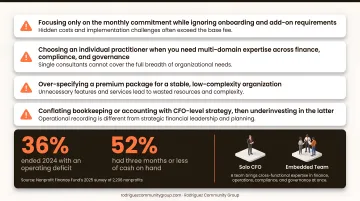
For nonprofits and mission-driven organizations in the growing-to-mid-size revenue range, an embedded team-based model often delivers better value than a premium solo CFO. A team brings cross-functional expertise in finance, operations, compliance, and governance at once, which maps more naturally to how small nonprofits actually operate. Rodriguez Community Group's approach is built around exactly this model.
Frequently Asked Questions
What is included in virtual CFO services?
Core services include financial strategy and planning, monthly reporting, KPI monitoring, compliance oversight, and board-ready financial packages. Scope varies by provider and engagement level, and some providers also integrate governance support and operational advisory.
What is the difference between a virtual CFO and a fractional CFO?
The terms are largely interchangeable. "Virtual" emphasizes remote delivery; "fractional" emphasizes part-time commitment. Both provide senior-level financial leadership without a full-time hire, and most providers use the terms interchangeably.
Do nonprofits need a virtual CFO?
Nonprofits managing multiple grant streams, donor reporting requirements, and audit obligations frequently lack the in-house financial leadership to handle all three well. Organizations in that position tend to see the clearest return from a virtual CFO engagement, particularly when preparing for an audit or scaling to new funding levels.
How do I know when my organization needs a virtual CFO?
Key signals include: inconsistent cash flow visibility, preparing for an audit or major funding round, outgrowing a bookkeeper's scope, or needing board-ready financial reporting that your current team can't produce.
Can a virtual CFO replace a full-time CFO?
For most smaller and mid-sized organizations, yes: a virtual CFO delivers equivalent strategic value through a more flexible engagement model. The model is particularly well-suited to organizations that need flexibility as they grow or navigate transitions.